The moral of the story here is too much freedom is even worse than too little for a woman.
There is very little glamorous about the average western woman. No grace. No subtlety. No shyness, cuteness or warmth. Not sophisticated nor classy.
Coarse, obnoxious, aggressive, and openly, shamelessly promiscuous.
This is what "women's freedom" looks like.
Take a good look.
The ruse is up pic.twitter.com/Wq68n9QIwE
— CCide (@chimericide) January 19, 2021
The moral of the story here is too much freedom is even worse than too little for a woman.
Free women are feral women.
An unmarriageable husk, an abomination that has all the negative qualities of the feminine, and all of the negative qualities of the masculine, with none of the positives of either
Neglect is abuse.
But libertariarians abuse their women in an altogether different way - they abdicate their duty to protect and guide her. They neglect her entirely.
"We are doing what is best for our women"
One, allowing her little room to even breathe incorrectly or make any sort of meaningful decision for herself without extreme social pressure and harsh punishment, the other, tossing her to the dogs.
"Why did you let me win" you can hear her soul cry.
And it ends with frivolous divorce, broken homes, widespread misandry, feminine sons, masculine daughters and the complete demonisation of any & all things masculine.
You cannot out of kindness, fairness and modern thinking grant them a few liberties, preserve society and be done with it.
Oh no.
Once the foot's in the door, it never ends. They will push for more until the universe itself explodes.
More from Society

A long thread on how an obsessive & violent antisemite & Holocaust denier has been embraced by the international “community of the good.”
Sarah Wilkinson has a history of Holocaust denial & anti-Jewish hatred dating back (in documented examples) to around 2015.
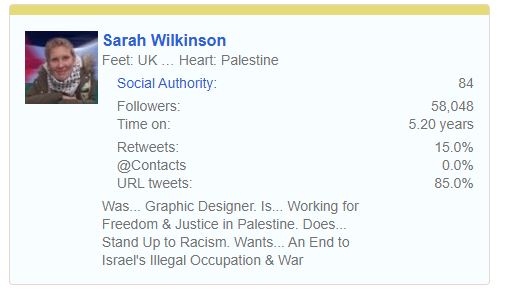
She is a self-proclaimed British activist for “Palestinian rights” but is more accurately a far Left neo-Nazi. Her son shares the same characteristics of violence, racism & Holocaust denial.
I first documented Sarah Wilkinson’s Holocaust denial back in July 2016. I believe I was the 1st person to do so.
Since then she has produced a long trail of written hate and abuse. See here for a good summary.
Wilkinson has recently been publicly celebrated by @XRebellionUK over her latest violent action against a Jewish owned business. Despite many people calling XR’s attention to her history, XR have chosen to remain in alliance with this neo-Nazi.
Former Labour Shadow Chancellor John McDonnell MP is among those who also chose to stand with Wilkinson via a tweet.
But McDonnell is not alone.
Neo-Nazi Sarah Wilkinson is supported and encouraged by thousands of those on the Left who consider themselves “anti-racists”.
Sarah Wilkinson has a history of Holocaust denial & anti-Jewish hatred dating back (in documented examples) to around 2015.
She is a self-proclaimed British activist for “Palestinian rights” but is more accurately a far Left neo-Nazi. Her son shares the same characteristics of violence, racism & Holocaust denial.
I first documented Sarah Wilkinson’s Holocaust denial back in July 2016. I believe I was the 1st person to do so.
Since then she has produced a long trail of written hate and abuse. See here for a good summary.
The internet is forever. https://t.co/zxBV7rjskB
— Heidi Bachram (@HeidiBachram) February 2, 2021
Wilkinson has recently been publicly celebrated by @XRebellionUK over her latest violent action against a Jewish owned business. Despite many people calling XR’s attention to her history, XR have chosen to remain in alliance with this neo-Nazi.
Former Labour Shadow Chancellor John McDonnell MP is among those who also chose to stand with Wilkinson via a tweet.
But McDonnell is not alone.
Neo-Nazi Sarah Wilkinson is supported and encouraged by thousands of those on the Left who consider themselves “anti-racists”.


Okay, let's do this summary again since there seems to be a collective amnesia relating to Christian Abolitionism in America.
Here again is a summary of the Christian Abolitionists’ arguments against enslavers’ appeals to the Scripture: Thread
Here again is a summary of the Christian Abolitionists’ arguments against enslavers’ appeals to the Scripture: Thread
Slavery is not a sin. It is never outlawed by the Bible. Manstealing is but not slavery.
— micah (@laborersarefew) February 20, 2021
Murdering babies and sodomy are sins according the the Bible. YOU don't get to make up things as you go Dolly, neither do I or Malachi.