For those wondering what the causes are of Texas blackouts, @JesseJenkins is doing a really good real time analysis of generator capacity and operation. (Short story: we have a natural gas problem in TX). A few additional thoughts to add:
Confidential info from a market participant in ERCOT: As of ~10 AM Eastern time, the system has ~30 GW of capacity offline, ~26 GW of thermal -- mostly natural gas which cant get fuel deliveries which are being priorities for heating loads -- and ~4 GW of wind due to icing. https://t.co/Bfpn0WeRIq
— JesseJenkins (@JesseJenkins) February 15, 2021
More from Society


global health policy in 2020 has centered around NPI's (non-pharmaceutical interventions) like distancing, masks, school closures
these have been sold as a way to stop infection as though this were science.
this was never true and that fact was known and knowable.
let's look.
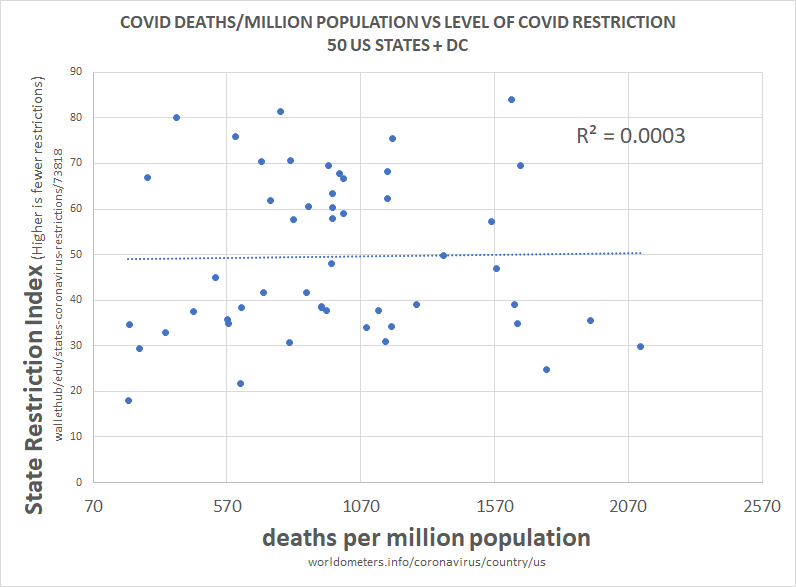
above is the plot of social restriction and NPI vs total death per million. there is 0 R2. this means that the variables play no role in explaining one another.
we can see this same relationship between NPI and all cause deaths.
this is devastating to the case for NPI.
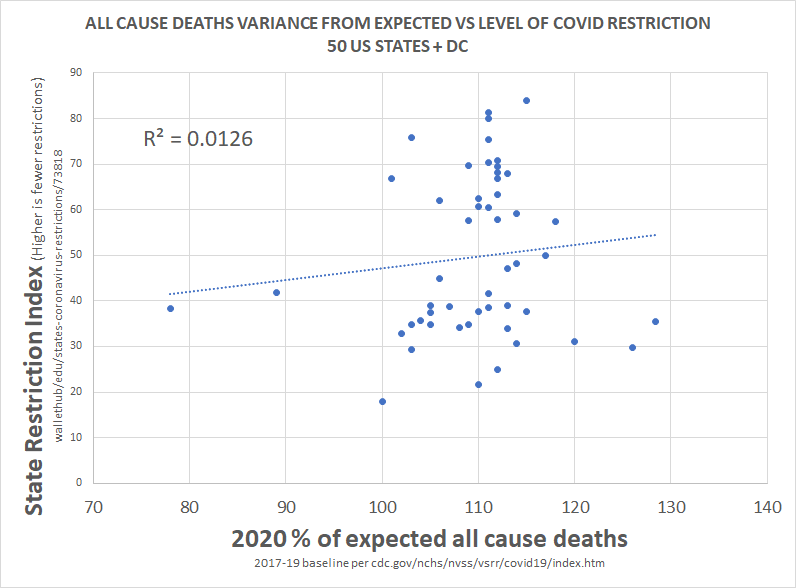
clearly, correlation is not proof of causality, but a total lack of correlation IS proof that there was no material causality.
barring massive and implausible coincidence, it's essentially impossible to cause something and not correlate to it, especially 51 times.
this would seem to pose some very serious questions for those claiming that lockdowns work, those basing policy upon them, and those claiming this is the side of science.
there is no science here nor any data. this is the febrile imaginings of discredited modelers.
this has been clear and obvious from all over the world since the beginning and had been proven so clearly by may that it's hard to imagine anyone who is actually conversant with the data still believing in these responses.
everyone got the same R
these have been sold as a way to stop infection as though this were science.
this was never true and that fact was known and knowable.
let's look.
above is the plot of social restriction and NPI vs total death per million. there is 0 R2. this means that the variables play no role in explaining one another.
we can see this same relationship between NPI and all cause deaths.
this is devastating to the case for NPI.
clearly, correlation is not proof of causality, but a total lack of correlation IS proof that there was no material causality.
barring massive and implausible coincidence, it's essentially impossible to cause something and not correlate to it, especially 51 times.
this would seem to pose some very serious questions for those claiming that lockdowns work, those basing policy upon them, and those claiming this is the side of science.
there is no science here nor any data. this is the febrile imaginings of discredited modelers.
this has been clear and obvious from all over the world since the beginning and had been proven so clearly by may that it's hard to imagine anyone who is actually conversant with the data still believing in these responses.
everyone got the same R
this methodology is a little complex, so let me explain what i did.
— el gato malo (@boriquagato) May 30, 2020
a few EU countries provide real day of death data. this lets us plot meaningful curves to show rate of disease change.
what struck me is how similar all the curves were.
everyone got the same shape. pic.twitter.com/bN0hILzoSl


Like most movements, I have learned that the definition of feminism has expanded to include simply treating women like human beings.
(A thread for whoever feels like reading)
I have observed feminists on Twitter advocating for rape victims to be heard, rapists to be held accountable, for people to address the misogyny that is deeply rooted in our culture, and for women to be treated with respect.
To me, very easy things to get behind.
And the amount of pushback they receive for those very basic requests is appalling. I see men trip over themselves to defend rape and rapists and misogyny every chance they get. Some accounts are completely dedicated to harassing women on this site. It’s unhealthy.
Furthermore, I have observed how dedicated these misogynists are by how they treat other men that do not immediately side with them. There is an entire lexicon they have created for men who do not openly treat women with disrespect.
Ex: simp, cuck, white knight, beta
All examples of terms they use to demean a man who respects women.
To paraphrase what a wise man on this app said:
Some men hate women so much, they hate men who don’t hate women
(A thread for whoever feels like reading)
Neighborhood gents, what\u2019s something you\u2019ve learned about feminism (or gained a better understanding of) that you think other men should know?
— feminist next door (@emrazz) February 19, 2021
Note - the quoted is a friendly/good faith replier. https://t.co/048kuxxX6q
I have observed feminists on Twitter advocating for rape victims to be heard, rapists to be held accountable, for people to address the misogyny that is deeply rooted in our culture, and for women to be treated with respect.
To me, very easy things to get behind.
And the amount of pushback they receive for those very basic requests is appalling. I see men trip over themselves to defend rape and rapists and misogyny every chance they get. Some accounts are completely dedicated to harassing women on this site. It’s unhealthy.
Furthermore, I have observed how dedicated these misogynists are by how they treat other men that do not immediately side with them. There is an entire lexicon they have created for men who do not openly treat women with disrespect.
Ex: simp, cuck, white knight, beta
All examples of terms they use to demean a man who respects women.
To paraphrase what a wise man on this app said:
Some men hate women so much, they hate men who don’t hate women