Sequoia Capital has created over $3.3 trillion dollars in value.

Steal their pitch deck framework for free:

The single best trait of an entrepreneur is someone who can tell a story.

Investors have a short attention span.

They will give you the most attention at the start of your pitch.

In the first 5 minutes be crystal clear about what you actually do.

Let's dive in:

1. Company Purpose

What is your mission?

Condense into a simple powerful sentence.

Don't list features– communicate your purpose.

Include a simple graphic that describes your business model.

Nobody cares what you can do. Everybody cares what you can do for them.
2. Problem

What challenges do you address and solve?

• Describe the pain of your customer (bigger the better)
• Explain how this is currently addressed
• Show why the current market offerings are inadequate

Don't build a solution that's looking for a problem.
3. Solution

What key points will communicate the most value?

• What was your 'aha' moment?
• Why is your value proposition unique and compelling?
• Are you building a competitive moat such as network effects?
• How big can this market grow?
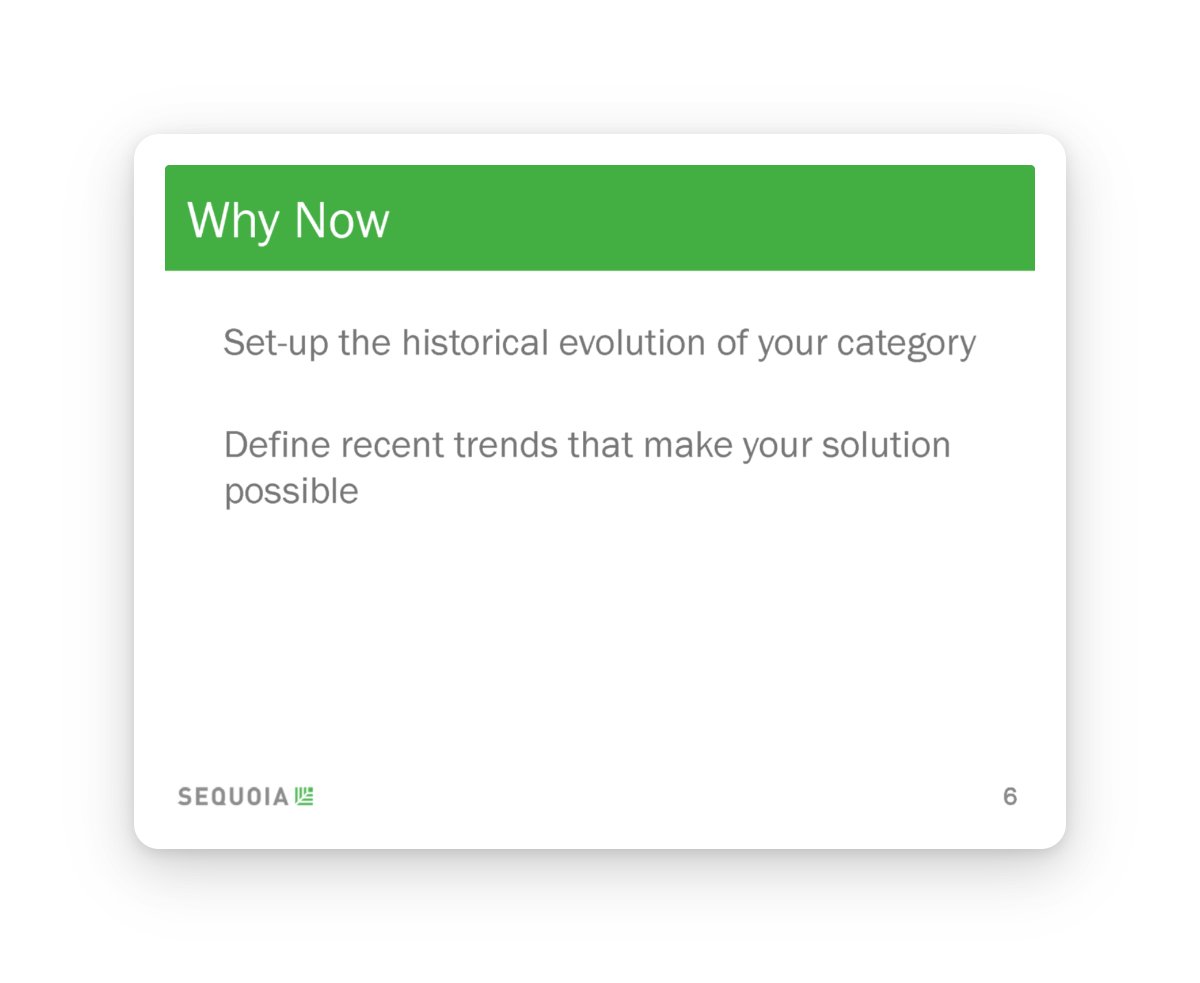
4. Why Now

Timing is everything.

The best companies have a clear why now.

• Why hasn't your solution been built before?
• What industry trends make this the perfect time to act?

A famous example is Netflix: high-speed internet made streaming services possible.
5. Market Size

Can this be a really big opportunity?

• Total addressable market (TAM) = total market demand
• Serviceable available market (SAM) = portion of TAM served by the company
• Serviceable obtainable market (SOM) = percentage of SAM which is realistically achieved
6. Competition

Thiel said:

"All failed companies are the same: they failed to escape competition."

Who are your direct and indirect competitors?

Know your market– map these out on an x/y axis.

What's your plan to win & differentiate?
7. Product

I recommend pre-recoding a demo with Loom.

You get to record your screen and camera whilst giving a clear explanation.

A picture is worth 1000 words, a movie is worth a million pictures.

Bring the solution alive.
8. Business Model

How do you make money?

Typically it falls into a few buckets:

• Advertising
• Subscription
• Transactions

Include metrics around critical areas including:

• Customer acquisition cost (CAC)
• Life time value (LTV)
9. Team

Your people are the most important factor that determine whether your startup succeeds or fails.

People recruit talent, garner attention and win deals.

Highlight special talents and experiences that make the individual suited to the business.
10. Financials

Don't get lost in the numbers– keep it simple.

I recommend highlighting key metrics and growth charts.

Show sources and uses (what you are raising and how you will spend it).

What are the key milestones?

Using a timeline will help demonstrate your runway.
TL;DR:

1. Company Purpose
2. Problem
3. Solution
4. Why Now
5. Market Size
6. Competition
7. Product
8. Business Model
9. Team
10. Financials
Follow me @thealexbanks for more threads on startups and investing.

If you liked this thread, you'll love the newsletter.

Subscribe here:
https://t.co/vlGCY549bQ
To go deeper on pitch deck metrics you should include, here's another thread I think you'll enjoy:
https://t.co/nIK8C3AFgL
Want advice on your pitch deck?

I've helped raise millions across early and late stage.

DM me!
Help the community grow and quote-tweet this thread: https://t.co/fkcmfP48x6

More from Alex Banks

Accounting is the language of business.

10 threads that will teach you more about accounting than any accounting degree:

1/ Who: @10kdiver

What: Understand the balance


2/ Who: @SoulFairy3

What: Income statement


3/ Who: @BrianFeroldi

What: Income statement


4/ Who: @AliTheCFO

What: Profit vs cash
I have a masters degree in finance.

But I've learned 10x more from Twitter.

10 threads that will make you a better investor:

1/ Who: @naval

What: Principles to wealth creation

Tweet:


2/ Who: @10kdiver

What: Achieving financial freedom

Tweet:


3/ Who: @trengriffin

What: Money flows as a function of the


4/ Who: @girdley

What: How to get paid when investing in a new
Over 3.5 billion tweets are posted each week.

But most people are reading the wrong ones.

Here are the 10 best tweets from the week guaranteed to make you smarter:

1/ Who: @KurtisHanni

Topic: Build an elite


2/ Who: @heykahn

Topic: Become an effective decision


3/ Who: @amandanat

Topic: Hot takes on life, careers and


4/ Who: @EvergreenMEP

Topic: Upgrade your

You May Also Like

I just finished Eric Adler's The Battle of the Classics, and wanted to say something about Joel Christiansen's review linked below. I am not sure what motivates the review (I speculate a bit below), but it gives a very misleading impression of the book. 1/x


The meat of the criticism is that the history Adler gives is insufficiently critical. Adler describes a few figures who had a great influence on how the modern US university was formed. It's certainly critical: it focuses on the social Darwinism of these figures. 2/x

Other insinuations and suggestions in the review seem wildly off the mark, distorted, or inappropriate-- for example, that the book is clickbaity (it is scholarly) or conservative (hardly) or connected to the events at the Capitol (give me a break). 3/x

The core question: in what sense is classics inherently racist? Classics is old. On Adler's account, it begins in ancient Rome and is revived in the Renaissance. Slavery (Christiansen's primary concern) is also very old. Let's say classics is an education for slaveowners. 4/x

It's worth remembering that literacy itself is elite throughout most of this history. Literacy is, then, also the education of slaveowners. We can honor oral and musical traditions without denying that literacy is, generally, good. 5/x
THE MEANING, SIGNIFICANCE AND HISTORY OF SWASTIK

The Swastik is a geometrical figure and an ancient religious icon. Swastik has been Sanatan Dharma’s symbol of auspiciousness – mangalya since time immemorial.


The name swastika comes from Sanskrit (Devanagari: स्वस्तिक, pronounced: swastik) &denotes “conducive to wellbeing or auspicious”.
The word Swastik has a definite etymological origin in Sanskrit. It is derived from the roots su – meaning “well or auspicious” & as meaning “being”.


"सु अस्ति येन तत स्वस्तिकं"
Swastik is de symbol through which everything auspicios occurs

Scholars believe word’s origin in Vedas,known as Swasti mantra;

"🕉स्वस्ति ना इन्द्रो वृधश्रवाहा
स्वस्ति ना पूषा विश्ववेदाहा
स्वस्तिनास्तरक्ष्यो अरिश्तनेमिही
स्वस्तिनो बृहस्पतिर्दधातु"


It translates to," O famed Indra, redeem us. O Pusha, the beholder of all knowledge, redeem us. Redeem us O Garudji, of limitless speed and O Bruhaspati, redeem us".

SWASTIK’s COSMIC ORIGIN

The Swastika represents the living creation in the whole Cosmos.


Hindu astronomers divide the ecliptic circle of cosmos in 27 divisions called
https://t.co/sLeuV1R2eQ this manner a cross forms in 4 directions in the celestial sky. At centre of this cross is Dhruva(Polestar). In a line from Dhruva, the stars known as Saptarishi can be observed.