Hello Friends 🤗
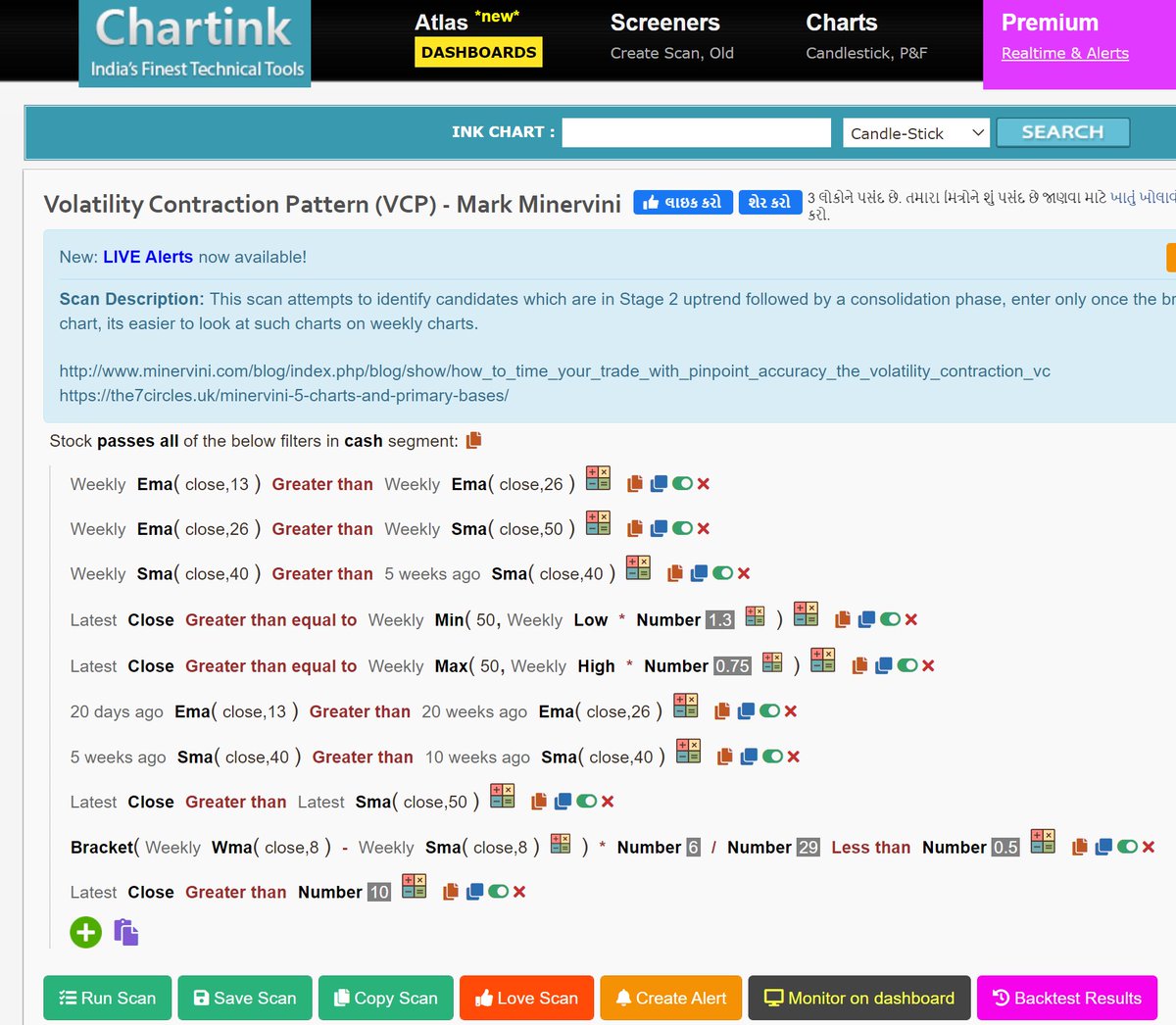
Here is my filter to identify short term breakout in #stocks
Save it & Make a part of your trading tool
More from Stock Market Scientist™

Here are the links of some important threads of TA 📊 for new learners to study 😇😇
1️⃣Moving Avg
https://t.co/xbORdUm2MH
2️⃣Fibonacci
https://t.co/QS2FveTuF7
3️⃣Ichimoku
https://t.co/pITLA6IL9m
4️⃣Darvas Box Theory
https://t.co/PJ70uverV4
Happy Learning😇
Moving Averages Simplified\U0001f4d2
— Stock Market Scientist\u2122 (@MarketScientist) April 30, 2020
\U0001f535Its a technical indicator used by traders to identify trading opportunities
\U0001f535Its a Lagging indicator
\U0001f5352 MAs which traders use more often are..
SMA(Simple moving average) & EMA(Exponential moving average)
1/n#StockMarket #Technicals pic.twitter.com/ClDPEgVWZP
Here is the single point to access
all the threads of Price Patterns📈
1️⃣H&S Pattern
https://t.co/fmWhajgRFk
2️⃣C&H Pattern
https://t.co/6ZW977dCbr
3️⃣Flag Patterns
https://t.co/YUVRiLrVgI
4️⃣Wedge Patterns
https://t.co/6Lhka9dgyw
Happy Learning..!! 😇
H & S Pattern Simplified\U0001f4d2
— Stock Market Scientist\u2122 (@MarketScientist) May 25, 2020
Head & Shoulder Pattern\U0001f4ca
\U0001f535It is\xa0formed by a peak (shoulder), followed by a higher peak (head), & then another lower peak (shoulder)
\U0001f535A line called neckline\xa0is\xa0drawn by connecting the lowest points of the two troughs
1/n#StockMarket #Technicals pic.twitter.com/ElCKkli5h3
Here are the links to access all the threads of Price Patterns📈
1️⃣H&S Pattern
https://t.co/fmWhajgRFk
2️⃣C&H Pattern
https://t.co/6ZW977dCbr
3️⃣Flag Patterns
https://t.co/YUVRiLrVgI
4️⃣Wedge Patterns
https://t.co/6Lhka9dgyw
Happy Learning..!! 😇
H & S Pattern Simplified\U0001f4d2
— Stock Market Scientist\u2122 (@MarketScientist) May 25, 2020
Head & Shoulder Pattern\U0001f4ca
\U0001f535It is\xa0formed by a peak (shoulder), followed by a higher peak (head), & then another lower peak (shoulder)
\U0001f535A line called neckline\xa0is\xa0drawn by connecting the lowest points of the two troughs
1/n#StockMarket #Technicals pic.twitter.com/ElCKkli5h3
More from Screeners


Do Share the above tweet 👆
These are going to be very simple yet effective pure price action based scanners, no fancy indicators nothing - hope you liked it.
https://t.co/JU0MJIbpRV
52 Week High
One of the classic scanners very you will get strong stocks to Bet on.
https://t.co/V69th0jwBr
Hourly Breakout
This scanner will give you short term bet breakouts like hourly or 2Hr breakout
Volume shocker
Volume spurt in a stock with massive X times

A small tribute/gift to members
Screeners
technical screeners - intraday and positional both
before proceeding - i have helped you , can i ask you so that it can help someone else too
thank you
positional one
run - find #stock - draw chart - find levels
1- Stocks closing daily 2% up from 5 days
https://t.co/gTZrYY3Nht
2- Weekly breakout
https://t.co/1f4ahEolYB
3- Breakouts in short term
https://t.co/BI4h0CdgO2
4- Bullish from last 5
intraday screeners
5- 15 minute Stock Breakouts
https://t.co/9eAo82iuNv
6- Intraday Buying seen in the past 15 minutes
https://t.co/XqAJKhLB5G
7- Stocks trading near day's high on 5 min chart with volume BO intraday
https://t.co/flHmm6QXmo
Thank you