Azar just released a delusional, alternative history of Covid testing in the US. I’m mad because our testing failures allowed this outbreak to blow-up. We can’t fix our system if we ignore where it is broken. I suspect @PublicHealth agrees.

My fact-check on remarks @HHSGov 🧵

“It is indisputable that the United States has built the most extensive testing system and strategy of any major country,” says Azar.

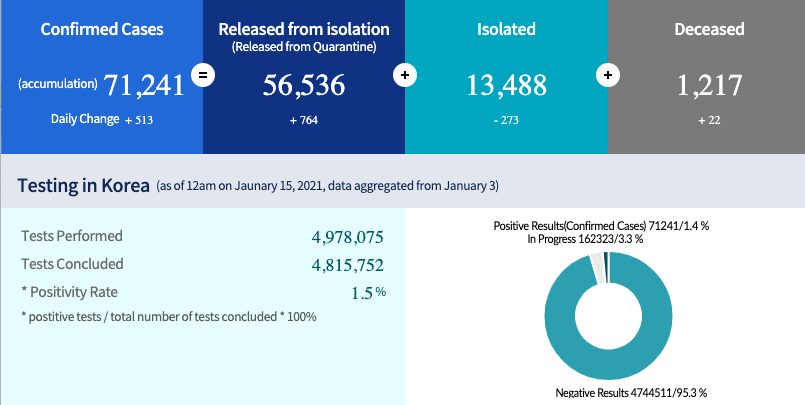
False. Several countries have had percent positivity ~1% whereas US has never been below 5% and is >10% today. Refs KCDC & USA @JohnsHopkins
"The federal government got out of the way of test development in safe and sensible ways,” says Azar.

False. In Feb, CDC & FDA blocked labs from testing as the disease spread exponentially. I broke this story👇🏼& wrote more like it as the year wore on. https://t.co/5zbGfZaSry
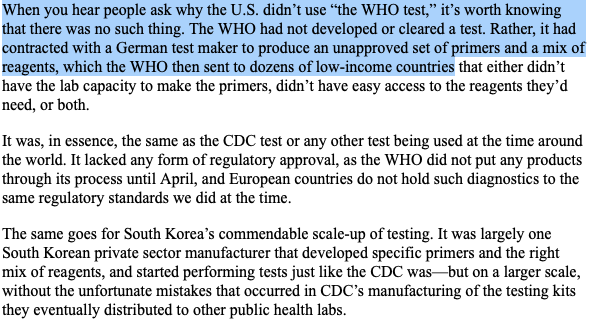
Azar defends questions about why the CDC refused an early German test vetted & distributed by WHO, by saying it was ‘unapproved’ & beneath us.

False. Top US researchers in my stories vetted several tests as early as Feb,& found that the one recommended by WHO was ideal.
Azar refuses to concede that other countries handled Covid better. He attributes Koreas success to less travel, invasiveness & private sector.

False. Korea's gov't marshaled the private sector & tracing success was largely from hiring tons of tracers. https://t.co/Ad1D1kpd6Q
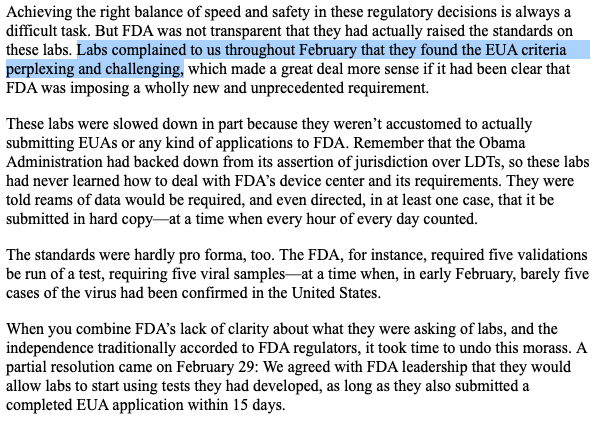
Here's a nugget of truth. The FDA held back academic labs from testing, and have been unclear. Researchers testing like @srikosuri @UrnovFyodor may be interested in this part of the discussion.
Azar asserts "There is a myth out there that, if only we’d had a superior testing system, we simply could have caught any cases and isolated them."

False (except for it being simple). Any outbreak specialist tells you that early days matter most. That's THE time for containment.
I need to get back to work but the speech goes on. I'll try to return to this later. In the meantime, here's my piece with @jefftollef about testing failures and why they matter so much. https://t.co/7pL6SzLvNc

More from Science

An interesting thing about carp is that they can go into anoxic hibernation and switch to an anaerobic metabolism based on converting glycogen to ethanol.

The waste ethanol is diffused out the gills

https://t.co/V3D1umHf04

Carp can switch over to an anaerobic metabolism and quietly exhale booze until the situation gets better.

They basically evolved the same metabolic pathway as yeast, independently.

In theory, if you spent a few thousand years breeding carp for it, you could use them to make booze.

They'd be enormous, almost entirely glycogen deposits with a fish added as an afterthought.

The really interesting thing about anaerobic carp, is that they can go 4-5 months without oxygen by relying on liver glycogen.

You, a human, have only about 100 grams of glycogen in your liver, about 400 more grams in your skeletal muscles. Call it 500 grams total.

In humans, glycogen is also burned for energy. This is where the marathon runner's bonk comes from: you only have about 2,000 calories worth, and running a marathon burns those 2,000 calories.
Ever since @JesseJenkins and colleagues work on a zero carbon US and this work by @DrChrisClack and colleagues on incorporating DER, I've been having the following set of thoughts about how to reduce the risk of failure in a US clean energy buildout. Bottom line is much more DER.


Typically, when we see zero-carbon electricity coupled to electrification of transport and buildings, implicitly standing behind that is totally unprecedented buildout of the transmission system. The team from Princeton's modeling work has this in spades for example.

But that, more even than the new generation required, runs straight into a thicket/woodchipper of environmental laws and public objections that currently (and for the last 50y) limit new transmission in the US. We built most transmission prior to the advent of environmental law.

So what these studies are really (implicitly) saying is that NEPA, CEQA, ESA, §404 permitting, eminent domain law, etc, - and the public and democratic objections that drive them - will have to change in order to accommodate the necessary transmission buildout.

I live in a D supermajority state that has, for at least the last 20 years, been in the midst of a housing crisis that creates punishing impacts for people's lives in the here-and-now and is arguably mostly caused by the same issues that create the transmission bottlenecks.

You May Also Like