
Read this thread from @lilithsaintcrow. I really mean it. Just read it. Because if what she is saying is true (and I happen to think it is) it explains *so much*
An example using the Flat Earthers: A thread of many parts:
Let me explain something to those of you who didn't grow up around violently abusive white supremacists.
— Lili Saintcrow (@lilithsaintcrow) January 7, 2021
*They absolutely do not believe their own bullshit*, but it's useful for them to pretend they do.
So how does this translate into the really *really* important thread I quoted at the beginning?
The core idea is that you can just say "I believe the Earth is flat" and *nobody* can prove you don't. Evidence is irrelevant, because we are *playing a game*.
1) People will rationalise their existing ideas. E.g. I don't like fat people, because... they're lazy, or they smell, or they are genetically inferior, or it's Tuesday or whatever insane reason you like.
4) It is impossible to *prove* whether someone genuinely believes it or not. To be fair, I expect that some of them don't even know.
6) People make shocking decisions on the basis of shit data.
Well I expect that some people are a lost cause. They have got so completely lost in a maze of justifications and lies that they are impossible to reach.
I'd argue that this kind of thing is largely the product of *ignorance*. Now I don't mean that we aren't arguing effectively - there are many cleverer and more eloquent people than me working on this. I think it's to do with *experience*.
1) stop peddling bullshit, and
More from Science

Localized Surface Plasmon Resonance - an overview | ScienceDirect Topics
https://t.co/mzS7vVSREJ
https://t.co/353PdAX2fa
https://t.co/3yBImjOdd4
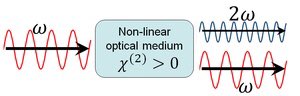
In some cases, almost 100% of the light energy can be converted to the second harmonic frequency. These cases typically involve intense pulsed laser beams passing through large crystals, and careful alignment to obtain phase matching.
https://t.co/mzS7vVSREJ
https://t.co/353PdAX2fa
https://t.co/3yBImjOdd4
In some cases, almost 100% of the light energy can be converted to the second harmonic frequency. These cases typically involve intense pulsed laser beams passing through large crystals, and careful alignment to obtain phase matching.





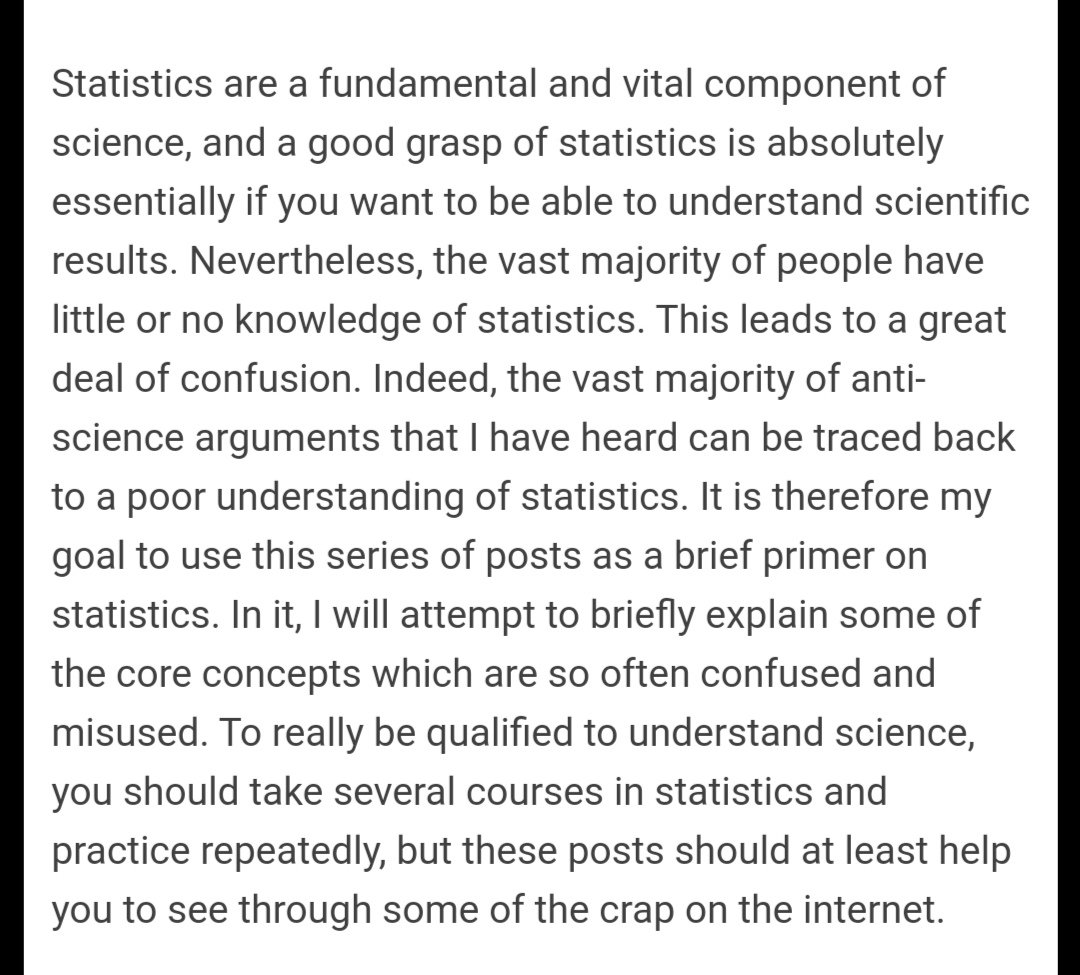
This is a thread on statistics in science: 1/7 (via @LogicofScience)
Basic Statistics Part 1: The Law of Large Numbers https://t.co/wUH8eAAIak
#Science #Statistics
Basic Statistics Part 2: Correlation vs. Causation
https://t.co/Azhyl8pDsX (2/7)
Basic Statistics Part 3: The Dangers of Large Data Sets: A Tale of P values, Error Rates, and Bonferroni Corrections
https://t.co/LetN6aEBRM (3/7)
Basic statistics part 4: understanding P values
https://t.co/K8MMMgTCOf (4/7)
Basic Statistics Part 5: Means vs Medians, Is the “Average”
Basic Statistics Part 1: The Law of Large Numbers https://t.co/wUH8eAAIak
#Science #Statistics
Basic Statistics Part 2: Correlation vs. Causation
https://t.co/Azhyl8pDsX (2/7)
Basic Statistics Part 3: The Dangers of Large Data Sets: A Tale of P values, Error Rates, and Bonferroni Corrections
https://t.co/LetN6aEBRM (3/7)
Basic statistics part 4: understanding P values
https://t.co/K8MMMgTCOf (4/7)
Basic Statistics Part 5: Means vs Medians, Is the “Average”
You May Also Like







"I really want to break into Product Management"
make products.
"If only someone would tell me how I can get a startup to notice me."
Make Products.
"I guess it's impossible and I'll never break into the industry."
MAKE PRODUCTS.
Courtesy of @edbrisson's wonderful thread on breaking into comics – https://t.co/TgNblNSCBj – here is why the same applies to Product Management, too.
There is no better way of learning the craft of product, or proving your potential to employers, than just doing it.
You do not need anybody's permission. We don't have diplomas, nor doctorates. We can barely agree on a single standard of what a Product Manager is supposed to do.
But – there is at least one blindingly obvious industry consensus – a Product Manager makes Products.
And they don't need to be kept at the exact right temperature, given endless resource, or carefully protected in order to do this.
They find their own way.
make products.
"If only someone would tell me how I can get a startup to notice me."
Make Products.
"I guess it's impossible and I'll never break into the industry."
MAKE PRODUCTS.
Courtesy of @edbrisson's wonderful thread on breaking into comics – https://t.co/TgNblNSCBj – here is why the same applies to Product Management, too.
"I really want to break into comics"
— Ed Brisson (@edbrisson) December 4, 2018
make comics.
"If only someone would tell me how I can get an editor to notice me."
Make Comics.
"I guess it's impossible and I'll never break into the industry."
MAKE COMICS.
There is no better way of learning the craft of product, or proving your potential to employers, than just doing it.
You do not need anybody's permission. We don't have diplomas, nor doctorates. We can barely agree on a single standard of what a Product Manager is supposed to do.
But – there is at least one blindingly obvious industry consensus – a Product Manager makes Products.
And they don't need to be kept at the exact right temperature, given endless resource, or carefully protected in order to do this.
They find their own way.

