In Brahm Puran, Brahma preached this to Marichi. So this Puran of ten thousand shlokas is called Brahm Puran.
STORY OF PURANAS AND SUB PURANA (उप पुराण).
We have already gone through the series on importance & characteristics of all the eighteen Purans. We also know that originally there were hundred crore shlokas but were divided by Vyas in each Kalp and was compiled as eighteen Purans
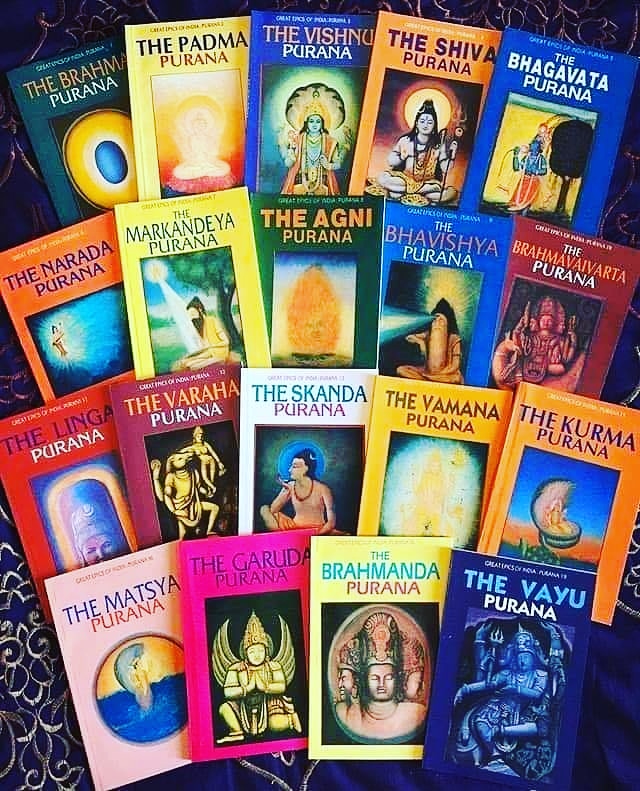
In Brahm Puran, Brahma preached this to Marichi. So this Puran of ten thousand shlokas is called Brahm Puran.
Vishnu Puran is primarily based in Varah kalp. This book is on Vishnu and this book has twenty three thousand shlokas.
In Bhagwat Puran, which is written with the base of Gayatri mantra describes Dharma extensively. It has 18000 shlokas. It also mentions the story of Vritrasur.
Markandeya Puran has nine thousand shlokas and here it is through the birds that Dharma is described.
In Bhavishya Puran, based in Aghor Kalp, Brahma preaches to Manu about the importance of Surya and foresees the future or bhavishya happenings. It has 14500 shlokas.
In Vamaan Puran Brahma describes the importance of Trivikrampur through Dharma, Arth and Kaam. It has ten thousand shlokas.
In Matsya Puran, in the very beginning, Bhagwan in the form of Matsya/fish encourages the Rishis,
Garud Puran describes the origin of Universe as told by Vishnu to Garud. Based in Garud Kalp, this book has 18000 shlokas.
In Brahmand Puran Brahma describes the future Kalps. It has twelve thousand shlokas.
The Sub Purans are as follows
Sanat Kumar
Narsingh
Skand
Nandishwar
Durvaasa
Narad
Kapil
Manu
Ushna
Brahmand
Varun
Kalika
Maheshwar
Saamb
Saur
Parashar
Marichi
Bhargav
So this way we get to know the importance of some in these sub purans.
Instagram link 👇
https://t.co/pidcghlLSe
Facebook link👇
https://t.co/EVyZz1frHQ
https://t.co/A6sXofFJZC
#THREAD
— Anshul Pandey (@Anshulspiritual) January 10, 2021
PURANAS.
SO I HAVE INCLUDED ALL THE PURANAS IMPORTANCE AND CHARACTERISTICS
From BRAMHA PURAN to BRAHMANDA PURAN
This thread is for those ppl who missed my PURAN series. All the Puranas are included in the below thread.
So lets start..... pic.twitter.com/4R9myViMn7
https://t.co/emKZTtHNw9
More from Anshul Pandey
WHY DID KING DAKSH BEHAVE NEGATIVELY TOWARDS SHIVA AND SATI.
It was actually the shakti form of devi which took birth as Sati in Daksh's house who acquired this name due to her satya swarup.
Everyone is aware of the story as to why Sati jumped into the Yagya fire.
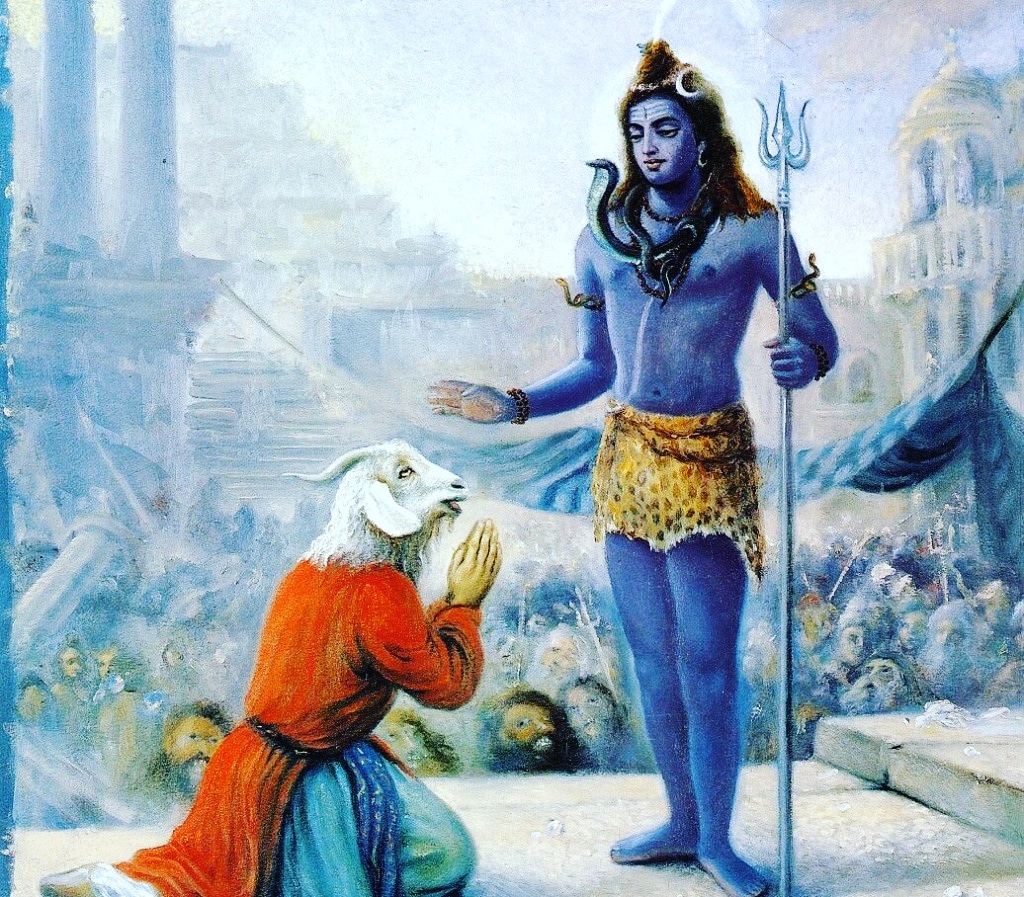
But there is a story behind the reason for the negative behaviour of Daksh.
It so happened that once Rishi Durvasa went to Devi Jambunadeshwari and after her darshan recited the Mayabeej mantra. The devi happily gave him a divine Garland. Durvasa happily accepted it and left.
On his way he met Daksh who was eager to get the divine Garland. He requested the Rishi to give him that Garland. Knowing that Daksh was a good person, Durvasa gave the garland to him.
But Daksh casually kept the garland on his bed and went about doing his earthly instinctive work. Due to this insulting behaviour of Daksh for the divine garland, he developed a negative feeling for Shiva and Sati(Aadi Shakti).
Source - Devi puran
Instagram link👇
https://t.co/papGLZvcaI
Facebook
It was actually the shakti form of devi which took birth as Sati in Daksh's house who acquired this name due to her satya swarup.
Everyone is aware of the story as to why Sati jumped into the Yagya fire.
But there is a story behind the reason for the negative behaviour of Daksh.
It so happened that once Rishi Durvasa went to Devi Jambunadeshwari and after her darshan recited the Mayabeej mantra. The devi happily gave him a divine Garland. Durvasa happily accepted it and left.
On his way he met Daksh who was eager to get the divine Garland. He requested the Rishi to give him that Garland. Knowing that Daksh was a good person, Durvasa gave the garland to him.
But Daksh casually kept the garland on his bed and went about doing his earthly instinctive work. Due to this insulting behaviour of Daksh for the divine garland, he developed a negative feeling for Shiva and Sati(Aadi Shakti).
Source - Devi puran
Instagram link👇
https://t.co/papGLZvcaI








More from Religion





You May Also Like






MASTER THREAD on Short Strangles.
Curated the best tweets from the best traders who are exceptional at managing strangles.
• Positional Strangles
• Intraday Strangles
• Position Sizing
• How to do Adjustments
• Plenty of Examples
• When to avoid
• Exit Criteria
How to sell Strangles in weekly expiry as explained by boss himself. @Mitesh_Engr
• When to sell
• How to do Adjustments
• Exit
Beautiful explanation on positional option selling by @Mitesh_Engr
Sir on how to sell low premium strangles yourself without paying anyone. This is a free mini course in
1st Live example of managing a strangle by Mitesh Sir. @Mitesh_Engr
• Sold Strangles 20% cap used
• Added 20% cap more when in profit
• Booked profitable leg and rolled up
• Kept rolling up profitable leg
• Booked loss in calls
• Sold only
2nd example by @Mitesh_Engr Sir on converting a directional trade into strangles. Option Sellers can use this for consistent profit.
• Identified a reversal and sold puts
• Puts decayed a lot
• When achieved 2% profit through puts then sold
Curated the best tweets from the best traders who are exceptional at managing strangles.
• Positional Strangles
• Intraday Strangles
• Position Sizing
• How to do Adjustments
• Plenty of Examples
• When to avoid
• Exit Criteria
How to sell Strangles in weekly expiry as explained by boss himself. @Mitesh_Engr
• When to sell
• How to do Adjustments
• Exit
1. Let's start option selling learning.
— Mitesh Patel (@Mitesh_Engr) February 10, 2019
Strangle selling. ( I am doing mostly in weekly Bank Nifty)
When to sell? When VIX is below 15
Assume spot is at 27500
Sell 27100 PE & 27900 CE
say premium for both 50-50
If bank nifty will move in narrow range u will get profit from both.
Beautiful explanation on positional option selling by @Mitesh_Engr
Sir on how to sell low premium strangles yourself without paying anyone. This is a free mini course in
Few are selling 20-25 Rs positional option selling course.
— Mitesh Patel (@Mitesh_Engr) November 3, 2019
Nothing big deal in that.
For selling weekly option just identify last week low and high.
Now from that low and high keep 1-1.5% distance from strike.
And sell option on both side.
1/n
1st Live example of managing a strangle by Mitesh Sir. @Mitesh_Engr
• Sold Strangles 20% cap used
• Added 20% cap more when in profit
• Booked profitable leg and rolled up
• Kept rolling up profitable leg
• Booked loss in calls
• Sold only
Sold 29200 put and 30500 call
— Mitesh Patel (@Mitesh_Engr) April 12, 2019
Used 20% capital@44 each
2nd example by @Mitesh_Engr Sir on converting a directional trade into strangles. Option Sellers can use this for consistent profit.
• Identified a reversal and sold puts
• Puts decayed a lot
• When achieved 2% profit through puts then sold
Already giving more than 2% return in a week. Now I will prefer to sell 32500 call at 74 to make it strangle in equal ratio.
— Mitesh Patel (@Mitesh_Engr) February 7, 2020
To all. This is free learning for you. How to play option to make consistent return.
Stay tuned and learn it here free of cost. https://t.co/7J7LC86oW0