One exciting thing from over the holidays is that the Int'l Civil Aviation Organization (@ICAO) and aircraft engine manufacturers for the first time publicly released quantitative emissions indices for particle # and mass emitted per unit fuel burn! 🧵 1/

https://t.co/zXuFN66SWe

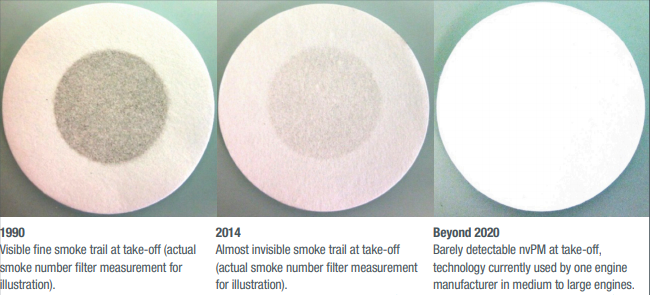
Up until now, certification data for aircraft engine particle emissions have been reported in terms of a "smoke number", which is derived from the change in reflectance of a Whatman 4 filter after collecting 16.2 kg/m² exhaust. 2/

https://t.co/6fa9Kkdupr
One challenge with the smoke number measurement is that the filter doesn't capture all of the particles -- especially small ones. Is the decrease in smoke number over time because we are trading a few large soot particles for many more smaller soot particles? 3/
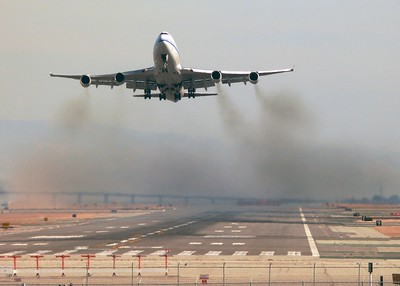
While smoke numbers are not particularly helpful for quantitatively assessing particle emissions impacts on air quality & upper tropospheric composition, they have been a huge success in motivating the reduction of unsightly exhaust plumes! 4/

Photo credit: flickr/dsleeter_2000
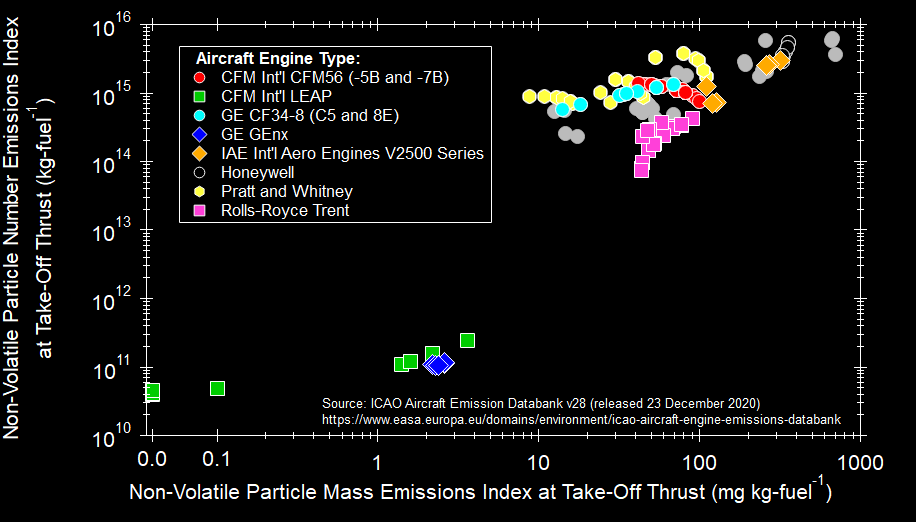
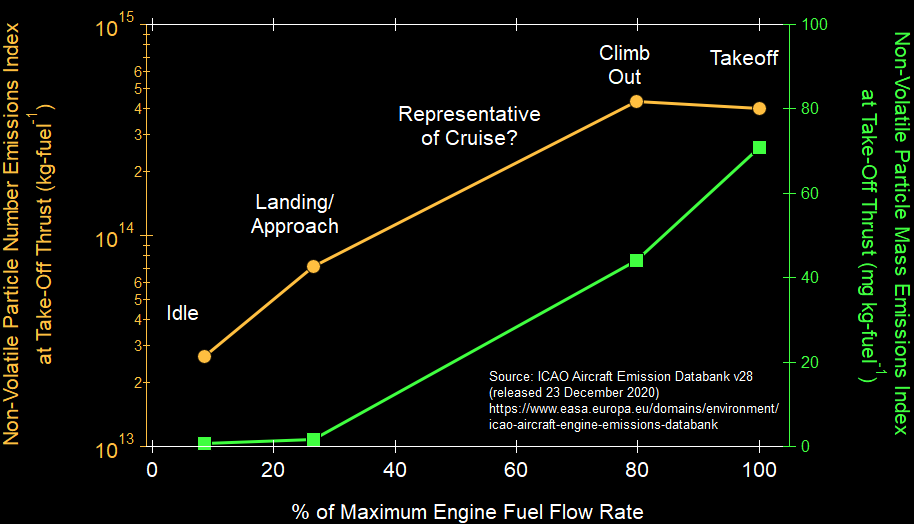
The new EI data are much more useful for #AirQuality and #Climate modeling efforts seeking to understand the environmental impacts of aviation. Since they're collected at ground conditions, the data are most relevant to AQ, but maybe can be extrapolated to cruise conditions? 5/
Of course, we still need to understand how well the certification EIs capture real world, near-surface emissions impacted by fuels, engine maintenance, and human behavior (e.g., reduced thrust takeoffs). 6/

Leipzig/Halle: https://t.co/ITMszAGSej

LAX: https://t.co/fSADIkoXEw
We also know that "spreading contrails and the cirrus clouds that evolve from them -- collectively known as contrail cirrus -- have a greater radiative forcing today than all aviation CO2 emissions since the first powered airplane flight" - B. Kärcher 7/

https://t.co/zLXnWyDCwc
If we can reduce engine soot particle emissions at cruise enough to fall below the soot-rich emissions regime (threshold ~ 10¹³ to 10¹⁴ per kg fuel) then that would translate into a reduction in climate-altering, aviation-induced cloudiness. 8/

https://t.co/Pi22W6Gw4Y
There are a number of promising approaches for meeting these targets in the short term including the use of sustainable, bio-based jet fuels as well as introduction of lean-burning combustion technologies. 9/

https://t.co/FSZWr27Tmg
Models of contrail formation and persistence provide the key to targeting these efforts when the economics might not make sense for widespread adoption of advanced (& expensive) biofuels. We can focus on large "contrail outbreaks" to have big impact! 10/

https://t.co/j3SmQwl0yy
The new ICAO aircraft engine particle emissions data released on Dec. 23rd are fertile ground for understanding how changes in engine technology (particularly advanced, lean-burning combustors) will impact the environment both near the ground and high above! 11/11
@threadreaderapp unroll

More from Science

"NO LONGER BEST IN THE WORLD"
UNEP's new Human Development Index includes a new (separate) index: Planetary pressures-adjusted HDI (PHDI). News in Norway is that its position drops from #1 to #16 because of this, while Ireland rises from #2 to #1.
Why?

https://t.co/aVraIEzRfh


Check out Norway's 'Domestic Material Consumption'. Fossil fuels are no different here to Ireland's. What's different is this huge 'non-metallic minerals' category.
(Note also the jump in 1998, suggesting data problems.)
https://t.co/5QvzONbqmN


In Norway's case, it looks like the apparent consumption equation (production+imports-exports) for non-metal minerals is dominated by production: extraction of material in Norway.
https://t.co/5QvzONbqmN


And here we see that this production of non-metallic minerals is sand, gravel and crushed rock for construction. So it's about Norway's geology.
https://t.co/y6rqWmFVWc


Norway drops 15 places on the PHDI list not because of its CO₂ emissions (fairly high at 41st highest in the world per capita), but because of its geology, because it shifts a lot of rock whenever it builds anything.

You May Also Like

Following @BAUDEGS I have experienced hateful and propagandist tweets time after time. I have been shocked that an academic community would be so reckless with their publications. So I did some research.
The question is:
Is this an official account for Bahcesehir Uni (Bau)?


Bahcesehir Uni, BAU has an official website
https://t.co/ztzX6uj34V which links to their social media, leading to their Twitter account @Bahcesehir

BAU’s official Twitter account


BAU has many departments, which all have separate accounts. Nowhere among them did I find @BAUDEGS
@BAUOrganization @ApplyBAU @adayBAU @BAUAlumniCenter @bahcesehirfbe @baufens @CyprusBau @bauiisbf @bauglobal @bahcesehirebe @BAUintBatumi @BAUiletisim @BAUSaglik @bauebf @TIPBAU

Nowhere among them was @BAUDEGS to find