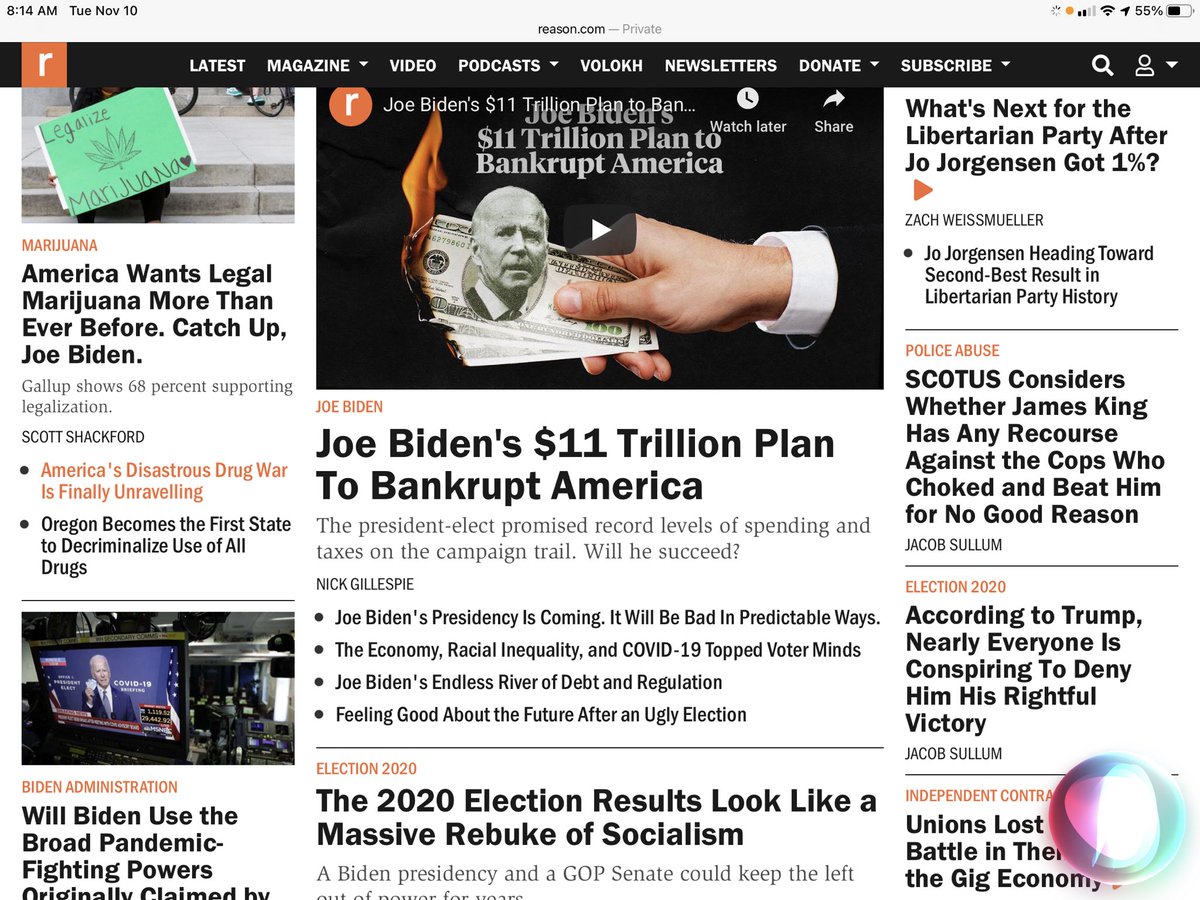
So shortly after the 2016 election, I pointed out how odd it was that the Reason homepage was dominated by stories either mocking and ridiculing the left for being fearful of what was to come, or articles about how Trump might actually be good for libertarians.
1. You know I love you, @reason, but I'm not getting your homepage right now. Lots of mocking the left, lecturing people who are scared...
— Radley Balko (@radleybalko) November 15, 2016
A big part of this is that many libertarians still see the left as a bigger threat than the right. I’m baffled by this given...
Part of it is also probably stems from the fact...
More from Politics



All the challenges to Leader Pelosi are coming from her right, in an apparent effort to make the party even more conservative and bent toward corporate interests.
Hard pass. So long as Leader Pelosi remains the most progressive candidate for Speaker, she can count on my support.
I agree that our party should, and must, evolve our leadership.
But changed leadership should reflect an actual, evolved mission; namely, an increased commitment to the middle + working class electorate that put us here.
Otherwise it’s a just new figure with the same problems.
I hope that we can move swiftly to conclude this discussion about party positions, so that we can spend more time discussing party priorities: voting rights, healthcare, wages, climate change, housing, cannabis legalization, good jobs, etc.
Hard pass. So long as Leader Pelosi remains the most progressive candidate for Speaker, she can count on my support.
The strange thing about the fight to displace Nancy Pelosi as Speaker of the House is that no one seems willing to run against her. https://t.co/VhBqf4KJom
— The New Yorker (@NewYorker) November 21, 2018
I agree that our party should, and must, evolve our leadership.
But changed leadership should reflect an actual, evolved mission; namely, an increased commitment to the middle + working class electorate that put us here.
Otherwise it’s a just new figure with the same problems.
I hope that we can move swiftly to conclude this discussion about party positions, so that we can spend more time discussing party priorities: voting rights, healthcare, wages, climate change, housing, cannabis legalization, good jobs, etc.

I told you they’d bring this up
I was wondering why that tweet had so many stupid replies. And now I see
Seriously, this was “the night before.” If you’re at the march where they’re changing “Jews will not replace us” and “Blood and soil,” you’re not a “very fine person.” Full stop.
There are 3 important moments in that transcript.
1.) When someone asked Trump about a statement *he had already made* about there being blame on “both sides,” he said the “fine people” line.
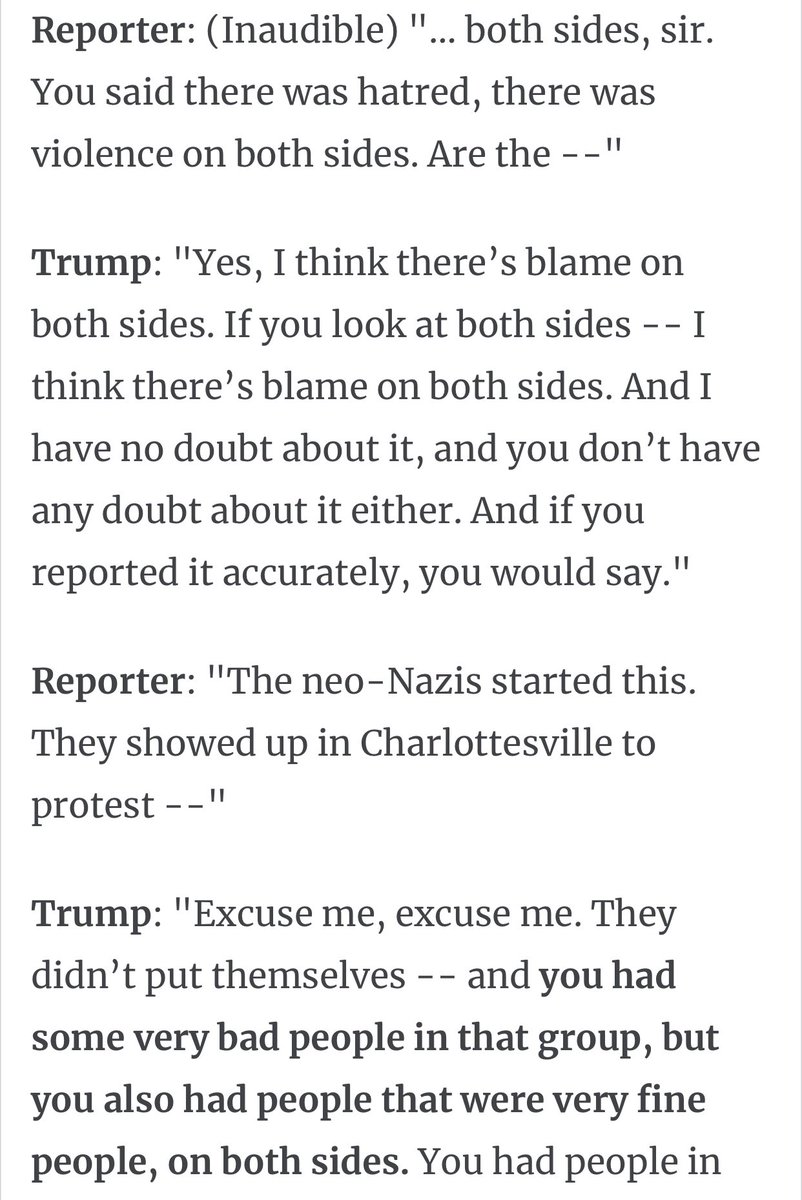
2. Trump does clarify! “I’m not talking about the neo-Nazis and white nationalists — because they should be condemned totally “
Okay!
Then adds that there were “many people in that group other than neo-Nazis and white nationalists.”

Right-wing media have essentially convinced themselves that Trump never said "very fine people." They're lying. https://t.co/5960NPMYLJ
— Parker Molloy (@ParkerMolloy) February 11, 2021
I was wondering why that tweet had so many stupid replies. And now I see
The Fine People Hoaxers are trying hard to keep you from reading the actual FULL transcript because then you would see how the hoax was pulled off with devious editing. https://t.co/PQLj0DWuPj
— Scott Adams (@ScottAdamsSays) February 11, 2021
Seriously, this was “the night before.” If you’re at the march where they’re changing “Jews will not replace us” and “Blood and soil,” you’re not a “very fine person.” Full stop.
Trump defense talking about how the then-president was praising the peaceful protests at Charlottesville that occurred "the night before" the violence on Saturday. That was the night where the torch-bearing crowd chanted "Jews will not replace us." pic.twitter.com/HCKS6Q9LBY
— Anthony Zurcher (@awzurcher) February 12, 2021
There are 3 important moments in that transcript.
1.) When someone asked Trump about a statement *he had already made* about there being blame on “both sides,” he said the “fine people” line.
2. Trump does clarify! “I’m not talking about the neo-Nazis and white nationalists — because they should be condemned totally “
Okay!
Then adds that there were “many people in that group other than neo-Nazis and white nationalists.”

This idea - that elections should translate into policy - is not wrong at all. But political science can help explain why it's not working this way. There are three main explanations: 1. mandates are constructed, not automatic, 2. party asymmetry, 3. partisan conpetition 1/
First, party/policy mandates from elections are far from self-executing in our system. Work on mandates from Dahl to Ellis and Kirk on the history of the mandate to mine on its role in post-Nixon politics, to Peterson Grossback and Stimson all emphasize that this link is... 2/
Created deliberately and isn't always persuasive. Others have to convinced that the election meant a particular thing for it to work in a legislative context. I theorized in the immediate period of after the 2020 election that this was part of why Repubs signed on to ...3/
Trump's demonstrably false fraud nonsense - it derailed an emerging mandate news cycle. Winners of elections get what they get - institutional control - but can't expect much beyond that unless the perception of an election mandate takes hold. And it didn't. 4/
Let's turn to the legislation element of this. There's just an asymmetry in terms of passing a relief bill. Republicans are presumably less motivated to get some kind of deal passed. Democrats are more likely to want to do *something.* 5/
I\u2019m sorry it\u2019s just insane that Democrats are like, \u201cwe won everything and our opening position on relief is $1.9T\u201d and Republicans are like, \u201cwe lost and our opening position is $600B,\u201d and the media will be like, \u201cDemocrats say they want unity but reject this bipartisan deal.\u201d
— Meredith Shiner (@meredithshiner) January 31, 2021
First, party/policy mandates from elections are far from self-executing in our system. Work on mandates from Dahl to Ellis and Kirk on the history of the mandate to mine on its role in post-Nixon politics, to Peterson Grossback and Stimson all emphasize that this link is... 2/
Created deliberately and isn't always persuasive. Others have to convinced that the election meant a particular thing for it to work in a legislative context. I theorized in the immediate period of after the 2020 election that this was part of why Repubs signed on to ...3/
Trump's demonstrably false fraud nonsense - it derailed an emerging mandate news cycle. Winners of elections get what they get - institutional control - but can't expect much beyond that unless the perception of an election mandate takes hold. And it didn't. 4/
Let's turn to the legislation element of this. There's just an asymmetry in terms of passing a relief bill. Republicans are presumably less motivated to get some kind of deal passed. Democrats are more likely to want to do *something.* 5/