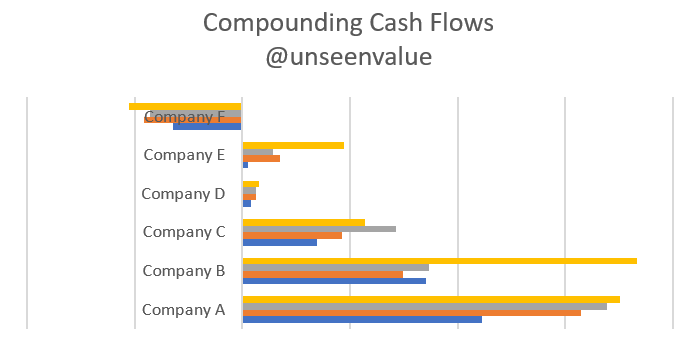
All these are Pharma sector companies. Company F consistently reports -ve cash flows. It's stock price never compounded. All other examples reported multi-years of +ve cash flow generation. These stocks have been multi-baggers over the years.
Focus on Cash Flows vs News Flows.
More from Sajal Kapoor
2. Put your neck on the line (invest your hard earned capital - experience comes by paying tuition fee)
3. Read non-investing books as well (Psychology, history, biographies or whatever non-fiction you like)
4. Read this :
https://t.co/6z3HvtKakL
How to augment your Sector knowledge? Follow these 5 points \U0001f447
— Conviction | Patience (@unseenvalue) May 18, 2019
1. The Five Rules For Successful Stock Investing by Pat Dorsey
2. Con Calls - as many as you can in that sector
3. Annual Reports - as many as you can in that sector
4. Interact with trade/channel partners
5. AGMs pic.twitter.com/2ZOx3nkC4i
Playing real estate and home improvement structural story in \U0001f1ee\U0001f1f3 via a focused proxy consumption \U0001f9fa
— Conviction | Patience (@unseenvalue) January 10, 2020
1. Asian Paints
2. Pidilite
3. SHIL (Hindware portfolio)
4. Fragrance SpecChem (Kelkar & Fairchem)
Consumption | Proxy Consumption
More from Pharma






You May Also Like

Ironies of Luck https://t.co/5BPWGbAxFi
— Morgan Housel (@morganhousel) March 14, 2018
"Luck is the flip side of risk. They are mirrored cousins, driven by the same thing: You are one person in a 7 billion player game, and the accidental impact of other people\u2019s actions can be more consequential than your own."
I’ve always felt that the luckiest people I know had a talent for recognizing circumstances, not of their own making, that were conducive to a favorable outcome and their ability to quickly take advantage of them.
In other words, dumb luck was just that, it required no awareness on the person’s part, whereas “smart” luck involved awareness followed by action before the circumstances changed.
So, was I “lucky” to be born when I was—nothing I had any control over—and that I came of age just as huge databases and computers were advancing to the point where I could use those tools to write “What Works on Wall Street?” Absolutely.
Was I lucky to start my stock market investments near the peak of interest rates which allowed me to spend the majority of my adult life in a falling rate environment? Yup.