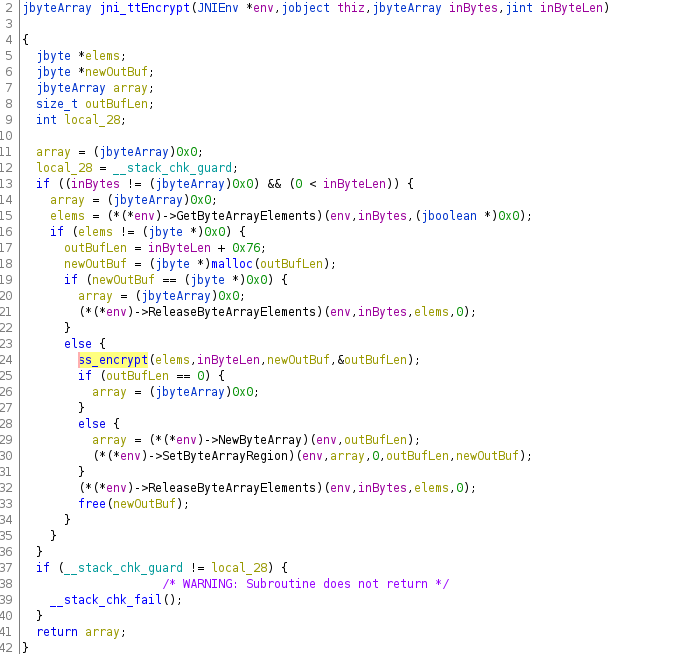
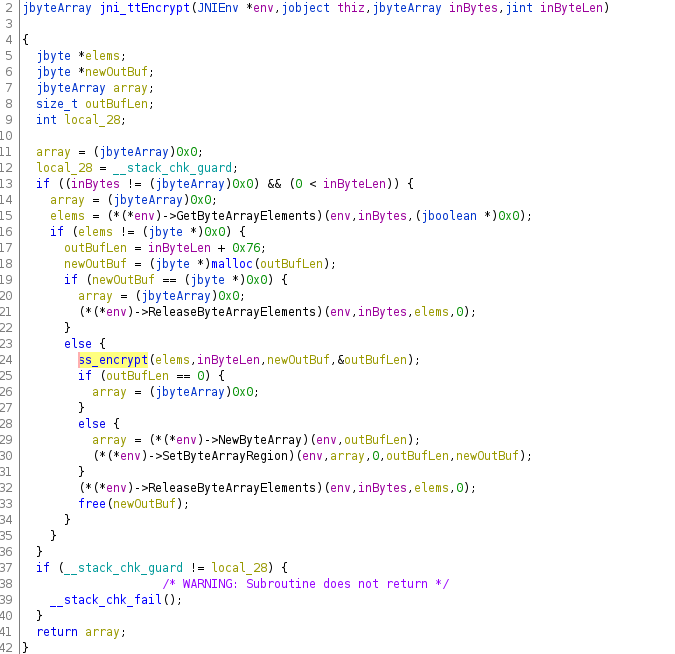
TikTok's (log data) encryption is accomplished by a native library. The Android Java code just serves as proxy function to the native function
Okay, doing my first baby steps with r2frida (which combines the power of @radareorg and @fridadotre).
Gonna share my progress in this thread (live, so keep calm).
The goal: Runtime inspection of data sent out by TikTok !!before!! it gets encrypted
1/many
TikTok's (log data) encryption is accomplished by a native library. The Android Java code just serves as proxy function to the native function
https://t.co/T63vo3N4fw
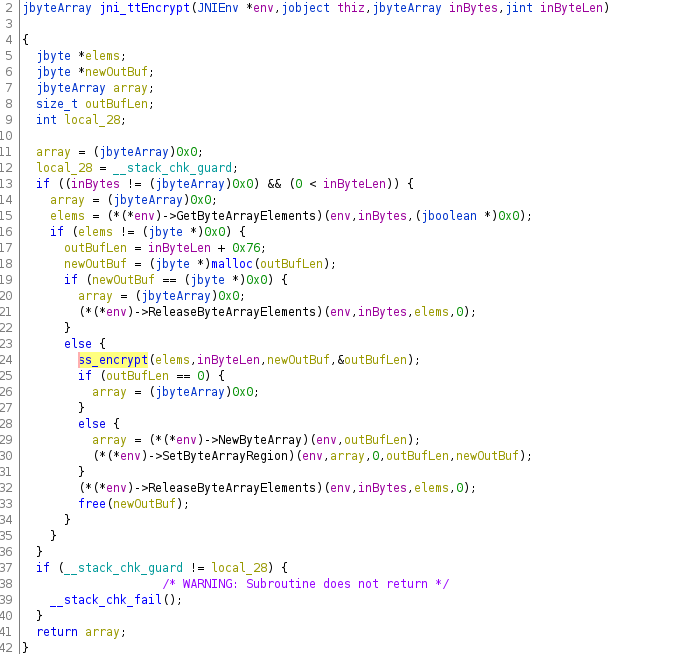
1) Unlike raw C-functions, JNI functions like the one showcased above, receive pointers to complex Java objects .
F.e. a function receiving a String on the Java layer...
In order to retrieve a C-String, to go on working with it in the native code, some translation functionality is required. This functionality is provided by the ...
If you look at the example screenshot again, you see exactly this. Functions provided by the 'env' pointer are used to parse the Java function arguments (f.e. jByteArrays) ...
2) There are two ways to expose JNI methods from a native library:
a) export them with proper naming convention, so that JNI could recognize same on library load
b) use the JNI functionality 'registerNatives'...
The second method of registering methods is wel suited for obfuscated code, as the methods neither have to follow naming convention, nor do they have to be exported.

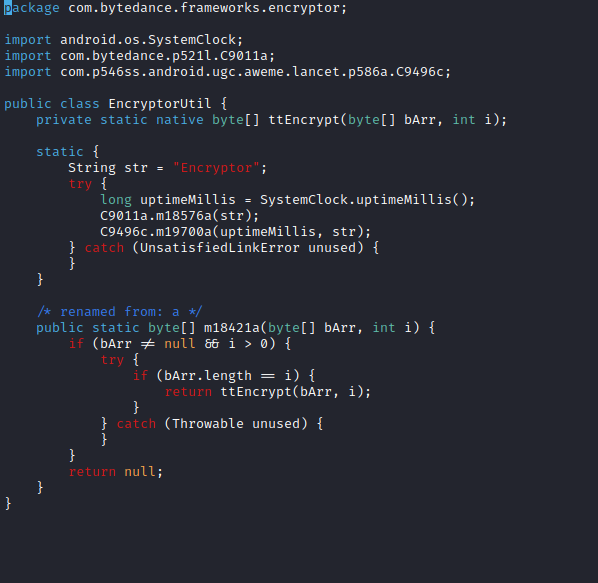
Internally, this data is forwarded to the native JNI method 'ttEncrypt'.
We already saw this signature in a previous screenshot

1) the call address of the native function implementation (0x7d70d1d5 in example)
2) The function name (ttEncrypt)
...
'(' start of parameters
'[B' byte[]
'I' int
')' end of parameters
'[B' byte[] (return value)
- the app is inspected on a physical device, running Android 9
- the device uses a !!32bit!! ARM application core
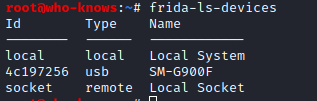
Now to get started, I already have the latest @fridadotre server running on my USB connected android device and 'frida-ls-device' shows it being ready-for-action
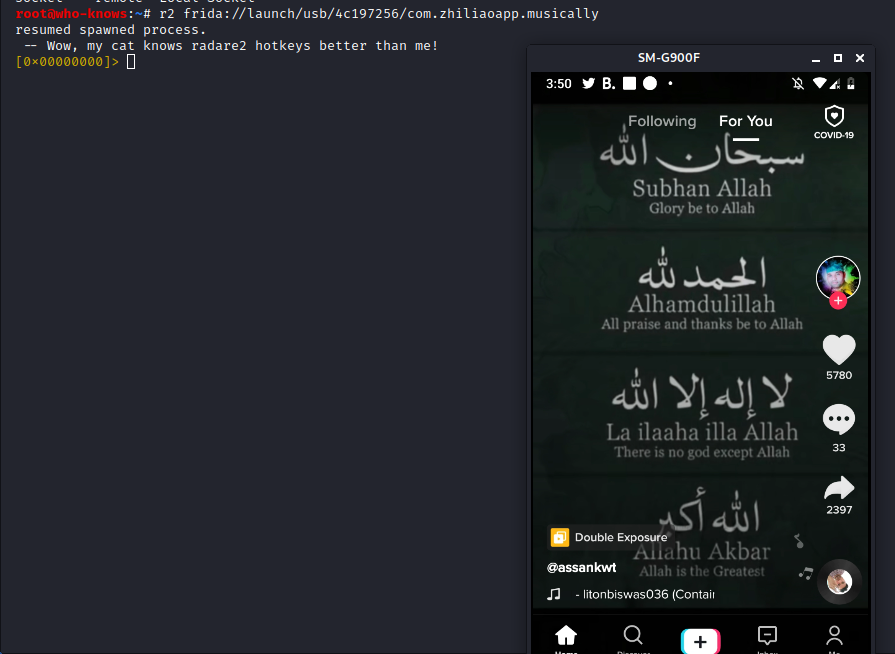
Instead of 'launch', two other options could be used:
- 'spawn' (like 'launch', but the process would not be resumed automatically after attaching)
Important: commands targeting the r2frida plugin have to be prefixed with '\'


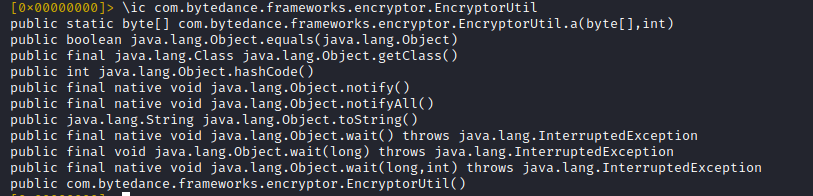
The signature of the static method 'EncryptorUtil.a' should look familiar to us (if you read the first tweets). It represents the Java layer of the encryption method and is called 'a' in this version
So lets search the whole address space for our native method name 'ttEncrypt'
Note: If you'd use r2's ascii search nothing would happen, you have to use the '\' prefix to search with r2frida
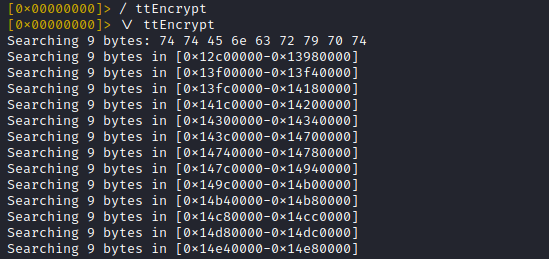
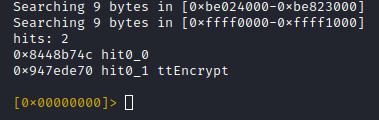
Reason: The memory region was not populated when r2 was started (encryption library was loaded after process launch)
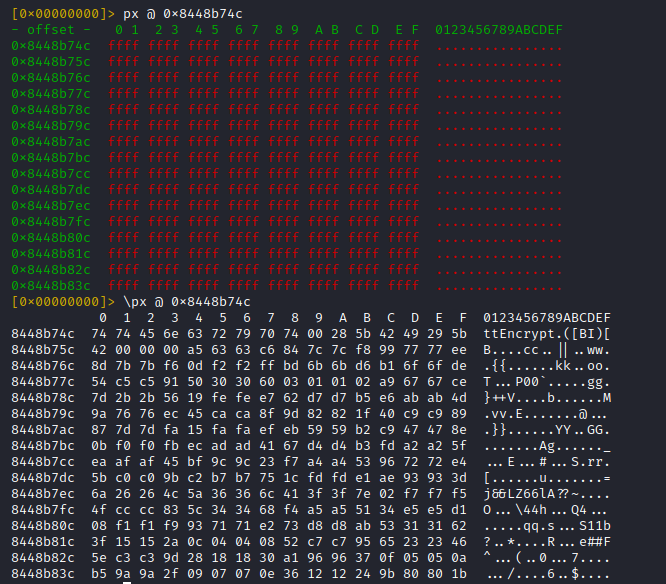
1) Quit r2
2) Open r2 with r2frida, again, but this time **attach** to the already running process
et voila ... the memory offset is mapped and dumpable with 'px' (without backslash prefix)
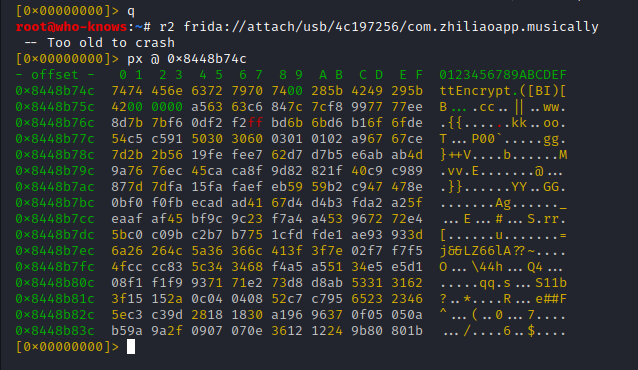
So chances are high, that this data is part of the structure which gets handed in to 'registerNatives'

- method name (C-string)
- method signature (C-string)
- method pointer (native pointer)
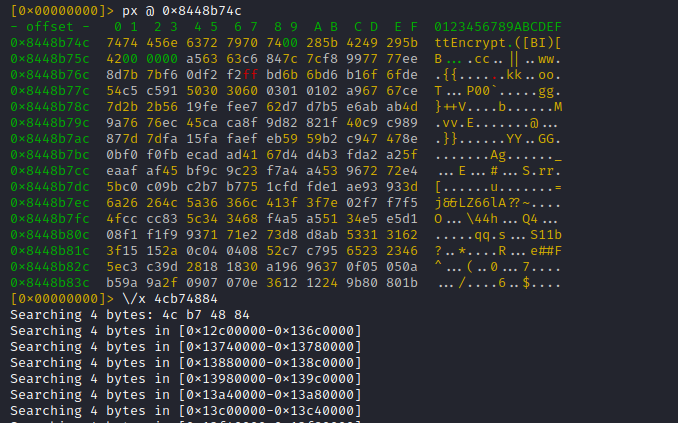
The result is promising: Only one hit, for a search across the whole address space:
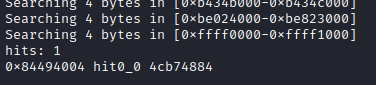
- 0x8448b74c (expected, method name pointer)
- 0x8448b756 (ptr to signature string, yay)
- 0x8448b1d5 (likely pointer to JNI method implementation)

Arm 32 supports two instruction sets "ARM mode" (32bit) and "Thumb mode" (16bit) which could be used interchangebly
For ARM the LSB is 0 (even address)
For THUMB the LSB is 1 (odd address)
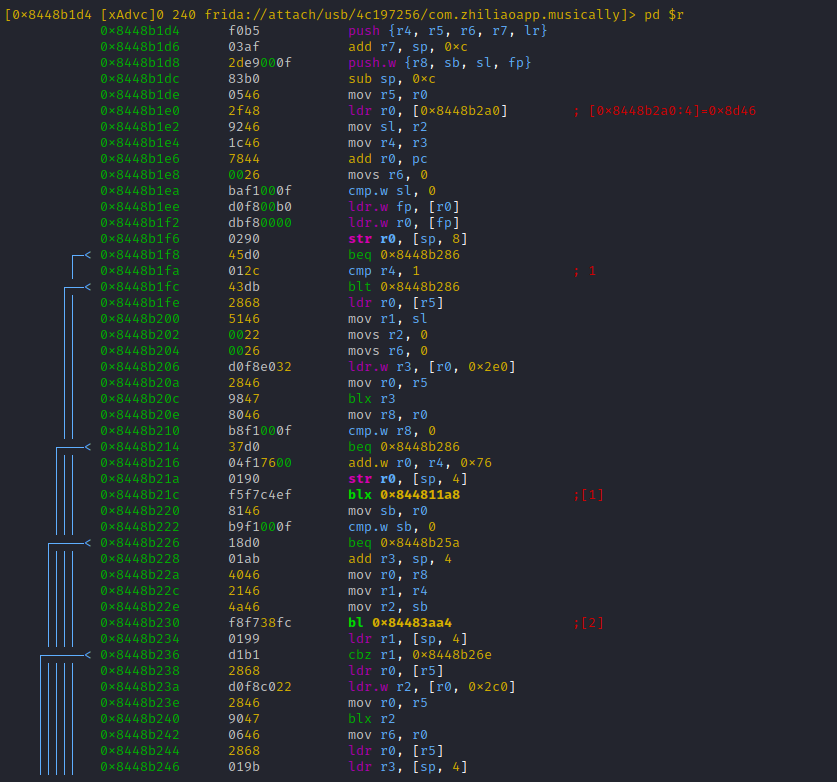
This means the function address 0x8448b1d5 homes code in THUMB mode (16bit), while the first instruction resides at 0x8448b1d4
(sorry if it gets a bit complicated, will be clear in a second)
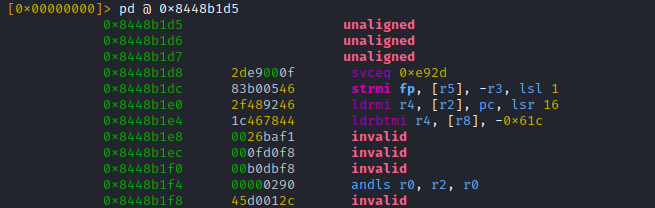
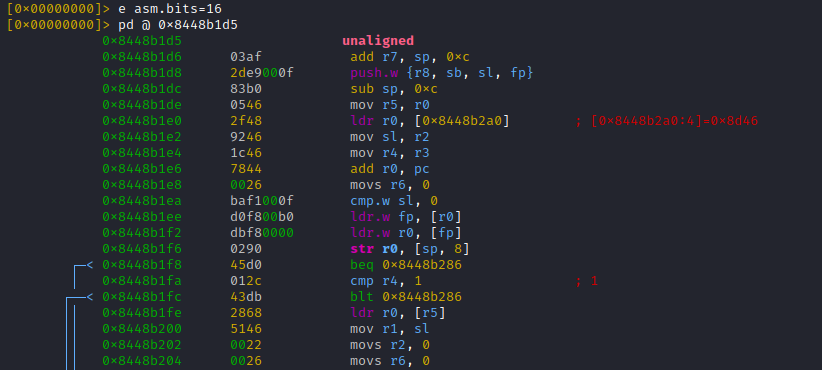
No seriously, as explained, on arm32 we have to disassemble at [THUMB mode address - 1] = 0x8448b1d4
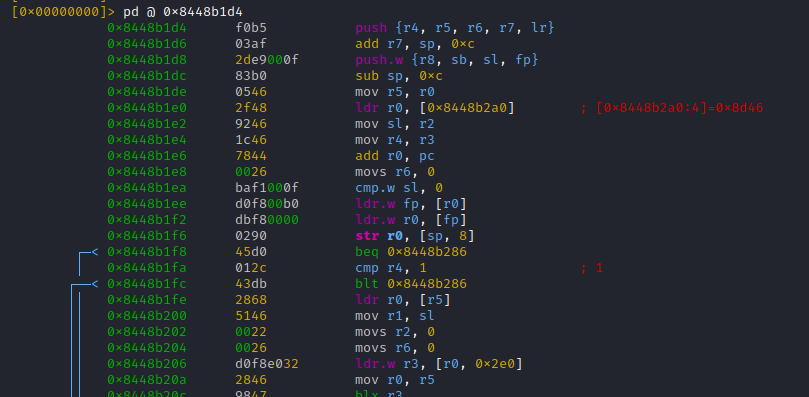
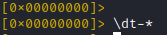
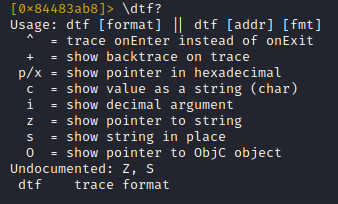
Now to get a feeling on how often this function is called, lets use 'r2frida' power to trace it.
Important: The thumb address has to be used here!!!

Some actions in the TikTok app ... trace logs for ttEncrypt-calls arrive

Trying to runtime-parse the function parameters, which represent Java object instances would be insane (maybe impossible)
It would be way easier to runtime-inspect these
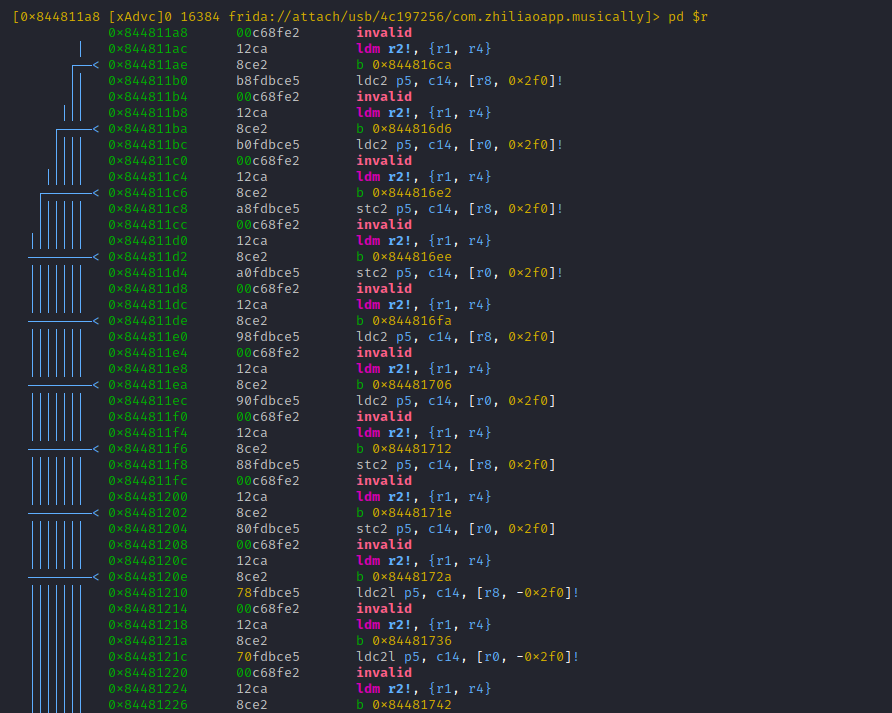
Hitting [alt+1] moves us straight to the marked branch offset:
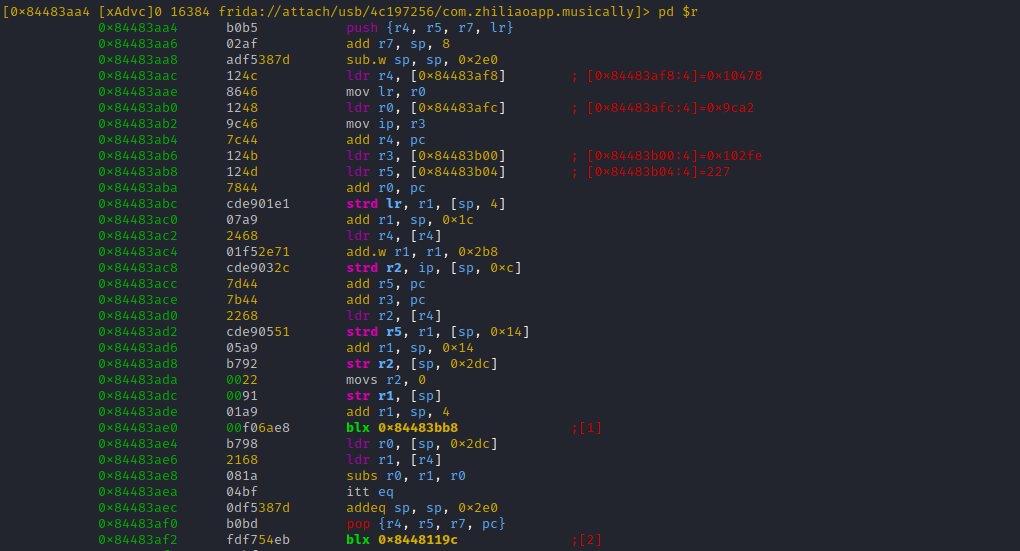
Hitting 'u' returns us to the parent function, followed by [alt+2] which brings us into the 2nd branch


More from Machine learning


Starting a new project using #Angular? Here is a list of all the stuff i use to launch my projects the fastest i can.
A THREAD 👇
Have you heard about Monorepo? I created one with all my Angular (and Nest) projects using https://t.co/aY5llDtXg8.
I can share A LOT of code with it. Ex: Everytime i start a new project, i just need to import an Auth lib, that i created, and all Auth related stuff is set up.
Everyone in the Angular community knows about https://t.co/kDnunQZnxE. It's not the most beautiful component library out there, but it's good and easy to work with.
There's a bunch of state management solutions for Angular, but https://t.co/RJwpn74Qev is by far my favorite.
There's a lot of boilerplate, but you can solve this with the built-in schematics and/or with your own schematics
Are you not using custom schematics yet? Take a look at this:
https://t.co/iLrIaHVafm
https://t.co/3382Tn2k7C
You can automate all the boilerplate with hundreds of files associates with creating a new feature.
A THREAD 👇
Have you heard about Monorepo? I created one with all my Angular (and Nest) projects using https://t.co/aY5llDtXg8.
I can share A LOT of code with it. Ex: Everytime i start a new project, i just need to import an Auth lib, that i created, and all Auth related stuff is set up.
Everyone in the Angular community knows about https://t.co/kDnunQZnxE. It's not the most beautiful component library out there, but it's good and easy to work with.
There's a bunch of state management solutions for Angular, but https://t.co/RJwpn74Qev is by far my favorite.
There's a lot of boilerplate, but you can solve this with the built-in schematics and/or with your own schematics
Are you not using custom schematics yet? Take a look at this:
https://t.co/iLrIaHVafm
https://t.co/3382Tn2k7C
You can automate all the boilerplate with hundreds of files associates with creating a new feature.

Happy 2⃣0⃣2⃣1⃣ to all.🎇
For any Learning machines out there, here are a list of my fav online investing resources. Feel free to add yours.
Let's dive in.
⬇️⬇️⬇️
Investing Services
✔️ @themotleyfool - @TMFStockAdvisor & @TMFRuleBreakers services
✔️ @7investing
✔️ @investing_city
https://t.co/9aUK1Tclw4
✔️ @MorningstarInc Premium
✔️ @SeekingAlpha Marketplaces (Check your area of interest, Free trials, Quality, track record...)
General Finance/Investing
✔️ @morganhousel
https://t.co/f1joTRaG55
✔️ @dollarsanddata
https://t.co/Mj1owkzRc8
✔️ @awealthofcs
https://t.co/y81KHfh8cn
✔️ @iancassel
https://t.co/KEMTBHa8Qk
✔️ @InvestorAmnesia
https://t.co/zFL3H2dk6s
✔️
Tech focused
✔️ @stratechery
https://t.co/VsNwRStY9C
✔️ @bgurley
https://t.co/NKXGtaB6HQ
✔️ @CBinsights
https://t.co/H77hNp2X5R
✔️ @benedictevans
https://t.co/nyOlasCY1o
✔️
Tech Deep dives
✔️ @StackInvesting
https://t.co/WQ1yBYzT2m
✔️ @hhhypergrowth
https://t.co/kcLKITRLz1
✔️ @Beth_Kindig
https://t.co/CjhLRdP7Rh
✔️ @SeifelCapital
https://t.co/CXXG5PY0xX
✔️ @borrowed_ideas
For any Learning machines out there, here are a list of my fav online investing resources. Feel free to add yours.
Let's dive in.
⬇️⬇️⬇️
Investing Services
✔️ @themotleyfool - @TMFStockAdvisor & @TMFRuleBreakers services
✔️ @7investing
✔️ @investing_city
https://t.co/9aUK1Tclw4
✔️ @MorningstarInc Premium
✔️ @SeekingAlpha Marketplaces (Check your area of interest, Free trials, Quality, track record...)
General Finance/Investing
✔️ @morganhousel
https://t.co/f1joTRaG55
✔️ @dollarsanddata
https://t.co/Mj1owkzRc8
✔️ @awealthofcs
https://t.co/y81KHfh8cn
✔️ @iancassel
https://t.co/KEMTBHa8Qk
✔️ @InvestorAmnesia
https://t.co/zFL3H2dk6s
✔️
Tech focused
✔️ @stratechery
https://t.co/VsNwRStY9C
✔️ @bgurley
https://t.co/NKXGtaB6HQ
✔️ @CBinsights
https://t.co/H77hNp2X5R
✔️ @benedictevans
https://t.co/nyOlasCY1o
✔️
Tech Deep dives
✔️ @StackInvesting
https://t.co/WQ1yBYzT2m
✔️ @hhhypergrowth
https://t.co/kcLKITRLz1
✔️ @Beth_Kindig
https://t.co/CjhLRdP7Rh
✔️ @SeifelCapital
https://t.co/CXXG5PY0xX
✔️ @borrowed_ideas

With hard work and determination, anyone can learn to code.
Here’s a list of my favorites resources if you’re learning to code in 2021.
👇
1. freeCodeCamp.
I’d suggest picking one of the projects in the curriculum to tackle and then completing the lessons on syntax when you get stuck. This way you know *why* you’re learning what you’re learning, and you're building things
2. https://t.co/7XC50GlIaa is a hidden gem. Things I love about it:
1) You can see the most upvoted solutions so you can read really good code
2) You can ask questions in the discussion section if you're stuck, and people often answer. Free
3. https://t.co/V9gcXqqLN6 and https://t.co/KbEYGL21iE
On stackoverflow you can find answers to almost every problem you encounter. On GitHub you can read so much great code. You can build so much just from using these two resources and a blank text editor.
4. https://t.co/xX2J00fSrT @eggheadio specifically for frontend dev.
Their tutorials are designed to maximize your time, so you never feel overwhelmed by a 14-hour course. Also, the amount of prep they put into making great courses is unlike any other online course I've seen.
Here’s a list of my favorites resources if you’re learning to code in 2021.
👇
1. freeCodeCamp.
I’d suggest picking one of the projects in the curriculum to tackle and then completing the lessons on syntax when you get stuck. This way you know *why* you’re learning what you’re learning, and you're building things
2. https://t.co/7XC50GlIaa is a hidden gem. Things I love about it:
1) You can see the most upvoted solutions so you can read really good code
2) You can ask questions in the discussion section if you're stuck, and people often answer. Free
3. https://t.co/V9gcXqqLN6 and https://t.co/KbEYGL21iE
On stackoverflow you can find answers to almost every problem you encounter. On GitHub you can read so much great code. You can build so much just from using these two resources and a blank text editor.
4. https://t.co/xX2J00fSrT @eggheadio specifically for frontend dev.
Their tutorials are designed to maximize your time, so you never feel overwhelmed by a 14-hour course. Also, the amount of prep they put into making great courses is unlike any other online course I've seen.

This is a Twitter series on #FoundationsOfML.
❓ Today, I want to start discussing the different types of Machine Learning flavors we can find.
This is a very high-level overview. In later threads, we'll dive deeper into each paradigm... 👇🧵
Last time we talked about how Machine Learning works.
Basically, it's about having some source of experience E for solving a given task T, that allows us to find a program P which is (hopefully) optimal w.r.t. some metric
According to the nature of that experience, we can define different formulations, or flavors, of the learning process.
A useful distinction is whether we have an explicit goal or desired output, which gives rise to the definitions of 1️⃣ Supervised and 2️⃣ Unsupervised Learning 👇
1️⃣ Supervised Learning
In this formulation, the experience E is a collection of input/output pairs, and the task T is defined as a function that produces the right output for any given input.
👉 The underlying assumption is that there is some correlation (or, in general, a computable relation) between the structure of an input and its corresponding output and that it is possible to infer that function or mapping from a sufficiently large number of examples.
❓ Today, I want to start discussing the different types of Machine Learning flavors we can find.
This is a very high-level overview. In later threads, we'll dive deeper into each paradigm... 👇🧵
Last time we talked about how Machine Learning works.
Basically, it's about having some source of experience E for solving a given task T, that allows us to find a program P which is (hopefully) optimal w.r.t. some metric
I'm starting a Twitter series on #FoundationsOfML. Today, I want to answer this simple question.
— Alejandro Piad Morffis (@AlejandroPiad) January 12, 2021
\u2753 What is Machine Learning?
This is my preferred way of explaining it... \U0001f447\U0001f9f5
According to the nature of that experience, we can define different formulations, or flavors, of the learning process.
A useful distinction is whether we have an explicit goal or desired output, which gives rise to the definitions of 1️⃣ Supervised and 2️⃣ Unsupervised Learning 👇
1️⃣ Supervised Learning
In this formulation, the experience E is a collection of input/output pairs, and the task T is defined as a function that produces the right output for any given input.
👉 The underlying assumption is that there is some correlation (or, in general, a computable relation) between the structure of an input and its corresponding output and that it is possible to infer that function or mapping from a sufficiently large number of examples.