Abduction is that thought process where we renew our past, question our present, and reimagine our future.
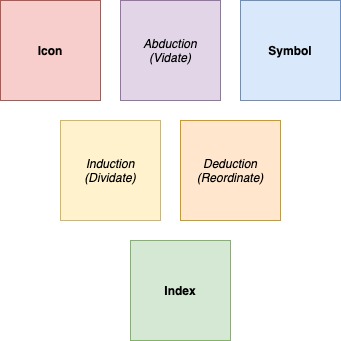
It was C.S. Peirce, a century ago, that coined the use of this term to describe a thought process that would convey hypothesis making.
A little over 50 years ago, proponents of Artificial Intelligence, proposed that deduction would be the core feature of human intelligence. This idea was driven by the bias towards formal logical systems and the emergence of computers.
This approach was in stark contrast to cybernetics (introduced a decade early) that proposed that dynamical systems were a model for intelligence. The descendant of this approach was coined as artificial neural networks.
This dynamical systems approach was later understood as being similar to an induction based thought process. Deep Learning leads to what can be characterized as Artificial Intuition.
But despite the massive gains in DL capabilities in the last 8 years, Abduction, as described by Peirce, is clearly missing.
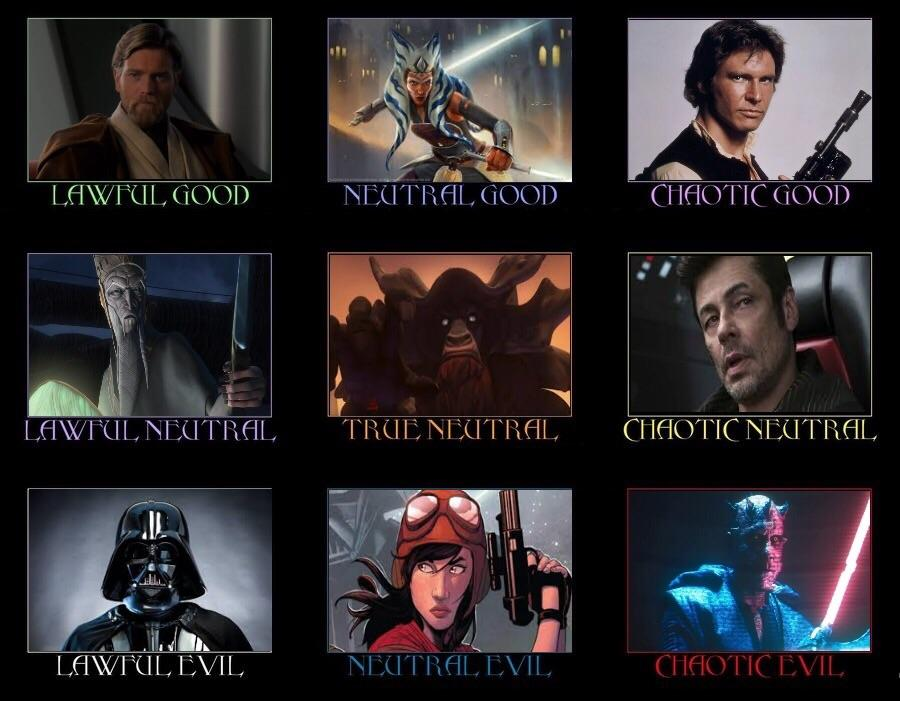
I've always found it instructive to employ Peirce's triadic thinking to understand complexities. It is usually the case the top middlebox (in purple) is difficult to grasp emergent phenomena.
It is expressed a downward causality where that emerges out of induction and deduction influences the dynamics of a system. Abduction comes from imagination. But imagination cannot happen without the vocabulary to imagine.
Refactoring is an activity practiced in software development that perhaps is a good analogy for abduction. Refactoring reorganizes concepts so as to better reflect the intentions of the programmer.
Refactoring is performed after an original design is implemented. This is because the programmer discovers new issues, that he previously wasn't aware of, with his current implementation.
As we build a model, we discover its flaws when we test it against reality. Refactoring is a systematic modification of the original model. An aspect of refactoring is that it does not involve wholesale changes, but one that introduces changes and keeps an original function.
Abduction is similar in that is not wild imagination, but rather imagination that is constrained by existing knowledge. Although there is some similarity with the perturbative learning methods of induction, there is a vast difference.
The perturbative learning methods tend to be first-order in that it is driven by a measure (which comes from a model of what's important). In contrast, Abduction is 2nd-order in that it is driven by a discrepancy in the formulation of a model.
This discrepancy is complex enough in structure that simple gradient descent is insufficient a solution. Rather, an informed modification is necessary to update the original model.
It requires a kind of empathy that understands the ramifications of actions that are to be performed to refactor an existing model.
It requires not only recognizing the flaws in our current knowledge but formulating the important questions so as to have a systematic way of discovering a new solution.
Intuition automatically allows us to see possibilities. Abductions however is that 2nd order skill that allows us to formulate good questions. It is only through questioning that we can discover possibilities that we've may never have imagined.
Peirce's Abduction is commonly understood as hypothesis selection. We often overlook though that a good hypothesis is one that makes obvious the generation of a good question.
Intuition relies on affordances that reveal possibilities. Abduction relies on hypotheses that reveal questions.

More from Carlos E. Perez

Programming in abstractions is very different from a system that is capable of its own 'abstracting'. But what does abstracting mean? We only know of its inputs and outputs, but we fail to describe its inner workings.

I like this short video about living in space. This is because it makes you realize the gaps in your knowledge when you turn off something (i.e. gravity) that you have always assumed to be present.


Perhaps we can understand 'abstracting' better if we turn of many assumptions that we unconsciously carry around. Perhaps we need to get rid of the excess baggage that is confusing our thinking about abstraction.

Turning off gravity and living in space is a perfect analogy. We somehow have to turn off a cognitive process to understand the meaning of abstraction.

The first step to divorce ourselves from our habitual cognitive processes is to realize the pervasiveness of 'noun-thinking' .

More from Life

You May Also Like

महाभारत की कहानी कौन नहीं जानता।लेकिन क्या आपको पता है कि महाभारत के ज्यादातर पात्र किसी न किसी श्राप में फंसे थे।अगर ये श्राप न होते तो कदाचित महाभारत की कहानी कुछ और होती।हिन्दु पौराणिक ग्रंथों में विभिन्न श्रापों का वर्णन मिलता है व हर श्राप के पीछे कोई कहानी अवश्य होती है।


आइए आज जानते हैं महाभारत कथा में वर्णित कुछ श्रापों के बारे में।

1) राजा पाण्डु को ऋषि किन्दम का श्राप

एकबार महाराज पाण्डु शिकार खेलने वन गए।झाडियों के पीछे कुछ हिल रहा था। मृग है सोचकर राजा ने बाण चलाया जो जाकर ऋषि किन्दम और उनकी पत्नी को लगा।वे दोनो रति-क्रीड़ा में लिप्त थे।

जब राजा ने उन्हें देखा तो बहुत दुखी हुए कि ये मुझसे क्या पाप हो गया।बहुत क्षमा याचना के बाद भी किन्दम ऋषि ने पाण्डु को श्राप दे दिया कि जब भी वो किसी स्त्री को काम भावना से स्पर्श करेंगे उसी क्षण उनकी मृत्यु हो जाएगी।पश्चाताप करने, वे सिंहासन पे अन्धे राजा धृतराष्ट्र को बैठाकर...


..स्वयं अपनी रानियों कुंती व माद्री के साथ वन चले गए।पांडवों का जन्म भी कुंती को ऋषि दुर्वासा द्वारा दिए गए मंत्र से हुआ था जिसमे किसी भी देव का स्मरण कर उस देव से कुंती,पुत्र प्राप्त कर सकती थी।एक बार माद्री पे मोहित हो जब पांडु ने उसे स्पर्श किया,उसी क्षण पांडु की मृत्यु होगयी।


2) उर्वशी का अर्जुन को श्राप

महाभारत युद्ध से पहले जब अर्जुन दिव्यास्त्र प्राप्त करने स्वर्ग गए तो वहां उर्वशी नाम की अप्सरा उन पर मोहित हो गयी। अर्जुन ने जब उन्हें अपनी माता के समान बताया तो यह सुनकर उर्वशी क्रोधित हो गयी और अर्जुन को श्राप दे डाला कि तुम नपुंसक की भांति...
प्राचीन काल में गाधि नामक एक राजा थे।उनकी सत्यवती नाम की एक पुत्री थी।राजा गाधि ने अपनी पुत्री का विवाह महर्षि भृगु के पुत्र से करवा दिया।महर्षि भृगु इस विवाह से बहुत प्रसन्न हुए और उन्होने अपनी पुत्रवधु को आशीर्वाद देकर उसे कोई भी वर मांगने को कहा।


सत्यवती ने महर्षि भृगु से अपने तथा अपनी माता के लिए पुत्र का वरदान मांगा।ये जानकर महर्षि भृगु ने यज्ञ किया और तत्पश्चात सत्यवती और उसकी माता को अलग-अलग प्रकार के दो चरू (यज्ञ के लिए पकाया हुआ अन्न) दिए और कहा कि ऋतु स्नान के बाद तुम्हारी माता पुत्र की इच्छा लेकर पीपल का आलिंगन...

...करें और तुम भी पुत्र की इच्छा लेकर गूलर वृक्ष का आलिंगन करना। आलिंगन करने के बाद चरू का सेवन करना, इससे तुम दोनो को पुत्र प्राप्ति होगी।परंतु मां बेटी के चरू आपस में बदल जाते हैं और ये महर्षि भृगु अपनी दिव्य दृष्टि से देख लेते हैं।

भृगु ऋषि सत्यवती से कहते हैं,"पुत्री तुम्हारा और तुम्हारी माता ने एक दुसरे के चरू खा लिए हैं।इस कारण तुम्हारा पुत्र ब्राह्मण होते हुए भी क्षत्रिय सा आचरण करेगा और तुम्हारी माता का पुत्र क्षत्रिय होकर भी ब्राह्मण सा आचरण करेगा।"
इस पर सत्यवती ने भृगु ऋषि से बड़ी विनती की।


सत्यवती ने कहा,"मुझे आशीर्वाद दें कि मेरा पुत्र ब्राह्मण सा ही आचरण करे।"तब महर्षि ने उसे ये आशीर्वाद दे दिया कि उसका पुत्र ब्राह्मण सा ही आचरण करेगा किन्तु उसका पौत्र क्षत्रियों सा व्यवहार करेगा। सत्यवती का एक पुत्र हुआ जिसका नाम जम्दाग्नि था जो सप्त ऋषियों में से एक हैं।