The definition I'll go with is that it's the actions people take to advance the things they care about in the workplace.
Do you struggle with "office politics," like when Colleague got a promotion because they seem to have the same hobbies as the boss?
Do you have no idea how to play the game?
Do you recoil at the very word?
Then this thread is for you 👇
The definition I'll go with is that it's the actions people take to advance the things they care about in the workplace.
1) The company hitting its goals
2) The success of one's projects and initiatives
3) A promotion
4) A plum assignment or leadership role
4) A change in workplace culture, values or process
5) The advancement of a colleague / group of people
6) Personal reputation
Office politics has a negative connotation but is simply another manifestation of humans being complicated and having multiple, sometimes conflicting desires.
1) there is clear hierarchy + power dynamic (ceos, managers, etc)
2) how we perform at work impacts our self-esteem, identity, and ability to sustain ourselves
3) we spend 1/3+ of our waking hours in our workplace
For example, both of us are angling for one leadership role, or there's a fixed budget and I'm hoping my project gets more, which means yours gets less.
Someone (usually a sr manager) has to make a call.
1) I'm disappointed but accepting of the decision
2) I'm upset bc the decision-maker was unqualified
3) I'm irate bc the criteria was wrong/unfair
1) Ensure that you know how your manager + their managers define success. Ask in 1:1s if this is not clear.
2) Make sure your manager understands how *you* define success.
3) ...
4) Continually hone your communication skills. It is a key advantage.
5) ...
6) Ask yourself: did the decision-maker intend to do what they thought was best for the org?
7) If 6 is yes, ask yourself: do I trust the decision-maker's abilities and their values?
Otherwise, make sure your perspective has been heard, and trust in the process. Don't take the decision personally. Disagreement isn't a bad thing; we all learn from it.
1) Walk the walk + talk the talk in putting the company's goals above your personal goals
2) Create transparency around the process ahead of a decision. Eg what is the criteria for promotion?
3)..
More from Life

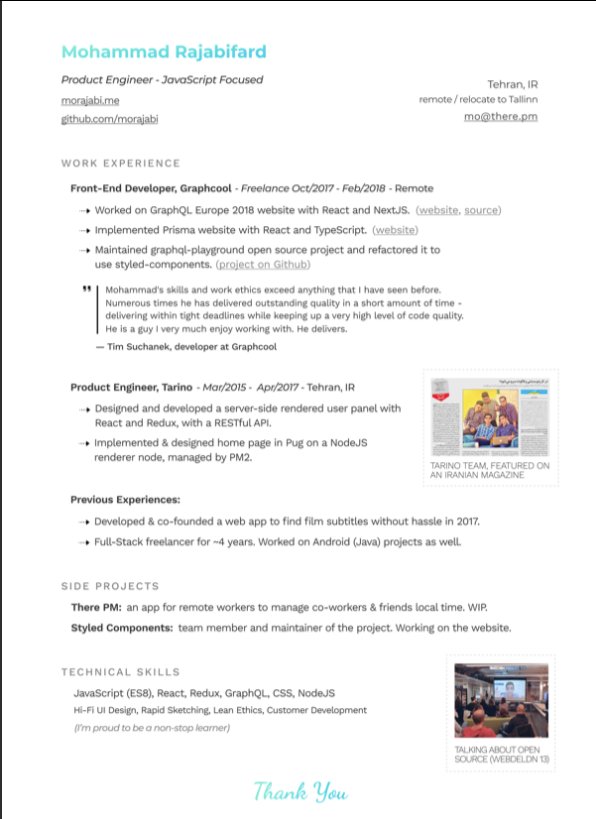
👨💻 Last resume I sent to a startup one year ago, sharing with you to get ideas:
- Forget what you don't have, make your strength bold
- Pick one work experience and explain what you did in detail w/ bullet points
- Write it towards the role you apply
- Give social proof
/thread
"But I got no work experience..."
Make a open source lib, make a small side project for yourself, do freelance work, ask friends to work with them, no friends? Find friends on Github, and Twitter.
Bonus points:
- Show you care about the company: I used the company's brand font and gradient for in the resume for my name and "Thank You" note.
- Don't list 15 things and libraries you worked with, pick the most related ones to the role you're applying.
-🙅♂️"copy cover letter"
"I got no firends, no work"
One practical way is to reach out to conferences and offer to make their website for free. But make sure to do it good. You'll get:
- a project for portfolio
- new friends
- work experience
- learnt new stuff
- new thing for Twitter bio
If you don't even have the skills yet, why not try your chance for @LambdaSchool? No? @freeCodeCamp. Still not? Pick something from here and learn https://t.co/7NPS1zbLTi
You'll feel very overwhelmed, no escape, just acknowledge it and keep pushing.
- Forget what you don't have, make your strength bold
- Pick one work experience and explain what you did in detail w/ bullet points
- Write it towards the role you apply
- Give social proof
/thread
"But I got no work experience..."
Make a open source lib, make a small side project for yourself, do freelance work, ask friends to work with them, no friends? Find friends on Github, and Twitter.
Bonus points:
- Show you care about the company: I used the company's brand font and gradient for in the resume for my name and "Thank You" note.
- Don't list 15 things and libraries you worked with, pick the most related ones to the role you're applying.
-🙅♂️"copy cover letter"
"I got no firends, no work"
One practical way is to reach out to conferences and offer to make their website for free. But make sure to do it good. You'll get:
- a project for portfolio
- new friends
- work experience
- learnt new stuff
- new thing for Twitter bio
If you don't even have the skills yet, why not try your chance for @LambdaSchool? No? @freeCodeCamp. Still not? Pick something from here and learn https://t.co/7NPS1zbLTi
You'll feel very overwhelmed, no escape, just acknowledge it and keep pushing.

It doesn't happen because you want it to happen.
It doesn't happen because you made it happen.
It happens because you allow it to happen.
https://t.co/j5hPyw9m9m
It doesn't happen because you made it happen.
It happens because you allow it to happen.
https://t.co/j5hPyw9m9m
There is a fine line between persistence and stubbornness.
— The Irrational Investor (@position_trader) August 28, 2019
True for life, true for investing.