They found that suspensions did have an impact on replies and retweets and overall dissemination. https://t.co/G12JUYtuzK
1. (THREAD) So, it seems like the deplatforming debate is once again kicking off, so I thought I would introduce some of the earlier work that was done in this area back when ISIS was buck wild on social media. What have we learned over the last six years might be useful today:
They found that suspensions did have an impact on replies and retweets and overall dissemination. https://t.co/G12JUYtuzK
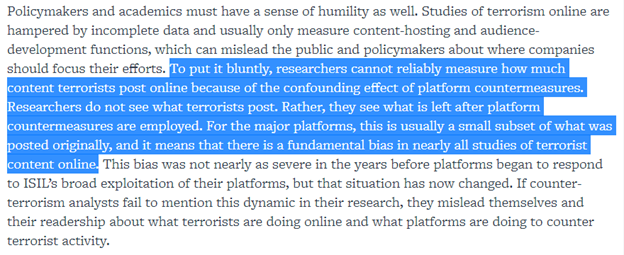
You can read my thoughts on the Islamic State’s online community here: https://t.co/1qSfLBNkyf
Elizabeth pearson has also discussed this issue here: https://t.co/Yloq6pHVQJ
1. NEW by me, @ShirazMaher, and @charliewinter for @crest_research.
— Amarnath Amarasingam (@AmarAmarasingam) January 8, 2021
Anyone paying to ISIS channels on Telegram in 2019 noticed something strange in late November: they started to disappear en masse. We decided to take a closer look at the data. https://t.co/ZG13ppBJxO pic.twitter.com/WaOj5YVGNn
More from Internet


There are lots of problems with ad-tech:
* being spied on all the time means that the people of the 21st century are less able to be their authentic selves;
* any data that is collected and retained will eventually breach, creating untold harms;
1/

* data-collection enables for discriminatory business practices ("digital redlining");
* the huge, tangled hairball of adtech companies siphons lots (maybe even most) of the money that should go creators and media orgs; and
2/
* anti-adblock demands browsers and devices that thwart their owners' wishes, a capability that can be exploited for even more nefarious purposes;
That's all terrible, but it's also IRONIC, since it appears that, in addition to everything else, ad-tech is a fraud, a bezzle.
3/
Bezzle was John Kenneth Galbraith's term for "the magic interval when a confidence trickster knows he has the money he has appropriated but the victim does not yet understand that he has lost it." That is, a rotten log that has yet to be turned over.
4/
Bezzles unwind slowly, then all at once. We've had some important peeks under ad-tech's rotten log, and they're increasing in both intensity and velocity. If you follow @Chronotope, you've had a front-row seat to the
* being spied on all the time means that the people of the 21st century are less able to be their authentic selves;
* any data that is collected and retained will eventually breach, creating untold harms;
1/
* data-collection enables for discriminatory business practices ("digital redlining");
* the huge, tangled hairball of adtech companies siphons lots (maybe even most) of the money that should go creators and media orgs; and
2/
* anti-adblock demands browsers and devices that thwart their owners' wishes, a capability that can be exploited for even more nefarious purposes;
That's all terrible, but it's also IRONIC, since it appears that, in addition to everything else, ad-tech is a fraud, a bezzle.
3/
Bezzle was John Kenneth Galbraith's term for "the magic interval when a confidence trickster knows he has the money he has appropriated but the victim does not yet understand that he has lost it." That is, a rotten log that has yet to be turned over.
4/
Bezzles unwind slowly, then all at once. We've had some important peeks under ad-tech's rotten log, and they're increasing in both intensity and velocity. If you follow @Chronotope, you've had a front-row seat to the
The numbers are all fking fake, the metrics are bullshit, the agencies responsible for enforcing good practices are knowing bullshiters enforcing and profiting off all the fake numbers and none of the models make sense at scale of actual human users. https://t.co/sfmdrxGBNJ pic.twitter.com/thvicDEL29
— Aram Zucker-Scharff (@Chronotope) December 26, 2018