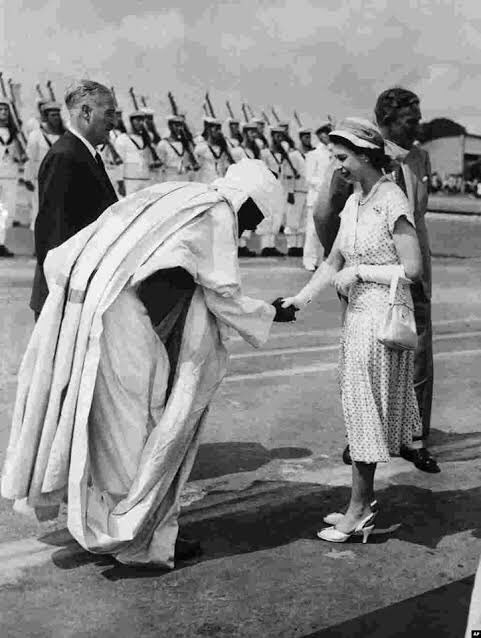
1. Yes Northern Nigeria had upper hand (not of their making btw), but they were first in the pecking order of things, had better interactions with the West (Britain in this context). But did all of that “western influence” penetrate into Northern society?
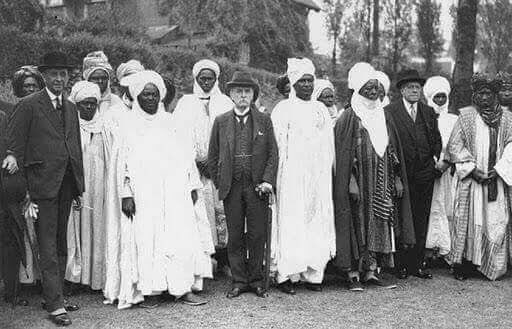
I am not advocating “culture & values disruption,” hell NO!! I’m just saying the North has to embrace western ideals. Islamic education for instance, should never replace formal education. Western education was what saved China from its dark ages.

More from History
This is THEFT!
Indians had Algebra BEFORE Mμslim prophet & religion was even born.
Here is Bakhshali Manuscript dating back to 3rd century CE. It is an Algebraic treatise. Have you anything like this from the Arabian desert? No, you simply plagiarized Algebra from Indians! https://t.co/cWXRNYMgDt
The Bakhshali manuscript, which has been carbon dated to 3rd century CE, is an ancient Hindu treatise on Arithmetic and Algebra.
The Algebraic problems deal with simultaneous equations, quadratic equations, arithmetic
geometric progressions & quadratic indeterminate equations.
Bakhshali isn't earliest Indian Algebraic treatise. Early Algebra is found in Shulba Sutras dating back to at least 800 BC. Traditional Algebra reached its pinnacle in the works of Aryabhata & Bhaskara.
What makes Bakhshali special is it offers mathematical proof to its theories
It is surprising to see that even after the ancient Indian algebraic treatise has been carbon dated to 3rd century CE by Oxford, they persist with "oh we invented Algebra. It is Halal".
A brief examination of the origins of "Halal Algebra" follows
https://t.co/eFIZ98FDrI
The earliest work of "Arabic Algebra" is the "Al-Kitāb Al-Jabr wal-muqābala" by Al Khwarizmi. The term "Algebra" comes from this book ("Al Jabr").
Before writing his treatise, Al Khwarizmi visited India. His book is a plagiarism from Indian Mathematics and an obvious one at that
Indians had Algebra BEFORE Mμslim prophet & religion was even born.
Here is Bakhshali Manuscript dating back to 3rd century CE. It is an Algebraic treatise. Have you anything like this from the Arabian desert? No, you simply plagiarized Algebra from Indians! https://t.co/cWXRNYMgDt
Muslims gave the world Algebra, so here's a "halal" way to say Merry Christmas to our Christian friends :)#MerryChristmas2020 pic.twitter.com/aLXEw2K2I1
— Qasim Rashid, Esq. (@QasimRashid) December 25, 2020
The Bakhshali manuscript, which has been carbon dated to 3rd century CE, is an ancient Hindu treatise on Arithmetic and Algebra.
The Algebraic problems deal with simultaneous equations, quadratic equations, arithmetic
geometric progressions & quadratic indeterminate equations.
Bakhshali isn't earliest Indian Algebraic treatise. Early Algebra is found in Shulba Sutras dating back to at least 800 BC. Traditional Algebra reached its pinnacle in the works of Aryabhata & Bhaskara.
What makes Bakhshali special is it offers mathematical proof to its theories
It is surprising to see that even after the ancient Indian algebraic treatise has been carbon dated to 3rd century CE by Oxford, they persist with "oh we invented Algebra. It is Halal".
A brief examination of the origins of "Halal Algebra" follows
https://t.co/eFIZ98FDrI
The earliest work of "Arabic Algebra" is the "Al-Kitāb Al-Jabr wal-muqābala" by Al Khwarizmi. The term "Algebra" comes from this book ("Al Jabr").
Before writing his treatise, Al Khwarizmi visited India. His book is a plagiarism from Indian Mathematics and an obvious one at that
You May Also Like
I’m torn on how to approach the idea of luck. I’m the first to admit that I am one of the luckiest people on the planet. To be born into a prosperous American family in 1960 with smart parents is to start life on third base. The odds against my very existence are astronomical.
I’ve always felt that the luckiest people I know had a talent for recognizing circumstances, not of their own making, that were conducive to a favorable outcome and their ability to quickly take advantage of them.
In other words, dumb luck was just that, it required no awareness on the person’s part, whereas “smart” luck involved awareness followed by action before the circumstances changed.
So, was I “lucky” to be born when I was—nothing I had any control over—and that I came of age just as huge databases and computers were advancing to the point where I could use those tools to write “What Works on Wall Street?” Absolutely.
Was I lucky to start my stock market investments near the peak of interest rates which allowed me to spend the majority of my adult life in a falling rate environment? Yup.
Ironies of Luck https://t.co/5BPWGbAxFi
— Morgan Housel (@morganhousel) March 14, 2018
"Luck is the flip side of risk. They are mirrored cousins, driven by the same thing: You are one person in a 7 billion player game, and the accidental impact of other people\u2019s actions can be more consequential than your own."
I’ve always felt that the luckiest people I know had a talent for recognizing circumstances, not of their own making, that were conducive to a favorable outcome and their ability to quickly take advantage of them.
In other words, dumb luck was just that, it required no awareness on the person’s part, whereas “smart” luck involved awareness followed by action before the circumstances changed.
So, was I “lucky” to be born when I was—nothing I had any control over—and that I came of age just as huge databases and computers were advancing to the point where I could use those tools to write “What Works on Wall Street?” Absolutely.
Was I lucky to start my stock market investments near the peak of interest rates which allowed me to spend the majority of my adult life in a falling rate environment? Yup.
A brief analysis and comparison of the CSS for Twitter's PWA vs Twitter's legacy desktop website. The difference is dramatic and I'll touch on some reasons why.
Legacy site *downloads* ~630 KB CSS per theme and writing direction.
6,769 rules
9,252 selectors
16.7k declarations
3,370 unique declarations
44 media queries
36 unique colors
50 unique background colors
46 unique font sizes
39 unique z-indices
https://t.co/qyl4Bt1i5x
PWA *incrementally generates* ~30 KB CSS that handles all themes and writing directions.
735 rules
740 selectors
757 declarations
730 unique declarations
0 media queries
11 unique colors
32 unique background colors
15 unique font sizes
7 unique z-indices
https://t.co/w7oNG5KUkJ
The legacy site's CSS is what happens when hundreds of people directly write CSS over many years. Specificity wars, redundancy, a house of cards that can't be fixed. The result is extremely inefficient and error-prone styling that punishes users and developers.
The PWA's CSS is generated on-demand by a JS framework that manages styles and outputs "atomic CSS". The framework can enforce strict constraints and perform optimisations, which is why the CSS is so much smaller and safer. Style conflicts and unbounded CSS growth are avoided.
Legacy site *downloads* ~630 KB CSS per theme and writing direction.
6,769 rules
9,252 selectors
16.7k declarations
3,370 unique declarations
44 media queries
36 unique colors
50 unique background colors
46 unique font sizes
39 unique z-indices
https://t.co/qyl4Bt1i5x
PWA *incrementally generates* ~30 KB CSS that handles all themes and writing directions.
735 rules
740 selectors
757 declarations
730 unique declarations
0 media queries
11 unique colors
32 unique background colors
15 unique font sizes
7 unique z-indices
https://t.co/w7oNG5KUkJ
The legacy site's CSS is what happens when hundreds of people directly write CSS over many years. Specificity wars, redundancy, a house of cards that can't be fixed. The result is extremely inefficient and error-prone styling that punishes users and developers.
The PWA's CSS is generated on-demand by a JS framework that manages styles and outputs "atomic CSS". The framework can enforce strict constraints and perform optimisations, which is why the CSS is so much smaller and safer. Style conflicts and unbounded CSS growth are avoided.