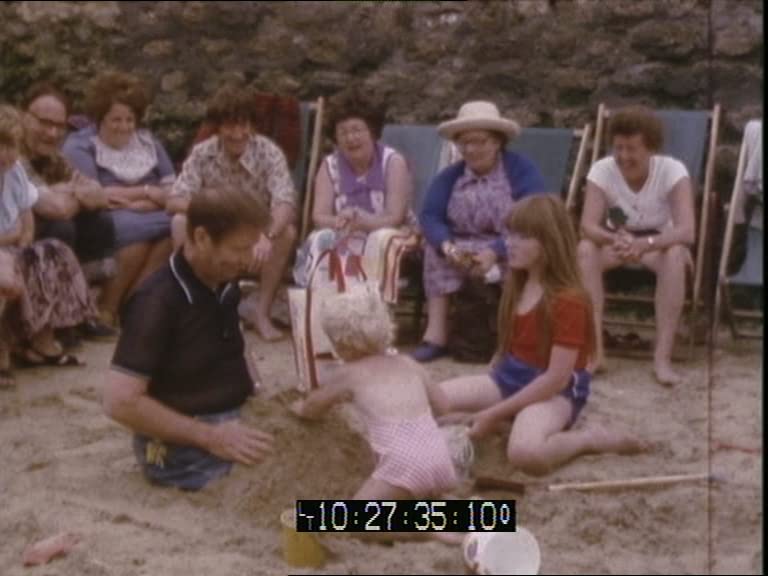
He aimed to show that ordinary people could find fulfilment away from the ever-growing influence of global capitalism.
His film was broadcast by the BBC on Tuesday 19th April 1983, only one day after 33 people were killed when terrorists bombed the US Embassy in Beirut.
This documentary was “Just Another Day: The Seaside” and it depicted the small coastal town of Walton-on-the-Naze, where innocent holiday-makers found pleasure in a technology-free utopia.
The same day this film was shown, Polish author Jerzy Andrzejewski, whose books explored topics such as betrayal and the final days of World War II, died in Warsaw of a heart attack.
Curtis was convinced that if the ancient pastimes of these Essex pleasure seekers – such as Punch and Judy shows, and Wild West re-enactments – were captured on film then people around the world might realise something.
But this was a fantasy.
As the years passed the memories of this innocent utopia faded while the disturbing influences Curtis had opposed grew ever stronger.
But then something strange happened.
The very powers the filmmaker was fighting against gave him another chance.
In 2005 three young men created a video-sharing service on the World Wide Web in the hope of collecting videos of attractive women, offering them $100 for each video.
But they had unleashed forces they could not comprehend and soon You Tube was out of control.
Soon, hundreds of hours of video were being uploaded to the service every minute and one of those was Curtis’s film that, until that moment, had been unseen for more than two decades.
Maybe now, available to the entire world, Curtis's dream could become a reality.
But then, another strange thing happened.
As surprisingly as it had appeared, the video vanished, made private, hidden by the forces of techno-capitalism, ever-larger media conglomerates, and runaway artificial intelligences.
Once again, the hopes of Curtis and his followers were dashed.
https://t.co/9LsLAfu6HP
But what of the BBC?
All that remains of “Just Another Day: The Seaside” and its utopian vision is a sketchy outline, a handful of bytes of data stored on a hard disk somewhere in an anonymous data centre.
https://t.co/dZGRmGIP53
And yet, surprisingly, the BBC controls its own public service video streaming service.
However, torn apart by the egos of power-hungry men, terrorised by out of touch politicians, and hounded by press barons, the corporation has yet to show this film on its i-Player.
For now, Walton-on-the-Naze will remain a hidden and largely unknown utopia.
And Adam Curtis’s dream, of showing the people of the world how to live, as if they were always on holiday at the seaside, must remain a dream.
[ This thread is also available in traditional blog post format at
https://t.co/R4WnHA5brT ]