Categories Health






Personally, I don't use but I gotta ask b/as long time SA Counselor & Clinical Neuropsychologist,
What ARE these people so on re weed about? Theres NOTHING abt weed comes anywhere close to t/individual, 1/
State Senator Amanda Chase has come out against the illegalization of marijuana. She is running for the Republican nomination for Governor of Virginia and has courted the libertarians of the party but this a wedge ti separate them. pic.twitter.com/zUTakAeyKE
— Goad Gatsby (@GoadGatsby) December 1, 2020
relational, marital familial, societal and physical and mental health damage done by alcohol (ism) daily. PERIOD FULL STOP
& Research that was so long denied has found a plethora of bennies.
That's not to say no abuse occurs or is possible, (however, [stick with me here] 2/
I see a variety of WS groups currently abusing [t/great American symbol of home family & motherhood] MILK these days...
Hey, if it's a substance/any substance or something transduced or processes by your chemical brain [neurochemistry baby] use misuse, abuse addiction & 3/
deadly addiction is a thing, A BIG THING including "thought addiction," [we MH profs call this obsession] which seems a likely group DX for folks on the right who are virtually obsessed with weed as if it were Hitler, meanwhile they're tryna convince themselves he had a 4/
rational national plan on repeat. But I digress).
Bottom line: Cannabis Use/Abuse Disorder is far less (note t/word LESS) common, far less damaging both in t/short- & long-term & pop #s for Cannibis Use/Abuse are no where near those of alcoholics & the resulting death maiming 5/

Dr.Thakur, this is a huge issue. Big industry. Powerful lobby. They crush critique wit money power. I hav experienced it first hand.
Here is my story.
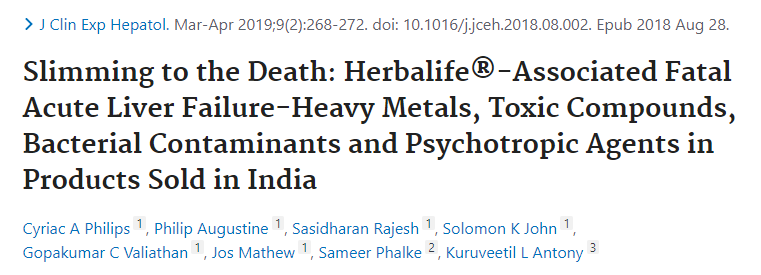
Last year March, I published this article based on my experience wit a patient who died after consuming herbalife products https://t.co/UBZRjWxIKE
So now in the list of QUACKS & AYUSH now we have to deal with these new class of health advisors "GYM Trainers ". They are misguiding youngsters.
— Dr. Thakur Prashant Singh (@drprashant91) December 20, 2020
Recently had a young 25 year Male with "DILI". Bilirubin rising Upto 50 with changes of early Cirrhosis. And guess the culprits? pic.twitter.com/Ws1pZDfE4T
2/
It went viral on @Twitter
This caught eye of the big company who then proceeded to email me directly regarding my study, asking for proof. I said all my data was in the paper (samples sourced samples frm Amazon from an 'associate seller' 4
Analysis of #Herbalife products found:
— Examine.com (@Examinecom) April 29, 2019
- Heavy metals
- Toxic compounds
- Traces of psychotropic drugs
- Highly pathogenic bacteria
Likely contributed to liver failure and the death of a 24-year-old woman, who took 3 Herbalife products for 2 months.https://t.co/iz37caqySQ
3/
They sent a direct letter (written by a prominent professor at Univ of Guelph, Canada / who works with the company) to the publisher #elsevier outlining 'problems' with my study, asking 4 'retraction'. The publisher suggested we provide a rebuttal - which we did, 24 page long.
4/
The rebuttal was strong wit #scientific evidences 2 support our findings, 2 defend their sometimes 'very stupid' concerns. I was astonished it came from a 'professor' & his team. Nonetheless, I did not hear from the Professor or that Univ again. Things calmed down. For a while
5/
Then came a letter to the editor. This time, from a professor working at a company called #planitox which also is funded by Herbalife. Dr Zambrone wrote this letter trying to show weakness in our manuscript. The editor in chief of the journal asked us to reply to that letter.


348,601 "ever-#snus users had about 60% lower Parkinson's disease risk compared with never-snus users."
https://t.co/YHB9FKkUtQ
30,000 British doctors followed for 60 years: "current smokers at baseline had a 30% lower risk of
#MedicalNicotine
Nicotine is beneficial for people with #ADHD. Research on adults and adolescents with ADHD shows that nicotine patches improve focus and attention, and reduce hyperactivity &
ADHD: "Nicotine ...may have properties similar to stimulant medications (e.g., Ritalin) used to treat ADHD. [It] may increase attention and reduce hyperactivity & impulsivity."https://t.co/l9QVnJHBhl#MedicalNicotine #ADHD #ADHDAwareness #Autism #Neurodiversity #Neurodivergent
— ClovisSangrail (@ClovisSangrail4) January 3, 2021
#MedicalNicotine
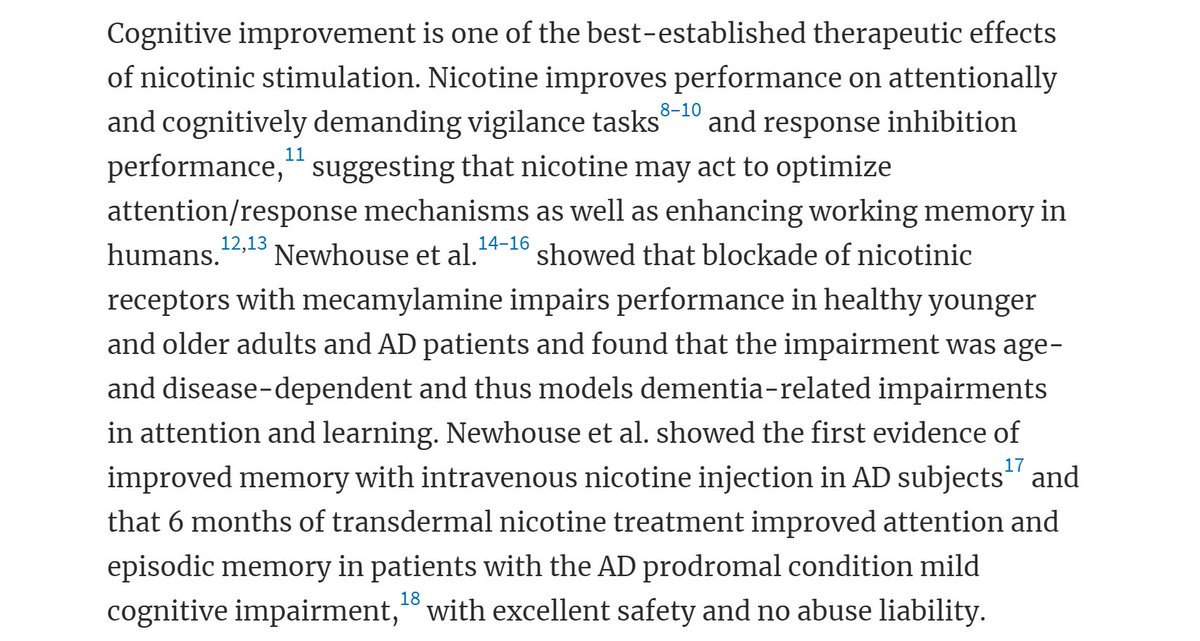
Nicotine reduces symptoms of Alzheimer's disease (AD).
https://t.co/Tht2Y8CZiN
#MedicalNicotine
Nicotine is beneficial for people with schizophrenia. More than 70% of people with schizophrenia smoke.
#SaferNicotine alternatives could help them as therapy, and to not die from
#MedicalNicotine
Nicotine, "(either 2 mg nicotine gum or 7 mg transdermal nicotine patch) potentiates [enhances] the therapeutic properties of neuroleptics in treating Tourette's syndrome... A single patch may be effective for a variable number of






A short 🧵
1/
Public health is not my thing
But Brexit is
And throughout 2019 and 2020 I have been trying to make predictions as to what will happen in that story. Lives do not depend on this, only my professional reputation (marginally) does
2/12
The three series of #BrexitDiagram I made in 2019 were extraordinarily accurate
Series 1/2
https://t.co/wOSzIXxJ2M
Series 3
https://t.co/E4fKeGoa5n
Series 4
https://t.co/yRsQ8mLGj1
Each series got that stage of Brexit right
3/12
The 2020 series was nowhere near as good - at one stage I had No Deal Brexit at 78% chance in early December - and that was not what
I own this error - I was wrong
I know *why* I was wrong - I thought the European Parliament would fight more on Provisional Application, and I thought agreeing everything in a week wouldn't work. I wasn't right
The Manston crisis / borders closing changed something too
5/12


