Let's talk honestly about "informed consent."
Someone with decades of training gives someone with none advice usually packed into 1-3 mins. Huge amount is based on trust. Huge potential for bias built in. But also there is no obligation to provide real alternative options.
MAiD isn't eugenics. The task for the medical profession is to ensure informed consent. Failures on that front should result in enforcement of the law. But Bill C-7 is the result of the existing regime imposing unnecessary, unconstitutional harms by blocked access to MAiD.
— Emmett Macfarlane (@EmmMacfarlane) February 13, 2021
Me: What?
Dr.: They did a MRI first before deciding right?
Me: No
Dr: What did they do??!
Me: Examined me for 2 minutes.
Dr: I am very angry rn. Can't talk.
They ordered a psych consult on me when I told them they ordered the wrong piece of equipment for my disabled body - a thing that was later proven to be true.
A psych consult because I disagreed!
https://t.co/bvYSaXuEtu
More from Health


Now you know I love to sh-t in Harvard. But I also like accuracy. So I decided to go look at Harvard’s catalog to see its lack of military history that this article describes (they only teach history of pets it claims) and what I found shocked me! Shocked me! A thread: 1/
First off, Harvard students literally have multiple sections of military history that they can take listed. (It appears these ones are taught at MIT, so they might have to walk down the street for these) but... 2/

Say they want to stay on campus...they can only take numerous classes on war and diplomacy...3/
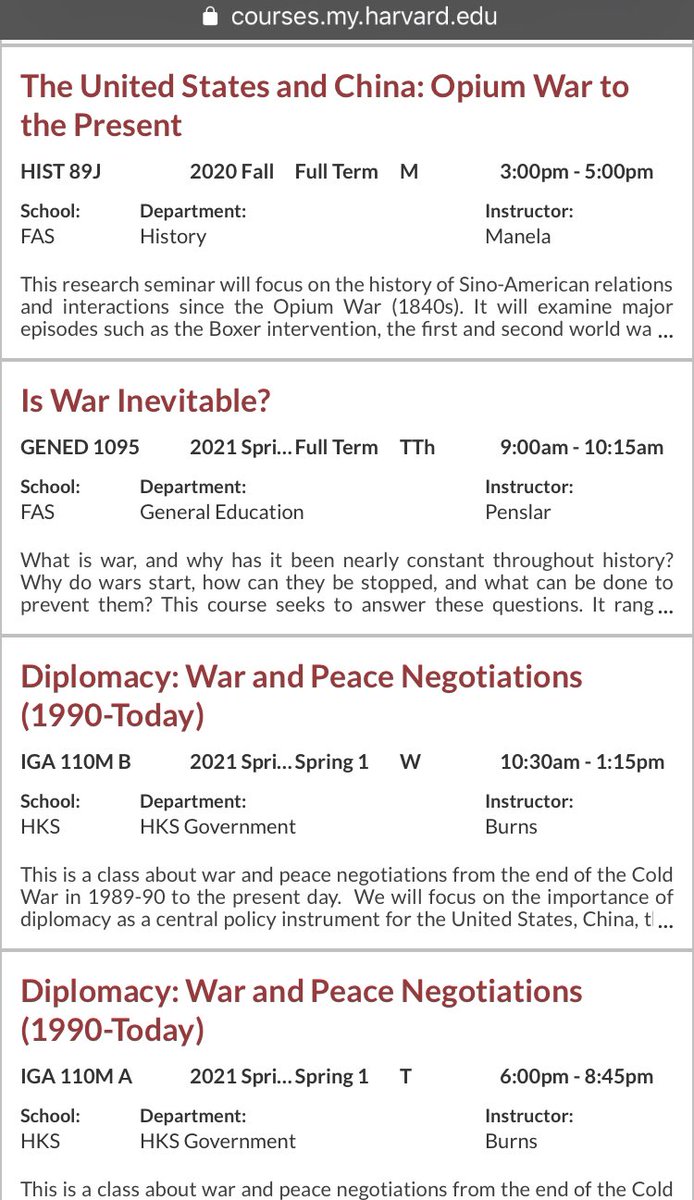
They have an entire class on Yalta. That’s right. An entire class on Yalta. 4/

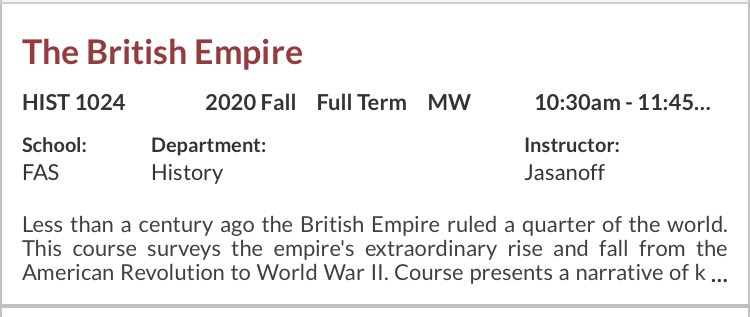
But wait! There is more! They can take the British Empire, The Fall of the Roman Empire for those wanting traditional topics... 5/
\u201cMilitary history\u201d is only in decline if you\u2014like the author & experts in this obnoxious piece\u2014see the subject as a narrowly defined, white dude-oriented, guns & bayonets approach. The field is 1000% better off w/today\u2019s diversity of topics & historians. https://t.co/dUf3OWyVpQ
— Jonathan S. Jones (@_jonathansjones) February 1, 2021
First off, Harvard students literally have multiple sections of military history that they can take listed. (It appears these ones are taught at MIT, so they might have to walk down the street for these) but... 2/
Say they want to stay on campus...they can only take numerous classes on war and diplomacy...3/
They have an entire class on Yalta. That’s right. An entire class on Yalta. 4/
But wait! There is more! They can take the British Empire, The Fall of the Roman Empire for those wanting traditional topics... 5/



@SMILEWithmeNGO Hello @SMILEWithmeNGO I am glad to be here. Thank you for having me.
A very big welcome to everyone joining today’s conversation. Our guest today needs no introduction especially in the sphere of cancer control and advocacy. Welcome @runciecwc
#CheatCervicalCancer
@runciecwc Q1: So Runcie @runciecwc, we see all the amazing work you do as an advocate.
Can you share with us some of the work that you have been doing in cancer control in Nigeria?
#CheatCervicalCancer
@runciecwc That’s amazing. Your work speaks for you. Thanks for all you do.
Q2: What is this @WHO Global Strategy to accelerate the Elimination of CervicalCancer? Can you elaborate on it?
#CheatCervicalCancer
@runciecwc @WHO Q3: In your experience, so far what are the greatest challenges you have identified with cancer control in Nigeria?
#CheatCervicalCancer.
@runciecwc @WHO Q4: Interestingly, we have seen that your organization is part of the Coalition of CSOs against Cervical Cancer in Nigeria, @CervicalCancerN, what is the goal of this Coalition? #CheatCervicalCancer
A very big welcome to everyone joining today’s conversation. Our guest today needs no introduction especially in the sphere of cancer control and advocacy. Welcome @runciecwc
#CheatCervicalCancer
Our First guest is Runcie Chidebe @runciecwc.
— Smile With Me (#CheatCervicalCancer) (@SMILEWithmeNGO) January 31, 2021
He is a patient advocate and global health expert. He is the ED of @projectpinkblue, a cancer nonprofit focused on cancer control in Nigeria. He is engaged in supporting people battling with cancer, fundraising for indigent patients, pic.twitter.com/6tKYkq4h4F
@runciecwc Q1: So Runcie @runciecwc, we see all the amazing work you do as an advocate.
Can you share with us some of the work that you have been doing in cancer control in Nigeria?
#CheatCervicalCancer
@runciecwc That’s amazing. Your work speaks for you. Thanks for all you do.
Q2: What is this @WHO Global Strategy to accelerate the Elimination of CervicalCancer? Can you elaborate on it?
#CheatCervicalCancer
@runciecwc @WHO Q3: In your experience, so far what are the greatest challenges you have identified with cancer control in Nigeria?
#CheatCervicalCancer.
@runciecwc @WHO Q4: Interestingly, we have seen that your organization is part of the Coalition of CSOs against Cervical Cancer in Nigeria, @CervicalCancerN, what is the goal of this Coalition? #CheatCervicalCancer

Thread on how atheism leads to mental retardation (backed with medical citations🧵💉)
To start with, atheism is an unnatural self-contradicting doctrine.
Medical terminology proves that human beings are naturally pre-disposed to believe in God. Oxford scientists assert that people are "born believers".
https://t.co/kE0Fi588yn
https://t.co/OqyXcGIMJn

It should be known that atheism could never produce an intelligently-functioning society and neither ever will.
Contrastingly, Islam produced several intellectuals & polymaths, was on the forefront of scientific development, boasting 100% literacy
It is also scientifically proven that atheism led to lesser scientific curiosity and scientific frauds, which is also why atheists incline to pseudo-science.
Whereas, religion in general and Islam in particular boosted education.
https://t.co/19Onc84u3g

Atheists are also likely to affected by pervasive mental and developmental disorders like high-functioning autism.
Cognitive Scientists and renowned Neurologists found that more atheism is leads to greater autism.
https://t.co/zRjEyFoX3P

To start with, atheism is an unnatural self-contradicting doctrine.
Medical terminology proves that human beings are naturally pre-disposed to believe in God. Oxford scientists assert that people are "born believers".
https://t.co/kE0Fi588yn
https://t.co/OqyXcGIMJn
It should be known that atheism could never produce an intelligently-functioning society and neither ever will.
Contrastingly, Islam produced several intellectuals & polymaths, was on the forefront of scientific development, boasting 100% literacy
If the Muslim world had not existed, there literally would be no technology/achievements today.
— Starks\u262a\ufe0f\U0001f1f9\U0001f1e9 (@MegaIntelIect) January 8, 2021
Science only developed because of Islam, Europe should be grateful to Islam for civilizing their barbaric cult.
Source: The Caliph's Splendor, Pg 204-05 https://t.co/HVypO52Tpc pic.twitter.com/00jYSbaDSs
It is also scientifically proven that atheism led to lesser scientific curiosity and scientific frauds, which is also why atheists incline to pseudo-science.
Whereas, religion in general and Islam in particular boosted education.
https://t.co/19Onc84u3g
Atheists are also likely to affected by pervasive mental and developmental disorders like high-functioning autism.
Cognitive Scientists and renowned Neurologists found that more atheism is leads to greater autism.
https://t.co/zRjEyFoX3P
You May Also Like

1/OK, data mystery time.
This New York Times feature shows China with a Gini Index of less than 30, which would make it more equal than Canada, France, or the Netherlands. https://t.co/g3Sv6DZTDE
That's weird. Income inequality in China is legendary.
Let's check this number.
2/The New York Times cites the World Bank's recent report, "Fair Progress? Economic Mobility across Generations Around the World".
The report is available here:
3/The World Bank report has a graph in which it appears to show the same value for China's Gini - under 0.3.
The graph cites the World Development Indicators as its source for the income inequality data.
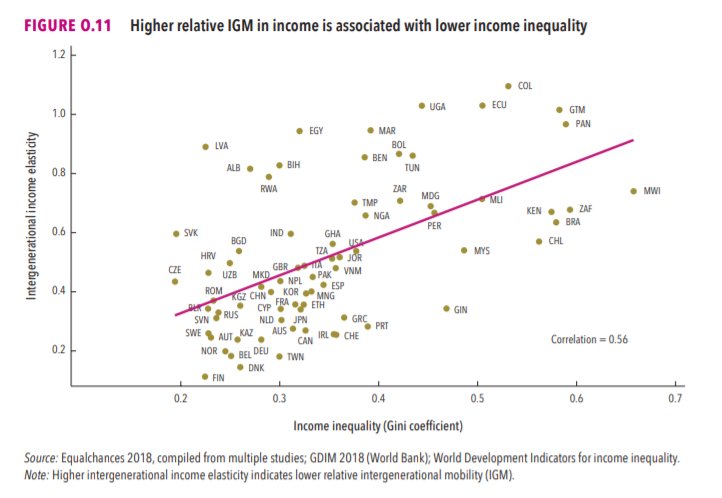
4/The World Development Indicators are available at the World Bank's website.
Here's the Gini index: https://t.co/MvylQzpX6A
It looks as if the latest estimate for China's Gini is 42.2.
That estimate is from 2012.
5/A Gini of 42.2 would put China in the same neighborhood as the U.S., whose Gini was estimated at 41 in 2013.
I can't find the <30 number anywhere. The only other estimate in the tables for China is from 2008, when it was estimated at 42.8.
This New York Times feature shows China with a Gini Index of less than 30, which would make it more equal than Canada, France, or the Netherlands. https://t.co/g3Sv6DZTDE
That's weird. Income inequality in China is legendary.
Let's check this number.
2/The New York Times cites the World Bank's recent report, "Fair Progress? Economic Mobility across Generations Around the World".
The report is available here:
3/The World Bank report has a graph in which it appears to show the same value for China's Gini - under 0.3.
The graph cites the World Development Indicators as its source for the income inequality data.
4/The World Development Indicators are available at the World Bank's website.
Here's the Gini index: https://t.co/MvylQzpX6A
It looks as if the latest estimate for China's Gini is 42.2.
That estimate is from 2012.
5/A Gini of 42.2 would put China in the same neighborhood as the U.S., whose Gini was estimated at 41 in 2013.
I can't find the <30 number anywhere. The only other estimate in the tables for China is from 2008, when it was estimated at 42.8.