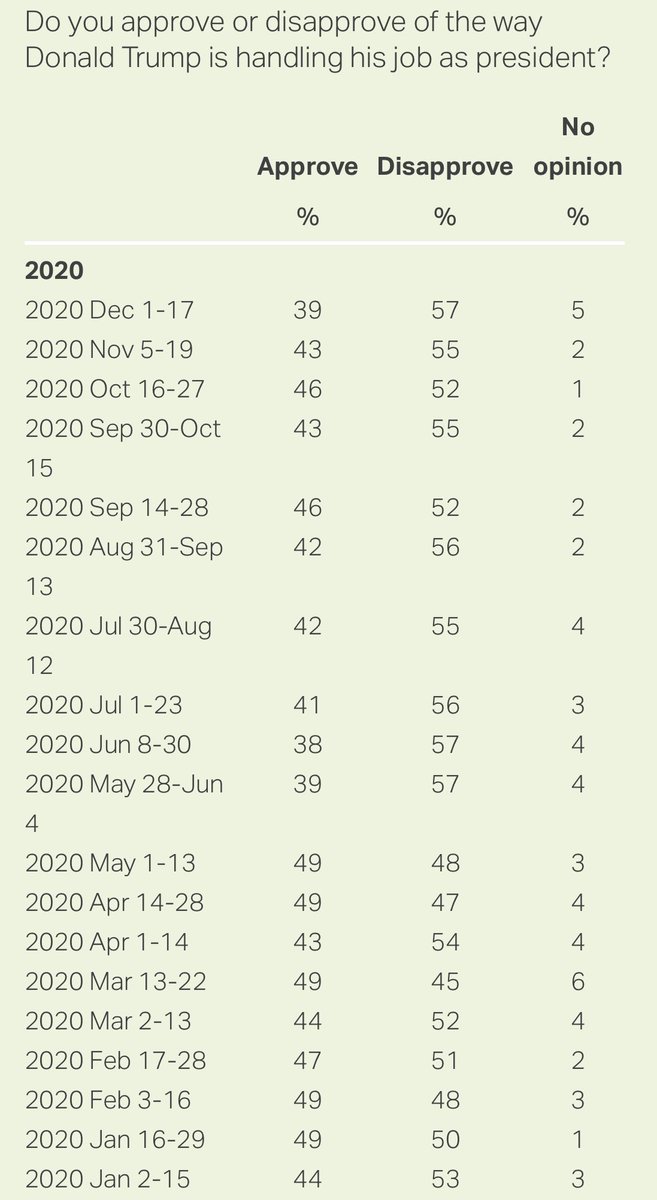
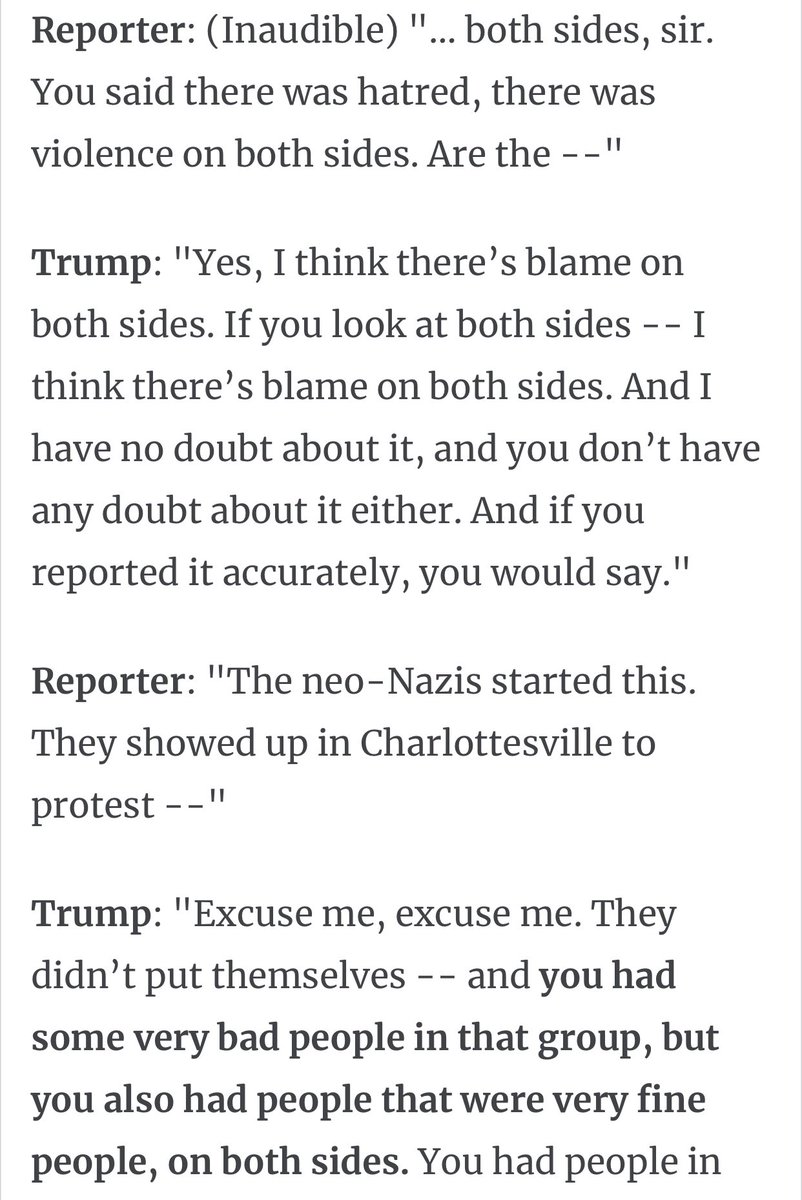
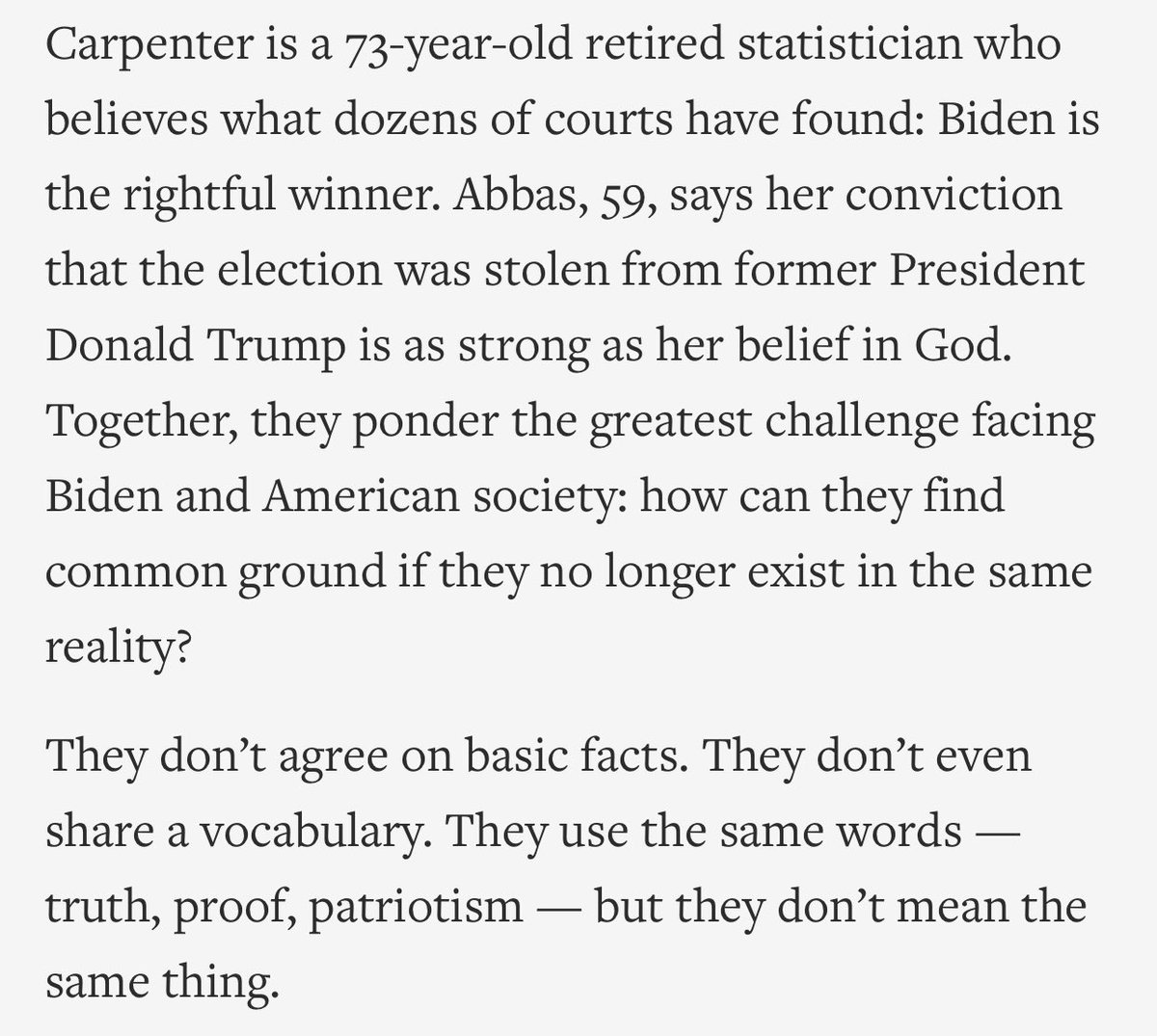
This is what happens when the Trump cultists refuse to acknowledge anything outside their extremely insular bubble: they can’t grasp that the majority of the country thinks he sucks and voted him out.

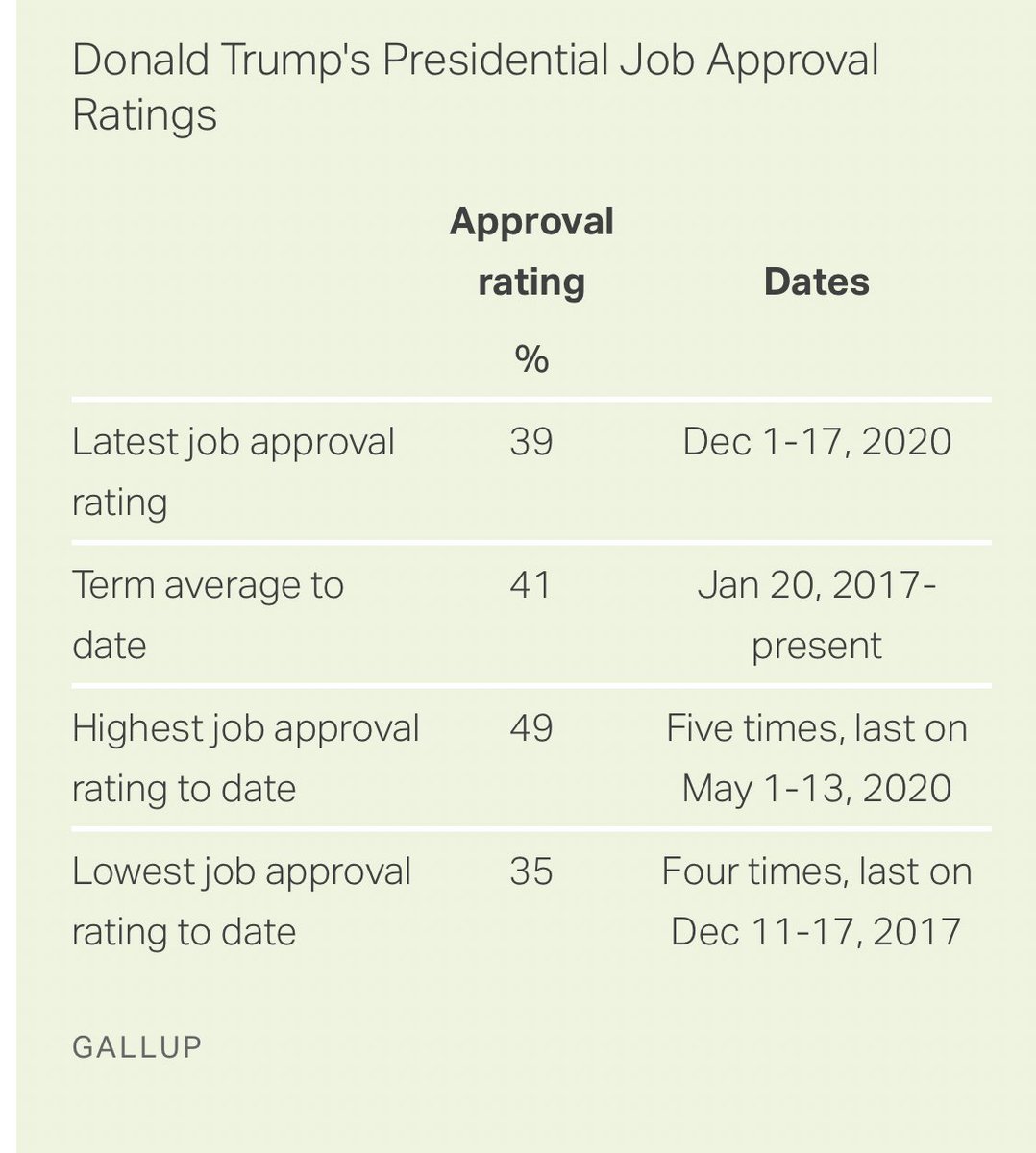
Not once in 4 years of Gallup’s 3-day tracking of Trump’s approval rating was it ever higher than 49%.

He was the least popular incumbent since Carter to run for re-election. It’s not shocking that he got his ass kicked in the election. https://t.co/7BSCQR2vI2
But if you do nothing other than consume conservative media, you’d be under the false impression that he’s popular, that his ideas are popular, and that the people who oppose him are a small group of haters.
In Gallup’s last update before the election, Trump had a -6 net approval rating. The last time it was a net positive was in May when it was +1.
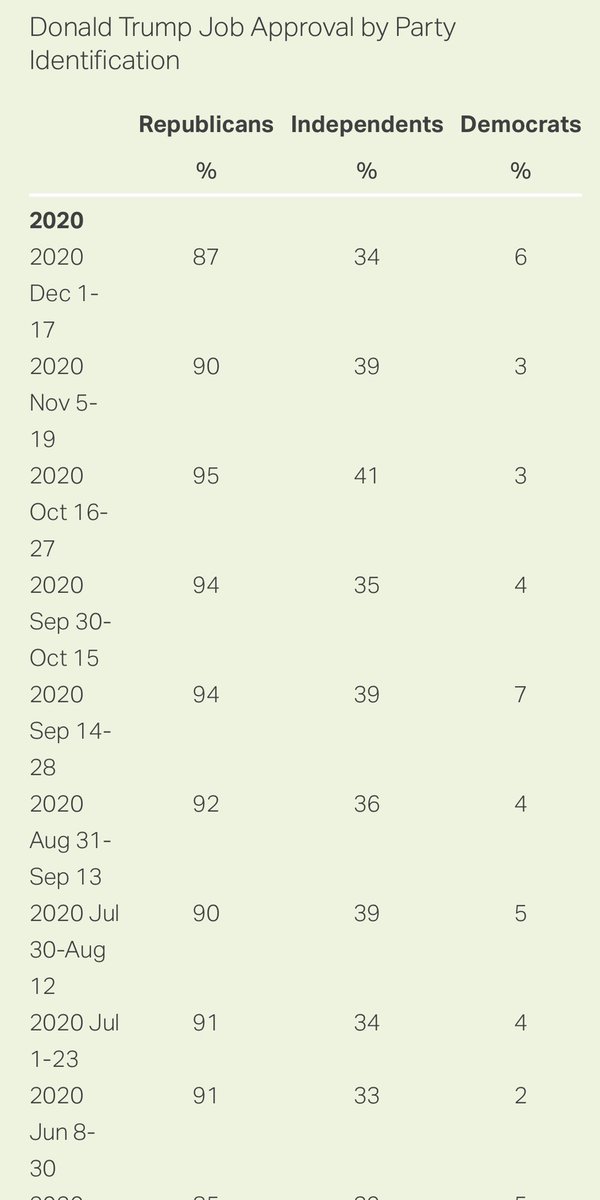
And here’s how you get numbers like that: you do absolutely nothing to try to win over people who aren’t already part of your base. Look at those numbers among independents.
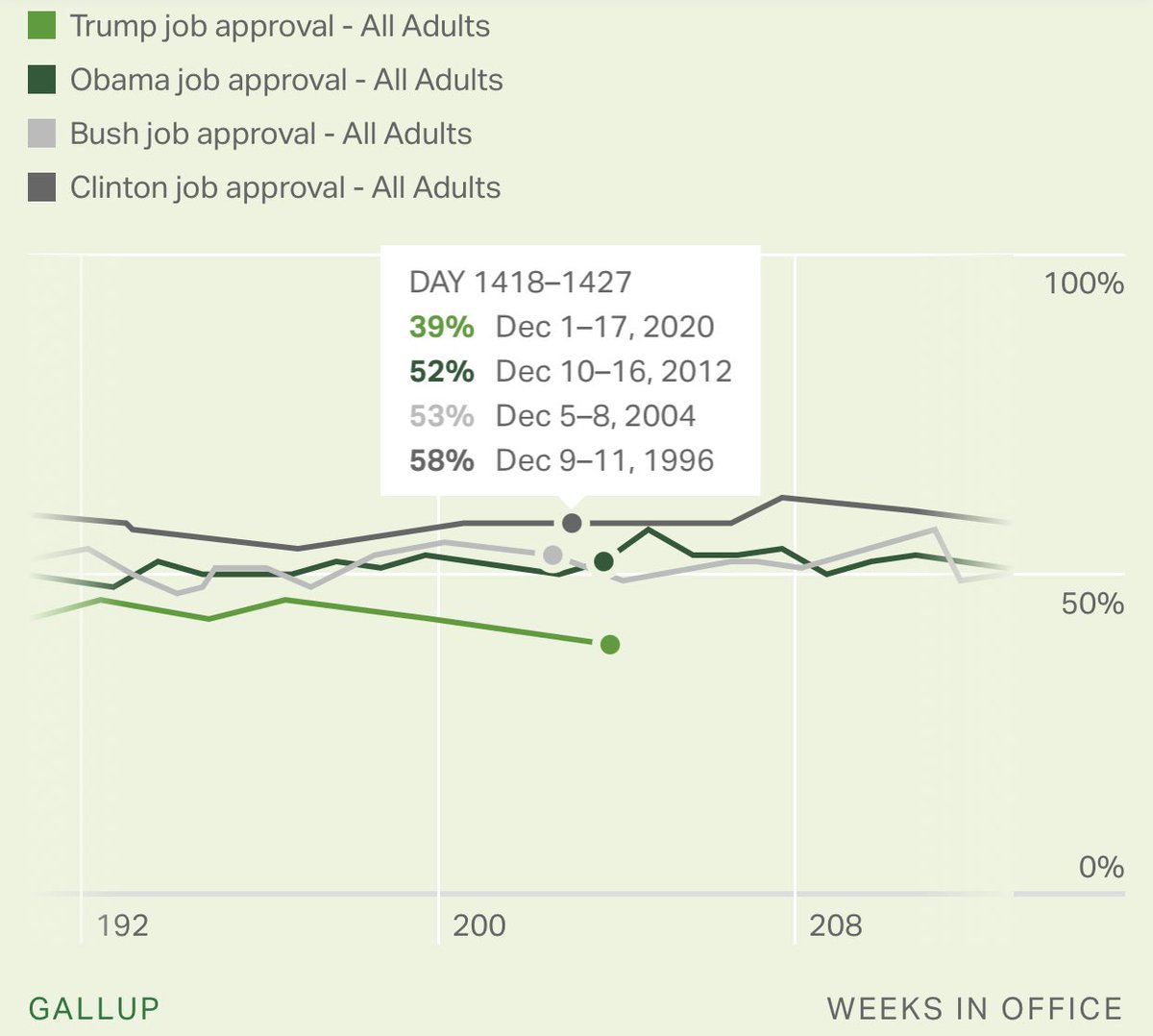
Just look how he compared to each of the previous 3 presidents at this point.

He banked on the Electoral College being tilted enough in favor of red states to get him re-elected. Turns out that it’s not “get 39% approval rating POTUS re-elected” level tilted.
Each of these “can you BELIEVE Biden got x number of votes more than Obama?!” takes ignore a.) population growth, and b.) highest turnout ever because people really, really wanted to kick him out of office because he’s wildly unpopular
You could tell me that a ham sandwich got 85 million votes, and as long as it was running against Trump, I’d think, “Yeah, that tracks.”
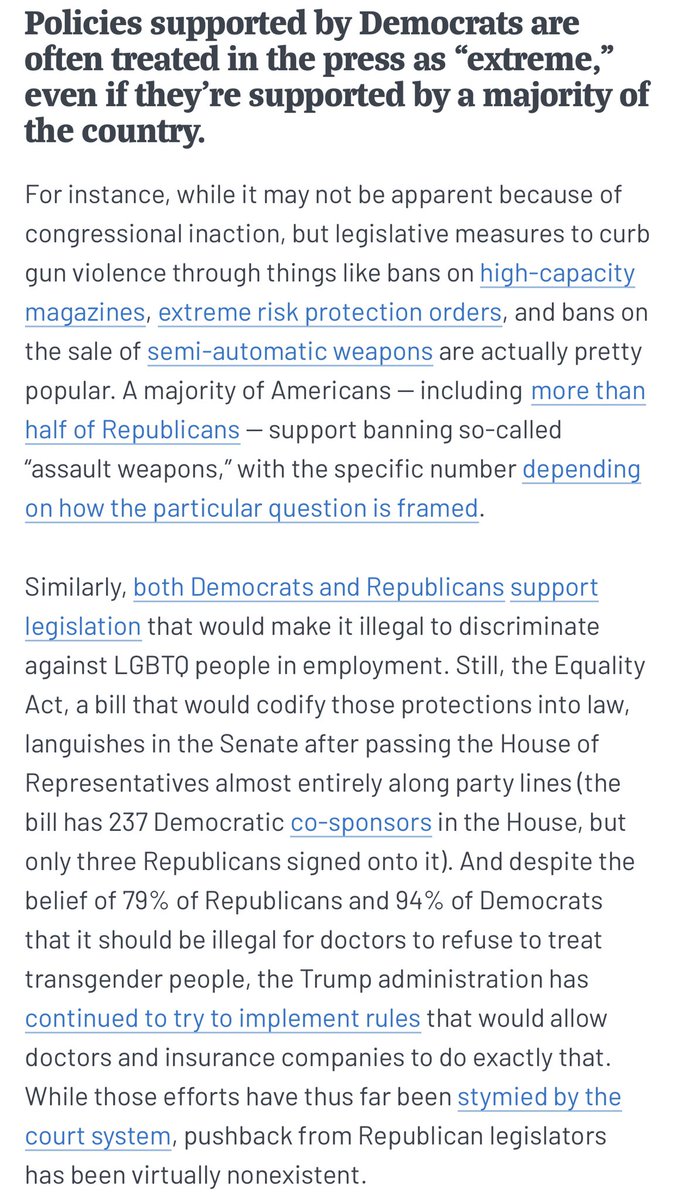
A few months ago, I wrote a piece that just took stock of how a.) Democratic policies tend to be much more popular than Republican ones, and b.) how despite this, Dems are the ones more often referred to in mainstream media as “extreme.” https://t.co/e6sZWFm45C
On this point, I think it’s worth exploring why it is that the press constantly scolds Democrats for supporting progressive policies are “out of step with America,” while those are policies are actually pretty popular. https://t.co/4KGMzeOuFV
Trump spent his time in office fighting for policies that *barely* even played well with Republican voters. For instance, he devoted time and resources to enacting policies about trans people in the military or accessing healthcare. https://t.co/CV3871q9Ai https://t.co/6qKK7wq023
The tl;dr is that Trump probably would have done better had he not obsessed with right-wing culture war crap and instead just worked on, you know, trying to govern as though he wants the support of everyone.
Like hey, you know what's actually really popular but is constantly treated like the most extreme policy on the face of the earth? Taxing the rich https://t.co/bQVPLiFrKb
And you know what wasn't popular? Trump's tax cut. https://t.co/e6sZWFm45C

If you're wondering why the framing of these things are often so tilted to show GOP policies as mainstream and Dem policies as extreme, it's media decision-makers looking out for their own interests.

More from Parker Molloy

If you're curious what Trump's defense will look like, all you have to do is turn on Fox News. My latest at @mmfa

The tl;dr is that for years right-wing media have been excusing Trump's violent rhetoric by going, "Yes, but THE DEMOCRATS..." and then bending themselves into knots to pretend that Dems were calling for violence when they very, very clearly weren't.

And in fact, this predates Trump.

In 2008, Obama was talking about not backing down in the face of an ugly campaign. He said "If they bring a knife to the fight, we bring a gun."

https://t.co/i5YaQJsKop


That quote was from the movie The Untouchables. And there's no way anybody reading that quote in good faith could conclude that he was talking about actual guns and knives. But it became a big talking point on the

In 2018, Obama-era Attorney General Eric Holder was speaking to a group of Georgia Democrats about GOP voter suppression. He riffed on Michelle Obama's "When they go low, we go high" line from the 2016 DNC.
This is what pisses me off about the constant bad faith victimhood crap people on the right do:

1. They wildly misrepresent something innocuous (no, Pelosi did not “ban” anything).

2. They come up with a “gotcha” example of hypocrisy... that relies on their misrepresentation.


This same exact nonsense gets trotted out constantly. “Oh, so now we’re not allowed to call ourselves husbands or mothers or uncles or aunts or men or women?! Outrage!” But no one at all is doing that, nor have they ever been doing that.

Yet the right loses its shit over this every few months. A lot of the time it’ll be something like... a lawmaker will introduce a bill that would tweak applications for marriage licenses to say “spouse 1” and “spouse 2” instead of just “husband/wife” because the status quo ...

... will have been creating actual legal issues for gay couples who then have to put something false on legal documents designating one of them as “wife.”

It’ll be something like that, just meant to fix an issue that has no material impact on 99% of people.

And the right, like clockwork, will lose their minds over it as though anyone is trying to “ban” the concept of someone being a husband or a wife or a man or a woman or whatever.

From a few years back, here’s Bill O’Reilly doing that
There are a number of reasons bills like these are wrongheaded. One is that it tries to implement the same kind of one-size-fits-all solution that opponents of trans inclusion claim to oppose.

But let’s get nuanced for a minute...


Do trans women and girls have an advantage in sports over other women and girls?

I’m here to provide a very unsatisfying answer: It depends.

What sport are we talking about?

How old are people competing in it?

What sort of hormone treatment has the person in question had and for how long?

Those are all factors that play into the fairness question.

Trying to implement broad policies in the name of ensuring fairness can actually have the opposite of the intended effect.

Take the case of Mack Beggs.

A few years back, Beggs was a high school student in Texas. He was a wrestler, and wanted to do it at the college level.

Beggs is a trans man, meaning his birth certificate said female on it. Like many trans guys, he takes testosterone as part of his medical transition.

He wanted to wrestle. Specifically, he wanted a spot on his school’s boys team.

He wasn’t allowed.

More from Government

The Government is making the same mistakes as it did in the first wave. Except with knowledge.

A thread.


The Government's strategy at the beginning of the pandemic was to 'cocoon' the vulnerable (e.g. those in care homes). This was a 'herd immunity' strategy. This interview is from


This strategy failed. It is impossible to 'cocoon' the vulnerable, as Covid is passed from younger people to older, more vulnerable people.

We can see this playing out through heatmaps. e.g. these heatmaps from the second


The Government then decided to change its strategy to 'preventing a second wave that overwhelms the NHS'. This was announced on 8 June in Parliament.

This is not the same as 'preventing a second wave'.

https://t.co/DPWiJbCKRm


The Academy of Medical Scientists published a report on 14 July 'Preparing for a Challenging Winter' commissioned by the Chief Scientific Adviser that set out what needed to be done in order to prevent a catastrophe over the winter

You May Also Like

1/ Some initial thoughts on personal moats:

Like company moats, your personal moat should be a competitive advantage that is not only durable—it should also compound over time.

Characteristics of a personal moat below:


2/ Like a company moat, you want to build career capital while you sleep.

As Andrew Chen noted:


3/ You don’t want to build a competitive advantage that is fleeting or that will get commoditized

Things that might get commoditized over time (some longer than


4/ Before the arrival of recorded music, what used to be scarce was the actual music itself — required an in-person artist.

After recorded music, the music itself became abundant and what became scarce was curation, distribution, and self space.

5/ Similarly, in careers, what used to be (more) scarce were things like ideas, money, and exclusive relationships.

In the internet economy, what has become scarce are things like specific knowledge, rare & valuable skills, and great reputations.