THREAD
There’s much debate around the UK's recommended use of the AZ vaccine with a two-dose schedule and flexible timing of second dose. Some thoughts on the AZ recommendation (not Pfizer) based on available data with refs to some excellent threads.

UK’s MHRA and JCVI are highly-experienced in vaccine assessments and recommendations, and they've surely weighed the benefits & risks of this recommendation carefully. That said, it would be good to see all the data underpinning their recommendation. 2/
https://t.co/NRcHbYxRIw
In general, vaccines should be taken on a schedule tested in an efficacy trial. But it wasn’t possible to conduct the typical dose and schedule optimization prior to these Ph3 trials, and those trials provided valuable data to inform these recommendations. 3/
The UK recommends a two-dose schedule, with the second dose between 4-12 weeks. This *is not* a single dose schedule. Given the data provided, and in the setting of limited supply, overstretched hospitals, and emergence of a more transmissible variant, this seems justifiable. 4/
The UK has important data on the AZ Vx that wasn’t available for Pfizer & Moderna at FDA's VRBPAC, including:
* single-dose efficacy through 4+ months; and
* single-dose immunogenicity (12+ weeks). 5/
https://t.co/vtbviE9VEx
The data shows the AZ vaccine maintains efficacy in the setting of a delayed second dose, although it’s not clear how fast this wanes over time. Delay of the second dose provides a better booster effect as measured by antibody levels, which is seen with other vaccines. 6/
The second dose is important because it can drive a more robust and higher quality antibody response through a process called affinity maturation. It's well-understood that longer intervals can provide a better boost. 7/ https://t.co/cqKIpomUHg
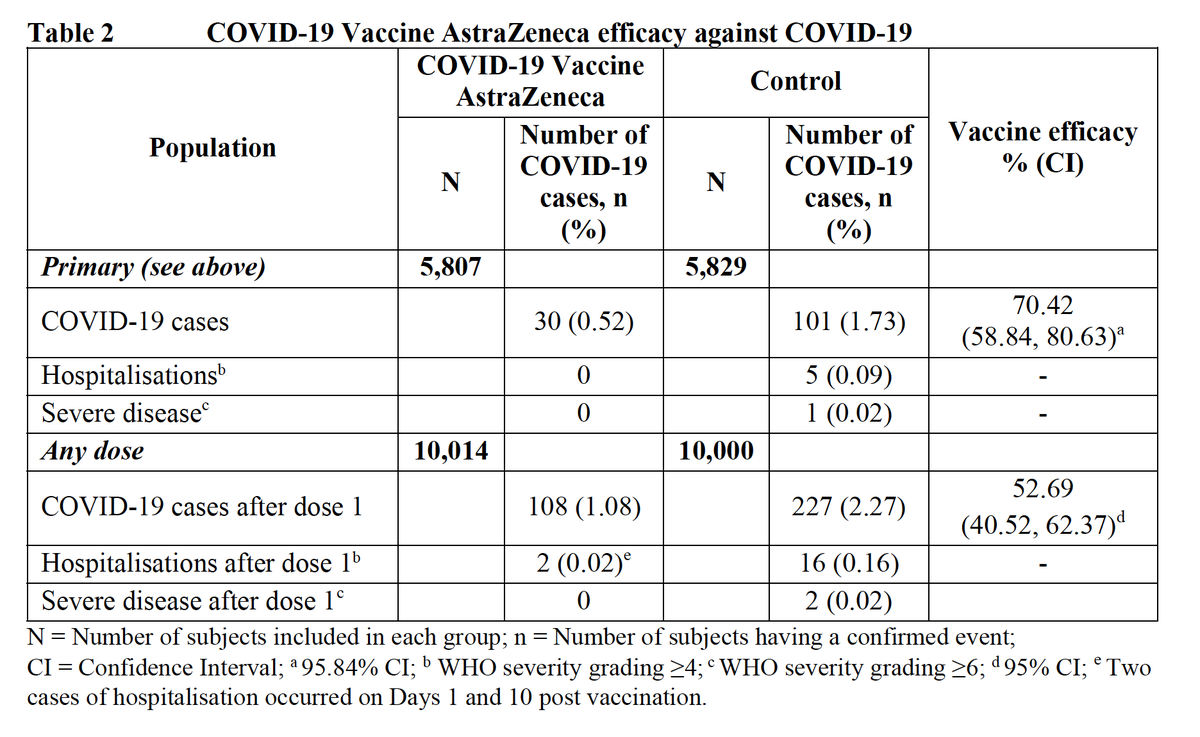
In my view, the immediate priority is prevention of severe disease that drives deaths and the strain on health systems. Efficacy against severe disease is likely better than overall vaccine efficacy. Data after the first dose is promising although the numbers are small. 8/
There’s nothing magic about the (short) 28d interval between doses, which was presumably chosen to ensure rapid onset of protection in Ph3. Vaccine efficacy won't disappear overnight with a delayed 2nd dose - it will wane over time, if at all. Ph3 data supports that concept. 9/
Yes there are risks of waning immunity, non-compliance with the second dose, confusion among the public, etc. Many are implementation considerations that can be addressed with planning and strong communication. 10/
It will be critically important to collect efficacy data around this “flexible second dose” schedule, esp in older adults & against severe disease, to inform licensure and recommendations in countries around the world that are counting on the introduction of this vaccine. 11/
Yes the AZ/Oxford studies had a number of issues, but we must remember that this highly-complex development program was executed in less than a year. And that Pfizer & Moderna's Ph3 execution & vaccine efficacy created very high expectations for all subsequent programs. 12/
The bottom line is that every country needs to make difficult policy decisions with the data they have, not what they'd like to have. There's no perfect answer here, but now that a decision has been taken, the UK can focus on maximizing the benefit and mitigating any risks. 13/

More from Government

You May Also Like

THREAD: 12 Things Everyone Should Know About IQ

1. IQ is one of the most heritable psychological traits – that is, individual differences in IQ are strongly associated with individual differences in genes (at least in fairly typical modern environments). https://t.co/3XxzW9bxLE


2. The heritability of IQ *increases* from childhood to adulthood. Meanwhile, the effect of the shared environment largely fades away. In other words, when it comes to IQ, nature becomes more important as we get older, nurture less.
https://t.co/UqtS1lpw3n


3. IQ scores have been increasing for the last century or so, a phenomenon known as the Flynn effect. https://t.co/sCZvCst3hw (N ≈ 4 million)

(Note that the Flynn effect shows that IQ isn't 100% genetic; it doesn't show that it's 100% environmental.)


4. IQ predicts many important real world outcomes.

For example, though far from perfect, IQ is the single-best predictor of job performance we have – much better than Emotional Intelligence, the Big Five, Grit, etc. https://t.co/rKUgKDAAVx https://t.co/DWbVI8QSU3


5. Higher IQ is associated with a lower risk of death from most causes, including cardiovascular disease, respiratory disease, most forms of cancer, homicide, suicide, and accident. https://t.co/PJjGNyeQRA (N = 728,160)
Moderna CEO Stephane Bancel was previously CEO of bioMerieux in France from 07-10.

Alain Merieux, who owns bioMerieux, was instrumental in the creation of the Wuhan Institute of Virology P4 Lab.

The same people who helped create the virus, also helped to create the vaccines...


Moderna partnered with French Pasteur Institute in 2015 to develop mRNA vaccine technology.

Pasteur Institute partnered with the Wuhan P4 Laboratory in 2017 along with the Merieux Foundation to study emerging viruses...
https://t.co/yFsHwrNYaK
https://t.co/9M5lydBKhM


Nobel prize winning scientist Luc Montagnier asserts that Sars-Cov-2 is man-made and originated from the Wuhan Institute of Virology.

Montagnier did extensive work with the Pasteur Institute in France which was partnered with the Wuhan P4.

Merieux Foundation & the Chinese government have worked together since 1965, and partnered to study emerging pathogens in Africa in 2015.

Their research included "PATHOGENS CARRIED BY BATS" that provoke respiratory diseases.

🚨🚨🚨
https://t.co/gVwpT0ssqI