
The big story in Parliament today really isn't which of three bad options the Opposition parties will choose. It is the absolute travesty of parliamentary democracy that is about to play out: a microcosm of the shattering effect Brexit has had on our constitution. [THREAD]
Third, the general implementation powers contained in cl 31 allow ministers to make any law that is required to implement the agreement by regulations - and that this power can be used to do anything an Act of Parliament can do (including amend the bill/Act itself).
— Jeff King (@jeff_a_king) December 30, 2020
More from Robert Saunders
This article, on the repeal of the Fixed Term Parliaments Act, raises a question that needs more public discussion: who wields the historic powers of the Crown once the monarchy is no longer politically active? Should there be *any* limit on their use by a prime minister? THREAD
2. Some of the highest powers of the British state still technically belong to the Crown: from declaring war & making treaties to suspending Parliament. Those powers are now exercised "on the advice of the PM". But they do not *belong* to the PM, & might, in theory, be withheld.
3.For example: the 1950 "Lascelles Principles" set out three conditions under which a monarch might refuse to dissolve Parliament (a "Royal Prerogative" pre-2011). Others might include "when the Oppn is in the middle of a leadership contest" or "when electoral fraud is suspected"
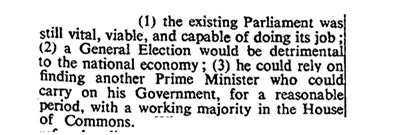
4. In effect, the monarchy became the "emergency brake" of the constitution. It could not exercise these powers itself, but it could stop a govt from doing so. It could deny a PM access to the "nuclear weapons" of the constitution: like the power to declare war or suspend Parlt.
5.This was never a very satisfactory brake. It relied on one person with no democratic authority, who might be inept, corrupt or Prince Andrew. And as Britain evolved from a "constitutional" to a "ceremonial" monarchy, it grew ever less likely that a monarch would actually use it
ON THE BLOG: The Dissolution and Calling of Parliament Bill \u2013 a return to constitutional normality?
— Constitution Unit (@ConUnit_UCL) August 1, 2021
Professor Alison Young, of @cambridgelaw, argues that it is wrong to place the blame for the extraordinary events of 2019 on the provisions of the FTPA.https://t.co/yYWEEOF1Td
2. Some of the highest powers of the British state still technically belong to the Crown: from declaring war & making treaties to suspending Parliament. Those powers are now exercised "on the advice of the PM". But they do not *belong* to the PM, & might, in theory, be withheld.
3.For example: the 1950 "Lascelles Principles" set out three conditions under which a monarch might refuse to dissolve Parliament (a "Royal Prerogative" pre-2011). Others might include "when the Oppn is in the middle of a leadership contest" or "when electoral fraud is suspected"
4. In effect, the monarchy became the "emergency brake" of the constitution. It could not exercise these powers itself, but it could stop a govt from doing so. It could deny a PM access to the "nuclear weapons" of the constitution: like the power to declare war or suspend Parlt.
5.This was never a very satisfactory brake. It relied on one person with no democratic authority, who might be inept, corrupt or Prince Andrew. And as Britain evolved from a "constitutional" to a "ceremonial" monarchy, it grew ever less likely that a monarch would actually use it
There are important differences between Trump and Johnson, but I'm wary of the idea that Johnson is "liberal" and Trump "authoritarian". I fear this overstates Johnson's "liberalism", and risks missing the warning lights that should now be flashing across British politics. THREAD
2. It's true that Johnson has a "libertarian" streak: he dislikes rules, taxes, "red tape", "do-gooders" and the "nanny state". But so does Trump. Indeed, Trump goes much further on this, presenting masks, lockdowns, gun control, taxes & environmentalism as a danger to "freedom".
3. Johnson is not morally conservative, but nor is Trump. Neither much cares what people do in private, & neither sets much store by "conservative" moral norms on truth, fidelity or sexual continence. (Tories used to call this "licence", not "liberalism", but it's common to both)
4. Johnson might, personally, be more "liberal" on immigration than Trump, but he's been no less quick to weaponize the issue for political gain. The demand to "Take Back Control of our Borders" was as central to Johnson's victory in 2016 as "Build the Wall" was to Trump's.
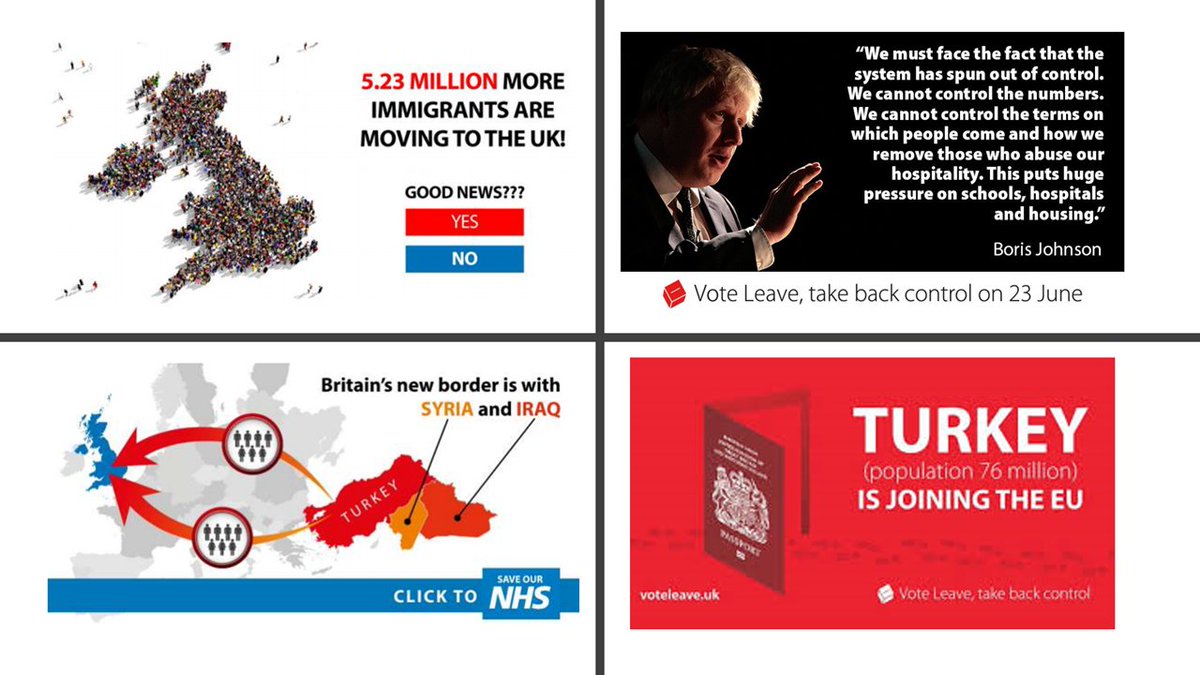
5. Johnson is not, like Trump, an instinctive protectionist. But he was happy to lead a nationalist insurgency against the UK's biggest free trade arrangement, and stoked support for a "no deal" Brexit that would have involved huge tariff increases. To quote an earlier leader...
Good piece on lazy "Boris is Trump" nonsense. I'd go further. Johnson is socially liberal at heart, Trump is authoritarian. Johnson is instinctive free trader, Trump is protectionist. Johnson is pro-migration at heart, Trump is xenophobe https://t.co/RGom19xSfx
— Matt Goodwin (@GoodwinMJ) January 7, 2021
2. It's true that Johnson has a "libertarian" streak: he dislikes rules, taxes, "red tape", "do-gooders" and the "nanny state". But so does Trump. Indeed, Trump goes much further on this, presenting masks, lockdowns, gun control, taxes & environmentalism as a danger to "freedom".
3. Johnson is not morally conservative, but nor is Trump. Neither much cares what people do in private, & neither sets much store by "conservative" moral norms on truth, fidelity or sexual continence. (Tories used to call this "licence", not "liberalism", but it's common to both)
4. Johnson might, personally, be more "liberal" on immigration than Trump, but he's been no less quick to weaponize the issue for political gain. The demand to "Take Back Control of our Borders" was as central to Johnson's victory in 2016 as "Build the Wall" was to Trump's.
5. Johnson is not, like Trump, an instinctive protectionist. But he was happy to lead a nationalist insurgency against the UK's biggest free trade arrangement, and stoked support for a "no deal" Brexit that would have involved huge tariff increases. To quote an earlier leader...
It is right to ask *why* industries like fishing have declined. The problem is the blithe assumption that the answer must always be "because of the EU". The problems facing the UK fishing industry long predate EU membership, and will not be magically solved by Brexit. [THREAD]
1. Fishing had been declining for much of the twentieth century. The number of UK fishermen more than halved in mid-century: from nearly 48,000 in 1938 to 21,000 in 1970. By 1970 - the year *before* the UK signed the Treaty of Accession - fishing made up less than 0.1% of UK GDP.
2. That decline had many causes. A century of over-fishing had left stocks dangerously depleted. Younger generations were moving out, in search of safer and better-paid work inland. And the "Cod Wars" with Iceland (1958-76) triggered the collapse of the Atlantic trawler fleet.
3. The "Cod Wars", in which Iceland expelled GB trawlers from its waters, were a grim reminder (a) that other states have sovereignty too & (b) that power-politics still exist outside the EU. For Cold-War reasons, the US backed Iceland. The UK had to fold. https://t.co/t8wdvtCgMb
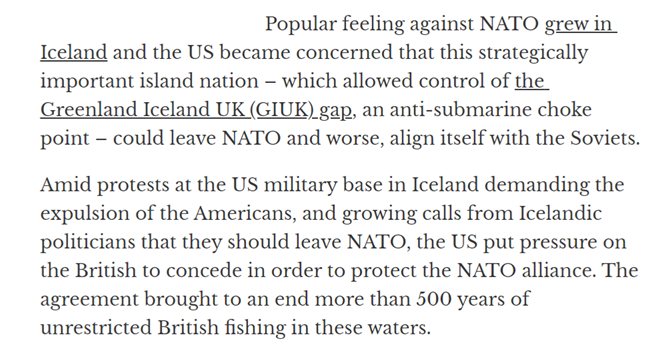
4. There were other challenges, too. In the early 1970s, Norway & Iceland were dumping large quantities of frozen fish on the British market, driving down prices for domestic suppliers. The fishing fleet badly needed investment for modernisation but was struggling to raise funds.
After all these years... remainers still go "AH HA but fishing is a tiny contribution to the economy".. Well why might that be? Why has it withered? Why has it become a totemic issue in our relationship with Brussels? Yes it is tiny now. But for millions that's the sodding point.
— Harry Cole (@MrHarryCole) December 17, 2020
1. Fishing had been declining for much of the twentieth century. The number of UK fishermen more than halved in mid-century: from nearly 48,000 in 1938 to 21,000 in 1970. By 1970 - the year *before* the UK signed the Treaty of Accession - fishing made up less than 0.1% of UK GDP.
2. That decline had many causes. A century of over-fishing had left stocks dangerously depleted. Younger generations were moving out, in search of safer and better-paid work inland. And the "Cod Wars" with Iceland (1958-76) triggered the collapse of the Atlantic trawler fleet.
3. The "Cod Wars", in which Iceland expelled GB trawlers from its waters, were a grim reminder (a) that other states have sovereignty too & (b) that power-politics still exist outside the EU. For Cold-War reasons, the US backed Iceland. The UK had to fold. https://t.co/t8wdvtCgMb
4. There were other challenges, too. In the early 1970s, Norway & Iceland were dumping large quantities of frozen fish on the British market, driving down prices for domestic suppliers. The fishing fleet badly needed investment for modernisation but was struggling to raise funds.
"3 million people are estimated not to have official photo ID, with ethnic minorities more at risk". They will "have to contact their council to confirm their ID if they want to vote"
This is shameful legislation, that does nothing to tackle the problems with UK elections.THREAD
There is no evidence in-person voter fraud is a problem, and it wd be near-impossible to organise on an effective scale. Campaign finance violations, digital disinformation & manipulation of postal voting are bigger issues, but these are crimes of the powerful, not the powerless.
In a democracy, anything that makes it harder to vote - in particular, anything that disadvantages one group of voters - should face an extremely high bar. Compulsory voter ID takes a hammer to 3 million legitimate voters (disproportionately poor & BAME) to crack an imaginary nut
If the government is concerned about the purity of elections, it should reflect on its own conduct. In 2019 it circulated doctored news footage of an opponent, disguised its twitter feed as a fake fact-checking site, and ran adverts so dishonest that even Facebook took them down.
Britain's electoral law largely predates the internet. There is little serious regulation of online campaigning or the cash that pays for it. That allows unscrupulous campaigners to ignore much of the legal framework erected since the C19th to guard against electoral misconduct.
This is shameful legislation, that does nothing to tackle the problems with UK elections.THREAD
Millions of people do not have photo ID. By forcing through mandatory voter-ID the government risk disenfranchising millions of legitimate voters. https://t.co/y0Upzof2FI
— Electoral Reform Society (@electoralreform) February 17, 2021
There is no evidence in-person voter fraud is a problem, and it wd be near-impossible to organise on an effective scale. Campaign finance violations, digital disinformation & manipulation of postal voting are bigger issues, but these are crimes of the powerful, not the powerless.
In a democracy, anything that makes it harder to vote - in particular, anything that disadvantages one group of voters - should face an extremely high bar. Compulsory voter ID takes a hammer to 3 million legitimate voters (disproportionately poor & BAME) to crack an imaginary nut
If the government is concerned about the purity of elections, it should reflect on its own conduct. In 2019 it circulated doctored news footage of an opponent, disguised its twitter feed as a fake fact-checking site, and ran adverts so dishonest that even Facebook took them down.
Britain's electoral law largely predates the internet. There is little serious regulation of online campaigning or the cash that pays for it. That allows unscrupulous campaigners to ignore much of the legal framework erected since the C19th to guard against electoral misconduct.
If anyone thinks this is a good faith proposal, designed to secure democratic consent for changes to public monuments, let's look at what Robert Jenrick said four months ago about the procedures he is about to impose. [THREAD]
2. In a speech last September, Jenrick complained that "the planning system is broken". Only "1% of people" had "the esoteric knowledge to navigate [its] arcane and protracted world", shutting out those "who don’t have the time to contribute to the lengthy and archaic process".
3. If campaigners make it through that process (which Jenrick himself calls "as inconsistent as it is slow") more barriers lie ahead. "I will not hesitate to use my powers as Secretary of State" to enforce the view, to "be set out in law", that statues should "almost always" stay
4. When this govt wants councils to do something - like building houses - it invariably overrides the planning system. When it wants to *stop* them doing something - like moving statues - it enforces it. This is not an attempt to democratise change. It's an attempt to obstruct it
5.If the goal were to prevent direct action against statues, blocking lawful & constitutional avenues for change would be a foolish way of doing it. As I wrote here, we need good faith mechanisms where the case for change can be argued & contested lawfully
Robert Jenrick is to change the law so that historic statues, plaques, memorials or monuments cannot be removed without going through a formal planning process.
— Christopher Hope\U0001f4dd (@christopherhope) January 16, 2021
Twelve thousand statues are covered by the law changes.
2. In a speech last September, Jenrick complained that "the planning system is broken". Only "1% of people" had "the esoteric knowledge to navigate [its] arcane and protracted world", shutting out those "who don’t have the time to contribute to the lengthy and archaic process".
3. If campaigners make it through that process (which Jenrick himself calls "as inconsistent as it is slow") more barriers lie ahead. "I will not hesitate to use my powers as Secretary of State" to enforce the view, to "be set out in law", that statues should "almost always" stay
4. When this govt wants councils to do something - like building houses - it invariably overrides the planning system. When it wants to *stop* them doing something - like moving statues - it enforces it. This is not an attempt to democratise change. It's an attempt to obstruct it
5.If the goal were to prevent direct action against statues, blocking lawful & constitutional avenues for change would be a foolish way of doing it. As I wrote here, we need good faith mechanisms where the case for change can be argued & contested lawfully
8. Debate around public statues is not going to go away. Nor should it, for it raises profound questions about our values & the ownership of public space. So councils need to establish good-faith processes in which debate can happen - and from which meaningful change can emerge.
— Robert Saunders (@redhistorian) June 9, 2020
More from Government


Canada is failing to act on Climate Change. @wef @WorldBank @IMFNews @IPCC_CH @UNDPGAIN @AntiCorruptIntl @Pontifex @JustinWelby @OCCRP @StopCorpAbuse @TaxJusticeNet @FairTaxCanada @ecojustice_ca @WCELaw @CanEnvLawAssn @envirodefence @IBA_Canada #cdnpoli
Covid recovery money is going to the oligarchy.
Ottawa and the provinces have put very little on the table to help clean-tech companies directly during Covid 19 while targeting fossil-fuel producers with more than $16 billion in aid.
Coast to coast people have demanded treaties be honored. We demanded climate action, divestment and land back but Canada is not listening. This video shows 10 years of rallies in Waterloo Ontario. City & regional council declared a climate emergency. 🚨
The Bank of China (BOC), SNC-Lavalin and WE Charity were recipients of taxpayer-funded the Covid 19 Canadian Emergency Wage Subsidy (CEWS)
Canada: Falling Far Short On Climate Policy, Emissions Reduction and Energy Transition #cdnpoli #bcpoli #alpolitics #onpoli @JimHarris @MikeHudema @SethDKlein @ElizabethMay @CitizensLobbyCa @lulex @kainagata https://t.co/jhm1TXvAKN pic.twitter.com/yEPINC5PTr
— Below2\xb0C (@Below2C_) December 29, 2020
Covid recovery money is going to the oligarchy.
Ottawa and the provinces have put very little on the table to help clean-tech companies directly during Covid 19 while targeting fossil-fuel producers with more than $16 billion in aid.
Coast to coast people have demanded treaties be honored. We demanded climate action, divestment and land back but Canada is not listening. This video shows 10 years of rallies in Waterloo Ontario. City & regional council declared a climate emergency. 🚨
The Bank of China (BOC), SNC-Lavalin and WE Charity were recipients of taxpayer-funded the Covid 19 Canadian Emergency Wage Subsidy (CEWS)


You May Also Like







1/x Fort Detrick History
Mr. Patrick, one of the chief scientists at the Army Biological Warfare Laboratories at Fort Detrick in Frederick, Md., held five classified US patents for the process of weaponizing anthrax.
2/x
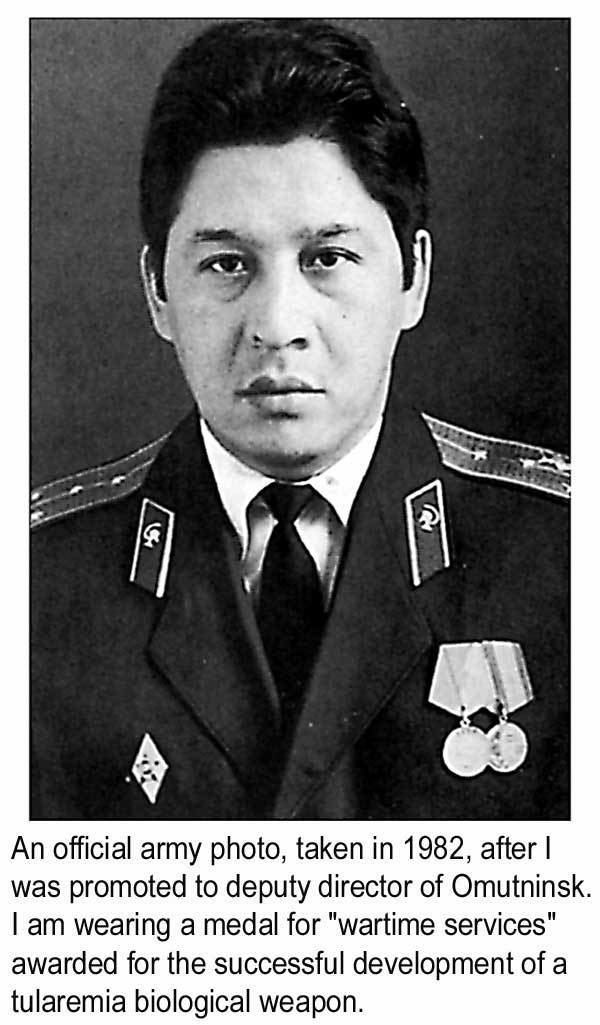
Under Mr. Patrick’s direction, scientists at Fort Detrick developed a tularemia agent that, if disseminated by airplane, could cause casualties & sickness over 1000s mi². In a 10,000 mi² range, it had 90% casualty rate & 50% fatality rate
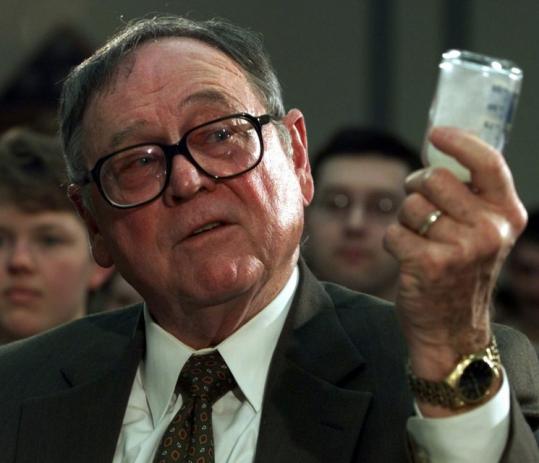
3/x His team explored Q fever, plague, & Venezuelan equine encephalitis, testing more than 20 anthrax strains to discern most lethal variety. Fort Detrick scientists used aerosol spray systems inside fountain pens, walking sticks, light bulbs, & even in 1953 Mercury exhaust pipes

4/x After retiring in 1986, Mr. Patrick remained one of the world’s foremost specialists on biological warfare & was a consultant to the CIA, FBI, & US military. He debriefed Soviet defector Ken Alibek, the deputy chief of the Soviet biowarfare program
https://t.co/sHqSaTSqtB
5/x Back in Time
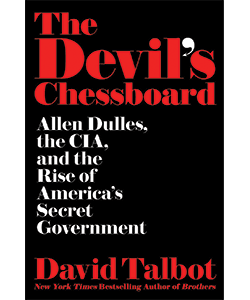
In 1949 the Army created a small team of chemists at "Camp Detrick" called Special Operations Division. Its assignment was to find military uses for toxic bacteria. The coercive use of toxins was a new field, which fascinated Allen Dulles, later head of the CIA
Mr. Patrick, one of the chief scientists at the Army Biological Warfare Laboratories at Fort Detrick in Frederick, Md., held five classified US patents for the process of weaponizing anthrax.
2/x
Under Mr. Patrick’s direction, scientists at Fort Detrick developed a tularemia agent that, if disseminated by airplane, could cause casualties & sickness over 1000s mi². In a 10,000 mi² range, it had 90% casualty rate & 50% fatality rate
3/x His team explored Q fever, plague, & Venezuelan equine encephalitis, testing more than 20 anthrax strains to discern most lethal variety. Fort Detrick scientists used aerosol spray systems inside fountain pens, walking sticks, light bulbs, & even in 1953 Mercury exhaust pipes
4/x After retiring in 1986, Mr. Patrick remained one of the world’s foremost specialists on biological warfare & was a consultant to the CIA, FBI, & US military. He debriefed Soviet defector Ken Alibek, the deputy chief of the Soviet biowarfare program
https://t.co/sHqSaTSqtB
5/x Back in Time
In 1949 the Army created a small team of chemists at "Camp Detrick" called Special Operations Division. Its assignment was to find military uses for toxic bacteria. The coercive use of toxins was a new field, which fascinated Allen Dulles, later head of the CIA