
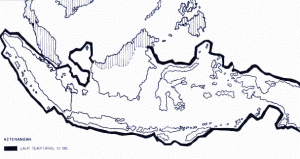
1/10 Today, 63 year ago, Prime Minister Indonesia, Mr. Djuanda, declared unilaterally the use of archipelagic baselines, for joining the outmost islands. The waters enclosed was then declared as internal waters (Deklarasi Djuanda 1957).
More from Government

Long thread: Because I couldn’t find anything comprehensive, I’m just going to post everything I’ve seen in the news/Twitter about Trump’s activities related to the Jan 6th insurrection. I think the timing & context of his actions/inactions will matter a lot for a senate trial.
12/12: The earlier DC protest over the electoral college vote during clearly inspired Jan 6th. On Dec 12th, he tweeted: “Wow! Thousands of people forming in Washington (D.C.) for Stop the Steal. Didn’t know about this, but I’ll be seeing them! #MAGA.”
12/19: Trump announces the Jan. 6th event by tweeting, “Big protest in D.C. on January 6th. Be there, will be wild!” Immediately, insurrectionists begin to discuss the “Wild Protest.” Just 2 days later, this UK political analyst predicts the violence
12/26-27: Trump announces his participation on Twitter. On Dec. 29, the FBI sends out a nationwide bulletin warning legislatures about attacks https://t.co/Lgl4yk5aO1
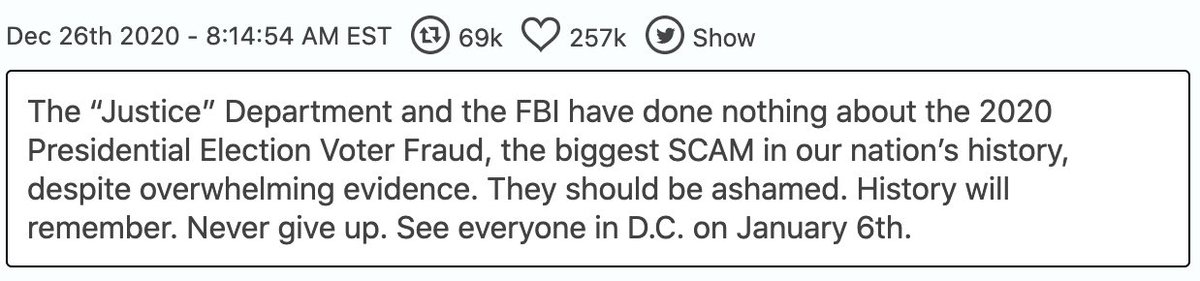
1/1: Trump tweets the time of his protest. Then he retweets “The calvary is coming” on Jan. 6!” Sounds like a war? About this time, the FBI begins visiting right wing extremists to tell them not to go--does the FBI tell the president? https://t.co/3OxnB2AHdr
12/12: The earlier DC protest over the electoral college vote during clearly inspired Jan 6th. On Dec 12th, he tweeted: “Wow! Thousands of people forming in Washington (D.C.) for Stop the Steal. Didn’t know about this, but I’ll be seeing them! #MAGA.”
Jumping in for @DCist/@wamu885 this evening. The scene rn coming up 17th Street from BLM Plaza. pic.twitter.com/Fn9aukjEPW
— Matt Blitz (@WhyBlitz) December 12, 2020
12/19: Trump announces the Jan. 6th event by tweeting, “Big protest in D.C. on January 6th. Be there, will be wild!” Immediately, insurrectionists begin to discuss the “Wild Protest.” Just 2 days later, this UK political analyst predicts the violence
On January 6, armed Trumpist militias will be rallying in DC, at Trump's orders. It's highly likely that they'll try to storm the Capitol after it certifies Joe Biden's win. I don't think this has sunk in yet.
— Arieh Kovler (@ariehkovler) December 21, 2020
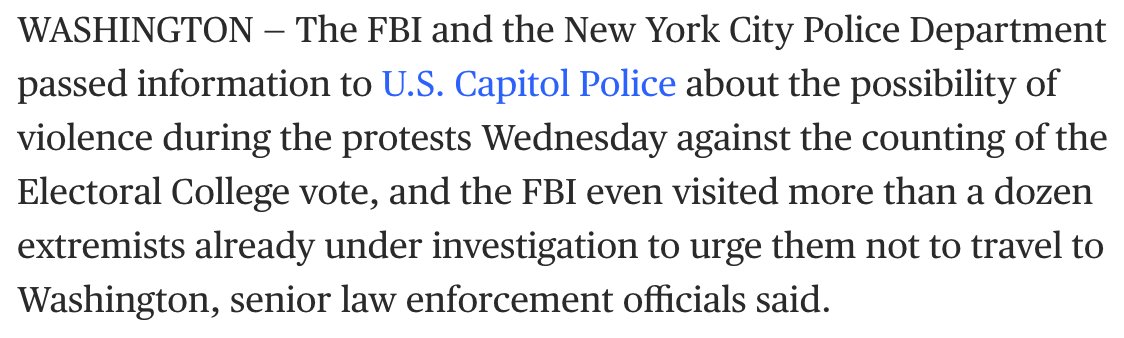
12/26-27: Trump announces his participation on Twitter. On Dec. 29, the FBI sends out a nationwide bulletin warning legislatures about attacks https://t.co/Lgl4yk5aO1
1/1: Trump tweets the time of his protest. Then he retweets “The calvary is coming” on Jan. 6!” Sounds like a war? About this time, the FBI begins visiting right wing extremists to tell them not to go--does the FBI tell the president? https://t.co/3OxnB2AHdr


You May Also Like



IMPORTANCE, ADVANTAGES AND CHARACTERISTICS OF BHAGWAT PURAN
It was Ved Vyas who edited the eighteen thousand shlokas of Bhagwat. This book destroys all your sins. It has twelve parts which are like kalpvraksh.
In the first skandh, the importance of Vedvyas
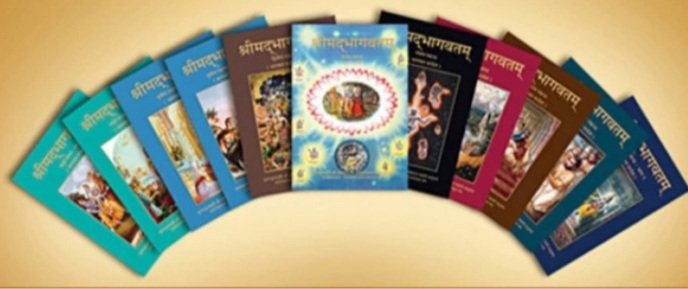
and characters of Pandavas are described by the dialogues between Suutji and Shaunakji. Then there is the story of Parikshit.
Next there is a Brahm Narad dialogue describing the avtaar of Bhagwan. Then the characteristics of Puraan are mentioned.
It also discusses the evolution of universe.( https://t.co/2aK1AZSC79 )
Next is the portrayal of Vidur and his dialogue with Maitreyji. Then there is a mention of Creation of universe by Brahma and the preachings of Sankhya by Kapil Muni.
In the next section we find the portrayal of Sati, Dhruv, Pruthu, and the story of ancient King, Bahirshi.
In the next section we find the character of King Priyavrat and his sons, different types of loks in this universe, and description of Narak. ( https://t.co/gmDTkLktKS )
In the sixth part we find the portrayal of Ajaamil ( https://t.co/LdVSSNspa2 ), Daksh and the birth of Marudgans( https://t.co/tecNidVckj )
In the seventh section we find the story of Prahlad and the description of Varnashram dharma. This section is based on karma vaasna.
It was Ved Vyas who edited the eighteen thousand shlokas of Bhagwat. This book destroys all your sins. It has twelve parts which are like kalpvraksh.
In the first skandh, the importance of Vedvyas
and characters of Pandavas are described by the dialogues between Suutji and Shaunakji. Then there is the story of Parikshit.
Next there is a Brahm Narad dialogue describing the avtaar of Bhagwan. Then the characteristics of Puraan are mentioned.
It also discusses the evolution of universe.( https://t.co/2aK1AZSC79 )
Next is the portrayal of Vidur and his dialogue with Maitreyji. Then there is a mention of Creation of universe by Brahma and the preachings of Sankhya by Kapil Muni.
HOW LIFE EVOLVED IN THIS UNIVERSE AS PER OUR SCRIPTURES.
— Anshul Pandey (@Anshulspiritual) August 29, 2020
Well maximum of Living being are the Vansaj of Rishi Kashyap. I have tried to give stories from different-different Puran. So lets start.... pic.twitter.com/MrrTS4xORk
In the next section we find the portrayal of Sati, Dhruv, Pruthu, and the story of ancient King, Bahirshi.
In the next section we find the character of King Priyavrat and his sons, different types of loks in this universe, and description of Narak. ( https://t.co/gmDTkLktKS )
Thread on NARK(HELL) / \u0928\u0930\u094d\u0915
— Anshul Pandey (@Anshulspiritual) August 11, 2020
Well today i will take you to a journey where nobody wants to go i.e Nark. Hence beware of doing Adharma/Evil things. There are various mentions in Puranas about Nark, But my Thread is only as per Bhagwat puran(SS attached in below Thread)
1/8 pic.twitter.com/raHYWtB53Q
In the sixth part we find the portrayal of Ajaamil ( https://t.co/LdVSSNspa2 ), Daksh and the birth of Marudgans( https://t.co/tecNidVckj )
In the seventh section we find the story of Prahlad and the description of Varnashram dharma. This section is based on karma vaasna.
#THREAD
— Anshul Pandey (@Anshulspiritual) August 12, 2020
WHY PARENTS CHOOSE RELIGIOUS OR PARAMATMA'S NAMES FOR THEIR CHILDREN AND WHICH ARE THE EASIEST WAY TO WASH AWAY YOUR SINS.
Yesterday I had described the types of Naraka's and the Sin or Adharma for a person to be there.
1/8 pic.twitter.com/XjPB2hfnUC