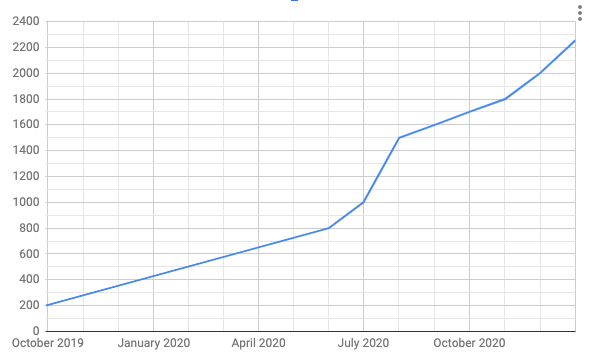
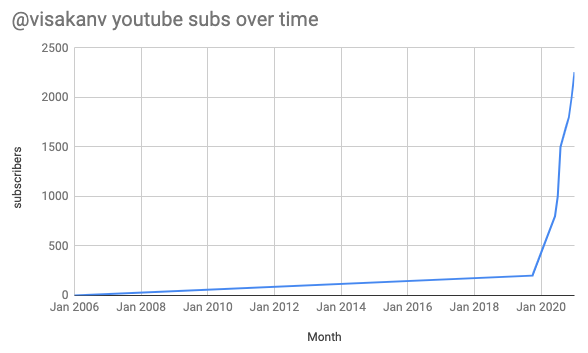
motivating myself by reminding myself that I created my youtube account in 2005 so I can extend the graph all the way back and make it look really exciting
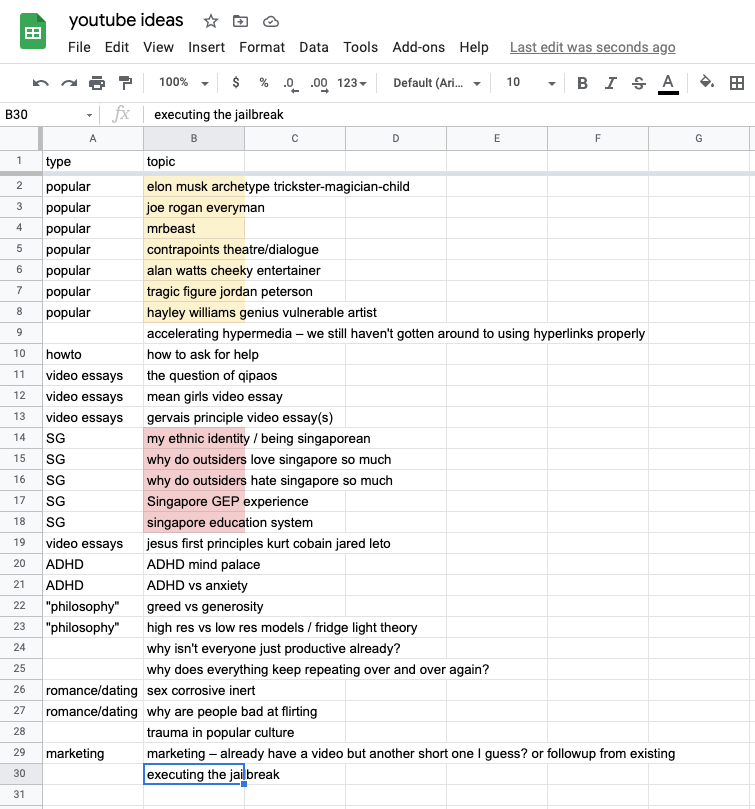
ok just sent that email I been procrastinating on pic.twitter.com/ytTAFPKwti
— visa is decluttering old drafts (@visakanv) January 30, 2021
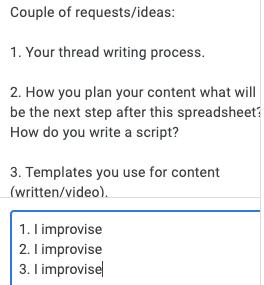
https://t.co/svGsmVhzzq
Plans are worthless, planning is priceless. Spend a day making elaborate plans and then disregard them completely to make whatever you think is most compelling. Repeat monthly or quarterly
— visa is decluttering old drafts (@visakanv) November 30, 2020

More from visa is decluttering old drafts


There is an art to replying and commenting, and probably like 60-70% of people I’ve seen on the internet fail at it. The important thing is not to speak your mind, but to “support” the OP. You can support them by disagreeing well & you can “mis-support” them by agreeing stupidly
Every “utterance” (status, tweet, whatever) is a bit of an invitation, a bit of a proposal. “Let’s play this game”. When strangers read the proposal accurately, and support the game, a shared understanding develops. You can make friends this way.
Some people deliberately choose to ignore, misread, disregard or denounce other people’s bids. Others are outright clueless and don’t know how to play, and sometimes cluelessness leads to worse bungling than deliberate malice (JJ’s razor)
I was a lot more belligerent and disagreeable when I was younger, in part because I simplistically thought playing other people’s games was a sheep-like way to live. Why should I support other people’s dumb games? Why not mock them instead? It’s easy, and intoxicating
I learned that you rarely build anything worthwhile that way. The “best” case scenario: you win over other disagreeable people. A few years of this & it becomes the world you live in – surrounded by other belligerent assholes who don’t know or care how to play nice. A cursed life
Every “utterance” (status, tweet, whatever) is a bit of an invitation, a bit of a proposal. “Let’s play this game”. When strangers read the proposal accurately, and support the game, a shared understanding develops. You can make friends this way.
Some people deliberately choose to ignore, misread, disregard or denounce other people’s bids. Others are outright clueless and don’t know how to play, and sometimes cluelessness leads to worse bungling than deliberate malice (JJ’s razor)
"The intentionality of an agent with behavior sufficiently indistinguishable from malice, is irrelevant." (JJ's razor > Hanlon's \U0001f609.) @cr1901
— JJ \u300cc\u03b9t\u03b9\u01b6\u03b5\u0273\u0192\u03b9v\u03b5\u300d \U0001f3f4\u200d\u2620\ufe0f (@CTZN5) June 6, 2016
I was a lot more belligerent and disagreeable when I was younger, in part because I simplistically thought playing other people’s games was a sheep-like way to live. Why should I support other people’s dumb games? Why not mock them instead? It’s easy, and intoxicating
I learned that you rarely build anything worthwhile that way. The “best” case scenario: you win over other disagreeable people. A few years of this & it becomes the world you live in – surrounded by other belligerent assholes who don’t know or care how to play nice. A cursed life
Several conversations with several friends - and also the story of my entire life - is getting me to crystalize some thoughts
The most valuable thing I know is how to make friends
The most powerful + valuable thing I can do is teach it to other people
The most important person you have to be friends with is yourself
Possibly the most important thing in a friendship- including one with yourself, or your spouse, or your child - is attention. Deep, focused, undivided, non-judgemental attention.
To really see + hear the other person, in a world where people constantly feel unseen & unheard

So: the most important thing about the most important thing in life is attention,
and in schools, IMO, we often screw up how we teach it.
If you use threats and coercion to force kids to “pay” attention...
...you set people up for dysfunctional relationships their whole life
becoming friends with yourself:
The most valuable thing I know is how to make friends
The most powerful + valuable thing I can do is teach it to other people
The most important person you have to be friends with is yourself
Possibly the most important thing in a friendship- including one with yourself, or your spouse, or your child - is attention. Deep, focused, undivided, non-judgemental attention.
To really see + hear the other person, in a world where people constantly feel unseen & unheard
So: the most important thing about the most important thing in life is attention,
and in schools, IMO, we often screw up how we teach it.
If you use threats and coercion to force kids to “pay” attention...
...you set people up for dysfunctional relationships their whole life
becoming friends with yourself:
Much of self-improvement, personal development, introspection, etc can quite simply be reframed as the art of socialising with yourself. Listen to yourself, pay close attention to yourself, don\u2019t interrupt yourself, be kind and supportive to yourself, be constructive in criticism
— Visa\u2019s Vexing Vacillations (@visakanv) March 27, 2019

More from For later read


You May Also Like



MASTER THREAD on Short Strangles.
Curated the best tweets from the best traders who are exceptional at managing strangles.
• Positional Strangles
• Intraday Strangles
• Position Sizing
• How to do Adjustments
• Plenty of Examples
• When to avoid
• Exit Criteria
How to sell Strangles in weekly expiry as explained by boss himself. @Mitesh_Engr
• When to sell
• How to do Adjustments
• Exit
Beautiful explanation on positional option selling by @Mitesh_Engr
Sir on how to sell low premium strangles yourself without paying anyone. This is a free mini course in
1st Live example of managing a strangle by Mitesh Sir. @Mitesh_Engr
• Sold Strangles 20% cap used
• Added 20% cap more when in profit
• Booked profitable leg and rolled up
• Kept rolling up profitable leg
• Booked loss in calls
• Sold only
2nd example by @Mitesh_Engr Sir on converting a directional trade into strangles. Option Sellers can use this for consistent profit.
• Identified a reversal and sold puts
• Puts decayed a lot
• When achieved 2% profit through puts then sold
Curated the best tweets from the best traders who are exceptional at managing strangles.
• Positional Strangles
• Intraday Strangles
• Position Sizing
• How to do Adjustments
• Plenty of Examples
• When to avoid
• Exit Criteria
How to sell Strangles in weekly expiry as explained by boss himself. @Mitesh_Engr
• When to sell
• How to do Adjustments
• Exit
1. Let's start option selling learning.
— Mitesh Patel (@Mitesh_Engr) February 10, 2019
Strangle selling. ( I am doing mostly in weekly Bank Nifty)
When to sell? When VIX is below 15
Assume spot is at 27500
Sell 27100 PE & 27900 CE
say premium for both 50-50
If bank nifty will move in narrow range u will get profit from both.
Beautiful explanation on positional option selling by @Mitesh_Engr
Sir on how to sell low premium strangles yourself without paying anyone. This is a free mini course in
Few are selling 20-25 Rs positional option selling course.
— Mitesh Patel (@Mitesh_Engr) November 3, 2019
Nothing big deal in that.
For selling weekly option just identify last week low and high.
Now from that low and high keep 1-1.5% distance from strike.
And sell option on both side.
1/n
1st Live example of managing a strangle by Mitesh Sir. @Mitesh_Engr
• Sold Strangles 20% cap used
• Added 20% cap more when in profit
• Booked profitable leg and rolled up
• Kept rolling up profitable leg
• Booked loss in calls
• Sold only
Sold 29200 put and 30500 call
— Mitesh Patel (@Mitesh_Engr) April 12, 2019
Used 20% capital@44 each
2nd example by @Mitesh_Engr Sir on converting a directional trade into strangles. Option Sellers can use this for consistent profit.
• Identified a reversal and sold puts
• Puts decayed a lot
• When achieved 2% profit through puts then sold
Already giving more than 2% return in a week. Now I will prefer to sell 32500 call at 74 to make it strangle in equal ratio.
— Mitesh Patel (@Mitesh_Engr) February 7, 2020
To all. This is free learning for you. How to play option to make consistent return.
Stay tuned and learn it here free of cost. https://t.co/7J7LC86oW0