
1/9 - “In the second wave we acquired much more evidence that schoolchildren are almost equally, if not more infected by SARS-CoV-2 than others.”
More from Education

I was a recipient of KGSP for my Msc from 2013-2016
Korean Government Scholarship Program (KGSP) Application made easy
Application period- 1 February 2021- 31 March, 2021
MS- 3yrs (1 year Korean language + 2 years MS)
PhD- 4yrs (1 year Korean language + 3 years PhD)
How to navigate the https://t.co/6Ne99JDfyv page
1. Type https://t.co/ow51lWVKcQ in your browser and hit the enter button
2. Click on scholarships and select GKS notice as attached in the picture👇
3. Play with the notice dashboard to see various announcements from NIIED.
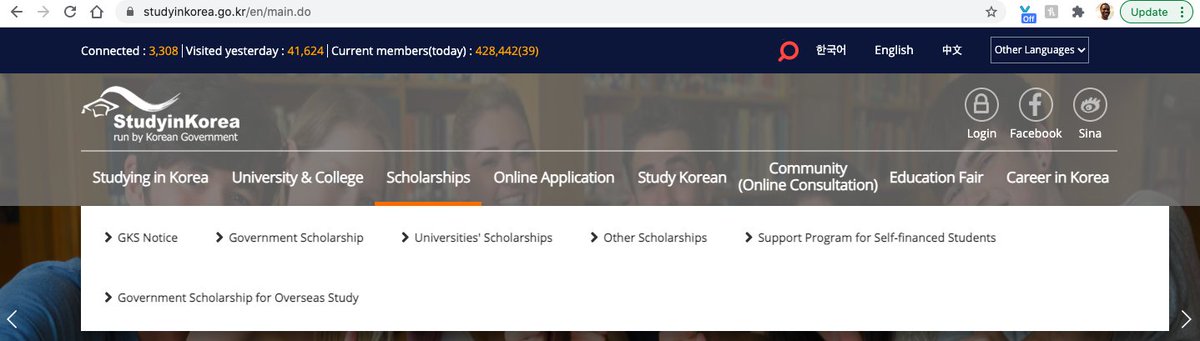
4. E.g in 2020, the Global Korea Scholarship for Graduate Degrees was announced on 11, February as indicated by no 205. You can click to download the application materials to get familiar with what is expected. I attached series of links in this thread to assist too.
Category- All fields
Benefits
1. Visa fee
2. Airfare: Actual cost (To and fro from your home country to Korea and upon completion to your home country)
3. Resettlement Allowance: KRW 200,000 (Given upon arrival in Korea)
4. Monthly stipend: Graduate (MS/PhD)-KRW 1000,000 (362,610.35 Nigerian Naira) per month ,Research Program including Postdoctoral fellow and visiting Professors - 1,500,000 KRW (542,824.78 Nigerian Naira) per month
Korean Government Scholarship Program (KGSP) Application made easy
Application period- 1 February 2021- 31 March, 2021
MS- 3yrs (1 year Korean language + 2 years MS)
PhD- 4yrs (1 year Korean language + 3 years PhD)
How to navigate the https://t.co/6Ne99JDfyv page
1. Type https://t.co/ow51lWVKcQ in your browser and hit the enter button
2. Click on scholarships and select GKS notice as attached in the picture👇
3. Play with the notice dashboard to see various announcements from NIIED.
4. E.g in 2020, the Global Korea Scholarship for Graduate Degrees was announced on 11, February as indicated by no 205. You can click to download the application materials to get familiar with what is expected. I attached series of links in this thread to assist too.
Category- All fields
Benefits
1. Visa fee
2. Airfare: Actual cost (To and fro from your home country to Korea and upon completion to your home country)
3. Resettlement Allowance: KRW 200,000 (Given upon arrival in Korea)
4. Monthly stipend: Graduate (MS/PhD)-KRW 1000,000 (362,610.35 Nigerian Naira) per month ,Research Program including Postdoctoral fellow and visiting Professors - 1,500,000 KRW (542,824.78 Nigerian Naira) per month


Department List of UCAS-China PROFESSORs for ANSO, CSC and UCAS (fully or partial) Scholarship Acceptance
1) UCAS School of physical sciences Professor
https://t.co/9X8OheIvRw
2) UCAS School of mathematical sciences Professor
3) UCAS School of nuclear sciences and technology
https://t.co/nQH8JnewcJ
4) UCAS School of astronomy and space sciences
https://t.co/7Ikc6CuKHZ
5) UCAS School of engineering
6) Geotechnical Engineering Teaching and Research Office
https://t.co/jBCJW7UKlQ
7) Multi-scale Mechanics Teaching and Research Section
https://t.co/eqfQnX1LEQ
😎 Microgravity Science Teaching and Research
9) High temperature gas dynamics teaching and research section
https://t.co/tVIdKgTPl3
10) Department of Biomechanics and Medical Engineering
https://t.co/ubW4xhZY2R
11) Ocean Engineering Teaching and Research
12) Department of Dynamics and Advanced Manufacturing
https://t.co/42BKXEugGv
13) Refrigeration and Cryogenic Engineering Teaching and Research Office
https://t.co/pZdUXFTvw3
14) Power Machinery and Engineering Teaching and Research
1) UCAS School of physical sciences Professor
https://t.co/9X8OheIvRw
2) UCAS School of mathematical sciences Professor
3) UCAS School of nuclear sciences and technology
https://t.co/nQH8JnewcJ
4) UCAS School of astronomy and space sciences
https://t.co/7Ikc6CuKHZ
5) UCAS School of engineering
6) Geotechnical Engineering Teaching and Research Office
https://t.co/jBCJW7UKlQ
7) Multi-scale Mechanics Teaching and Research Section
https://t.co/eqfQnX1LEQ
😎 Microgravity Science Teaching and Research
9) High temperature gas dynamics teaching and research section
https://t.co/tVIdKgTPl3
10) Department of Biomechanics and Medical Engineering
https://t.co/ubW4xhZY2R
11) Ocean Engineering Teaching and Research
12) Department of Dynamics and Advanced Manufacturing
https://t.co/42BKXEugGv
13) Refrigeration and Cryogenic Engineering Teaching and Research Office
https://t.co/pZdUXFTvw3
14) Power Machinery and Engineering Teaching and Research


You asked. So here are my thoughts on how osteopathic medical students should respond to the NBOME.
(thread)
Look, even before the Step 2 CS cancellation, my DMs and email were flooded with messages from osteopathic medical students who are fed up with the NBOME.
There is *real* anger toward this organization. Honestly, more than I even heard about from MD students and the NBME.
The question is, will that sentiment translate into action?
Amorphous anger on social media is easy to ignore. But if that anger gets channeled into organized efforts to facilitate change, then improvements are possible.
This much should be clear: begging the NBOME to reconsider their Level 2-PE exam is a waste of your time.
Best case scenario, you’ll get another “town hall” meeting, a handful of platitudes, and some thoughtful beard stroking before being told that they’re keeping the exam.
Instead of complaining to the NBOME, here are a few things that are more likely to bring about real change.
(thread)
I think most of us are over here waiting to see what @jbcarmody has to say about the latest NBOME email pic.twitter.com/bVWkS23V7z
— Jake Berg (@jberg521) January 28, 2021
Look, even before the Step 2 CS cancellation, my DMs and email were flooded with messages from osteopathic medical students who are fed up with the NBOME.
There is *real* anger toward this organization. Honestly, more than I even heard about from MD students and the NBME.
The question is, will that sentiment translate into action?
Amorphous anger on social media is easy to ignore. But if that anger gets channeled into organized efforts to facilitate change, then improvements are possible.
This much should be clear: begging the NBOME to reconsider their Level 2-PE exam is a waste of your time.
Best case scenario, you’ll get another “town hall” meeting, a handful of platitudes, and some thoughtful beard stroking before being told that they’re keeping the exam.
Instead of complaining to the NBOME, here are a few things that are more likely to bring about real change.
You May Also Like




Great article from @AsheSchow. I lived thru the 'Satanic Panic' of the 1980's/early 1990's asking myself "Has eveyrbody lost their GODDAMN MINDS?!"
The 3 big things that made the 1980's/early 1990's surreal for me.
1) Satanic Panic - satanism in the day cares ahhhh!
2) "Repressed memory" syndrome
3) Facilitated Communication [FC]
All 3 led to massive abuse.
"Therapists" -and I use the term to describe these quacks loosely - would hypnotize people & convince they they were 'reliving' past memories of Mom & Dad killing babies in Satanic rituals in the basement while they were growing up.
Other 'therapists' would badger kids until they invented stories about watching alligators eat babies dropped into a lake from a hot air balloon. Kids would deny anything happened for hours until the therapist 'broke through' and 'found' the 'truth'.
FC was a movement that started with the claim severely handicapped individuals were able to 'type' legible sentences & communicate if a 'helper' guided their hands over a keyboard.
For three years I have wanted to write an article on moral panics. I have collected anecdotes and similarities between today\u2019s moral panic and those of the past - particularly the Satanic Panic of the 80s.
— Ashe Schow (@AsheSchow) September 29, 2018
This is my finished product: https://t.co/otcM1uuUDk
The 3 big things that made the 1980's/early 1990's surreal for me.
1) Satanic Panic - satanism in the day cares ahhhh!
2) "Repressed memory" syndrome
3) Facilitated Communication [FC]
All 3 led to massive abuse.
"Therapists" -and I use the term to describe these quacks loosely - would hypnotize people & convince they they were 'reliving' past memories of Mom & Dad killing babies in Satanic rituals in the basement while they were growing up.
Other 'therapists' would badger kids until they invented stories about watching alligators eat babies dropped into a lake from a hot air balloon. Kids would deny anything happened for hours until the therapist 'broke through' and 'found' the 'truth'.
FC was a movement that started with the claim severely handicapped individuals were able to 'type' legible sentences & communicate if a 'helper' guided their hands over a keyboard.