
I’ve compiled 6 tips for the move online based on @AccessTCD & @SchoolofEdTCD research. During #schoolclosures last year we surveyed 1000+ students and 700+ teachers about their experience of #onlinelearning. Although it's difficult to be back here, we have learned so much. (1/N)
More from Education


I was a recipient of KGSP for my Msc from 2013-2016
Korean Government Scholarship Program (KGSP) Application made easy
Application period- 1 February 2021- 31 March, 2021
MS- 3yrs (1 year Korean language + 2 years MS)
PhD- 4yrs (1 year Korean language + 3 years PhD)
How to navigate the https://t.co/6Ne99JDfyv page
1. Type https://t.co/ow51lWVKcQ in your browser and hit the enter button
2. Click on scholarships and select GKS notice as attached in the picture👇
3. Play with the notice dashboard to see various announcements from NIIED.
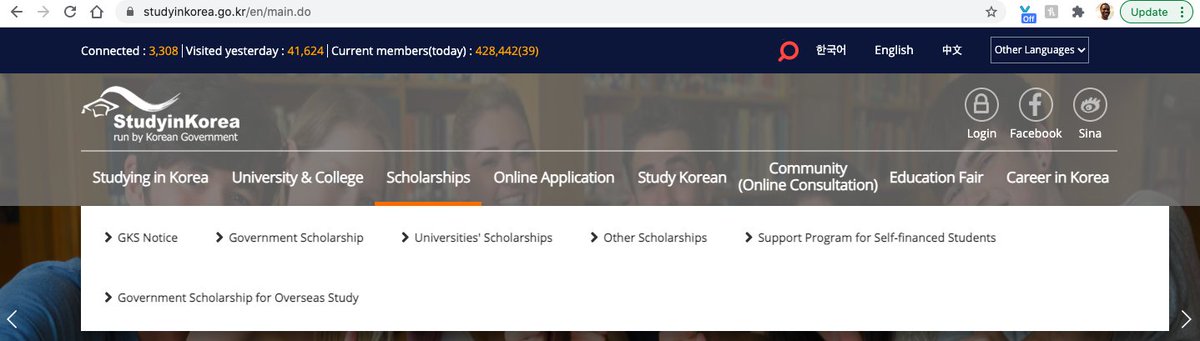
4. E.g in 2020, the Global Korea Scholarship for Graduate Degrees was announced on 11, February as indicated by no 205. You can click to download the application materials to get familiar with what is expected. I attached series of links in this thread to assist too.
Category- All fields
Benefits
1. Visa fee
2. Airfare: Actual cost (To and fro from your home country to Korea and upon completion to your home country)
3. Resettlement Allowance: KRW 200,000 (Given upon arrival in Korea)
4. Monthly stipend: Graduate (MS/PhD)-KRW 1000,000 (362,610.35 Nigerian Naira) per month ,Research Program including Postdoctoral fellow and visiting Professors - 1,500,000 KRW (542,824.78 Nigerian Naira) per month
Korean Government Scholarship Program (KGSP) Application made easy
Application period- 1 February 2021- 31 March, 2021
MS- 3yrs (1 year Korean language + 2 years MS)
PhD- 4yrs (1 year Korean language + 3 years PhD)
How to navigate the https://t.co/6Ne99JDfyv page
1. Type https://t.co/ow51lWVKcQ in your browser and hit the enter button
2. Click on scholarships and select GKS notice as attached in the picture👇
3. Play with the notice dashboard to see various announcements from NIIED.
4. E.g in 2020, the Global Korea Scholarship for Graduate Degrees was announced on 11, February as indicated by no 205. You can click to download the application materials to get familiar with what is expected. I attached series of links in this thread to assist too.
Category- All fields
Benefits
1. Visa fee
2. Airfare: Actual cost (To and fro from your home country to Korea and upon completion to your home country)
3. Resettlement Allowance: KRW 200,000 (Given upon arrival in Korea)
4. Monthly stipend: Graduate (MS/PhD)-KRW 1000,000 (362,610.35 Nigerian Naira) per month ,Research Program including Postdoctoral fellow and visiting Professors - 1,500,000 KRW (542,824.78 Nigerian Naira) per month


Below is a list of awesome courses that dive into all different aspects of visual communication and storytelling.
Visual storytelling is a way for people to communicate their story using visuals and digital media such as video, graphics, and photography.
Visual Storytelling appeals to the emotions of the intended audience and it can humanize the business, giving the target market a way to relate to the business and their story.
1. The Art of Storytelling
2. Visual Thinking: Drawing Data to Communicate Ideas
https://t.co/YPiexr9RYJ
3. Find what fascinates you as you explore these visual storytelling
4. Awesome and affordable online art classes for artists of all skill levels! Take your art to the next level no matter where you are. https://t.co/k7xpp4sR4r
5. Digital Storytelling
6. Visual Storytelling | For Screenwriters & Novelists
https://t.co/FsZ7EFFVzo
7. Learn about storytelling with online courses and
Visual storytelling is a way for people to communicate their story using visuals and digital media such as video, graphics, and photography.
Visual Storytelling appeals to the emotions of the intended audience and it can humanize the business, giving the target market a way to relate to the business and their story.
1. The Art of Storytelling
2. Visual Thinking: Drawing Data to Communicate Ideas
https://t.co/YPiexr9RYJ
3. Find what fascinates you as you explore these visual storytelling
4. Awesome and affordable online art classes for artists of all skill levels! Take your art to the next level no matter where you are. https://t.co/k7xpp4sR4r
5. Digital Storytelling
6. Visual Storytelling | For Screenwriters & Novelists
https://t.co/FsZ7EFFVzo
7. Learn about storytelling with online courses and
You May Also Like


I’m torn on how to approach the idea of luck. I’m the first to admit that I am one of the luckiest people on the planet. To be born into a prosperous American family in 1960 with smart parents is to start life on third base. The odds against my very existence are astronomical.
I’ve always felt that the luckiest people I know had a talent for recognizing circumstances, not of their own making, that were conducive to a favorable outcome and their ability to quickly take advantage of them.
In other words, dumb luck was just that, it required no awareness on the person’s part, whereas “smart” luck involved awareness followed by action before the circumstances changed.
So, was I “lucky” to be born when I was—nothing I had any control over—and that I came of age just as huge databases and computers were advancing to the point where I could use those tools to write “What Works on Wall Street?” Absolutely.
Was I lucky to start my stock market investments near the peak of interest rates which allowed me to spend the majority of my adult life in a falling rate environment? Yup.
Ironies of Luck https://t.co/5BPWGbAxFi
— Morgan Housel (@morganhousel) March 14, 2018
"Luck is the flip side of risk. They are mirrored cousins, driven by the same thing: You are one person in a 7 billion player game, and the accidental impact of other people\u2019s actions can be more consequential than your own."
I’ve always felt that the luckiest people I know had a talent for recognizing circumstances, not of their own making, that were conducive to a favorable outcome and their ability to quickly take advantage of them.
In other words, dumb luck was just that, it required no awareness on the person’s part, whereas “smart” luck involved awareness followed by action before the circumstances changed.
So, was I “lucky” to be born when I was—nothing I had any control over—and that I came of age just as huge databases and computers were advancing to the point where I could use those tools to write “What Works on Wall Street?” Absolutely.
Was I lucky to start my stock market investments near the peak of interest rates which allowed me to spend the majority of my adult life in a falling rate environment? Yup.