Watching Cobra Kai, plus a lot of the manosphere plus the insurrectionists has put me in a mind of the idea of "the world's hard, so I have to make you hard to succeed" and how much that's used to justify... well, pretty much everything. But mostly abuse. /1
1) I went through this so YOU have to, even though I hated it
and
2) A better world is not possible. This is how it always has been and how it always will be.
/5
Except... they didn't. They turned out as people who think that hitting a child is not just acceptable but necessary and laudable. /7
And that this is both good and a sign of your strength. Now YOU get to dominate others. /8
But much of this is just self-justification. It's the convenient excuse for choosing to inflict pain on others, not the unfortunate necessity. /13
The garbage, however, was tainted with tuberculosis. An outbreak occurred in the troop, killing half the males. /16
Theoretically, this should mean that new males to the troop would rapidly dominate through aggression and violence.
But they didn't. /17
@IwriteOK has a great episode about this in his Behind The Bastards podcast: https://t.co/mrEZe0XXYj /21
The advocates of that aren't strong. They're afraid. They don't want to face the truth. /22
The people who hurt them *lied*. /24
It's recognizing that people hurt him because they just wanted to hurt someone and dressed it up with noble sounding bullshit. /25
But even then, this gets misconstrued by people who want to justify the abuse. /26
No, it didn't. The abuse didn't do that. The PERSON made THEMSELVES kind.
Saying otherwise is just another form of justifying those mindsets. /27
It comes from compassion. It comes from care. From kindness. /33
The world can be cruel. It can be mean. It can be deeply unfair. This is all true. /34
More from Culture



One of the authors of the Policy Exchange report on academic free speech thinks it is "ridiculous" to expect him to accurately portray an incident at Cardiff University in his study, both in the reporting and in a question put to a student sample.
Here is the incident Kaufmann incorporated into his study, as told by a Cardiff professor who was there. As you can see, the incident involved the university intervening to *uphold* free speech principles:
Here is the first mention of the Greer at Cardiff incident in Kaufmann's report. It refers to the "concrete case" of the "no-platforming of Germaine Greer". Any reasonable reader would assume that refers to an incident of no-platforming instead of its opposite.

Here is the next mention of Greer in the report. The text asks whether the University "should have overruled protestors" and "stepped in...and guaranteed Greer the right to speak". Again the strong implication is that this did not happen and Greer was "no platformed".
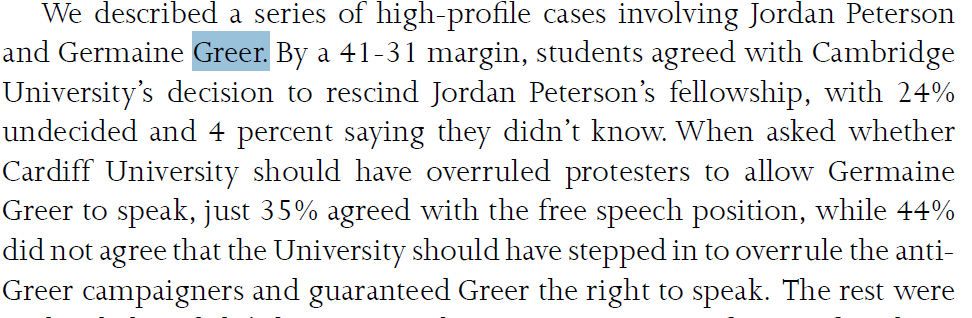
The authors could easily have added a footnote at this point explaining what actually happened in Cardiff. They did not.
This is ridiculous. Students were asked for their views on this example and several others. The study findings and conclusions were about student responses not the substance of each case. Could\u2019ve used hypotheticals. The responses not the cases were the basis of the conclusions.
— Eric Kaufmann (@epkaufm) February 17, 2021
Here is the incident Kaufmann incorporated into his study, as told by a Cardiff professor who was there. As you can see, the incident involved the university intervening to *uphold* free speech principles:
The UK govt\u2019s paper on free speech in Unis (with implications for Wales) is getting a lot of attention.
— Richard Wyn Jones (@RWynJones) February 16, 2021
Worth noting then that an important part of the evidence-base on which it rests relates to (demonstrably false) claims about my own institution
1/https://t.co/buoGE7ocG7
Here is the first mention of the Greer at Cardiff incident in Kaufmann's report. It refers to the "concrete case" of the "no-platforming of Germaine Greer". Any reasonable reader would assume that refers to an incident of no-platforming instead of its opposite.
Here is the next mention of Greer in the report. The text asks whether the University "should have overruled protestors" and "stepped in...and guaranteed Greer the right to speak". Again the strong implication is that this did not happen and Greer was "no platformed".
The authors could easily have added a footnote at this point explaining what actually happened in Cardiff. They did not.