We all know about how "Advance Australia Fair" was first performed in the middle of a outbreak of race riots, right?

As @LukeLPearson points out here, the cosmetic change of one word is pretty pathetic.

But we've genuinely forgotten the context in which the song was written: an outbreak of anti-Chinese violence in 1870s Sydney, which ultimately led to Federation.

https://t.co/9eIsmEqRl1
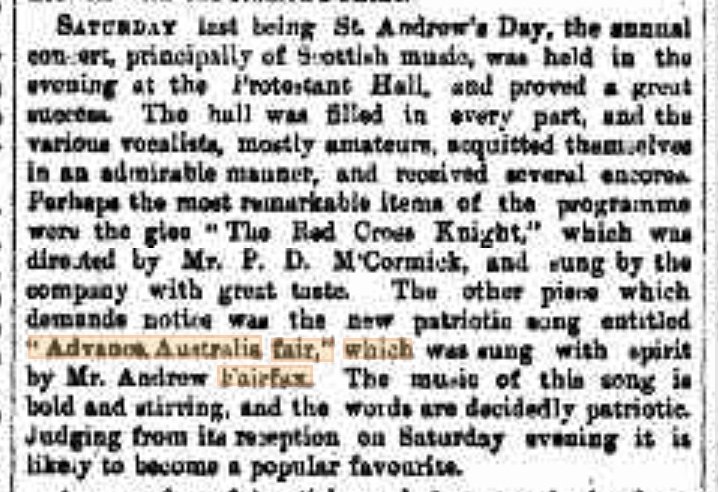
Here's the Sydney Morning Herald's account of its first performance on St. Andrews Day, 30 November 1878:

https://t.co/6DunDKIbvB
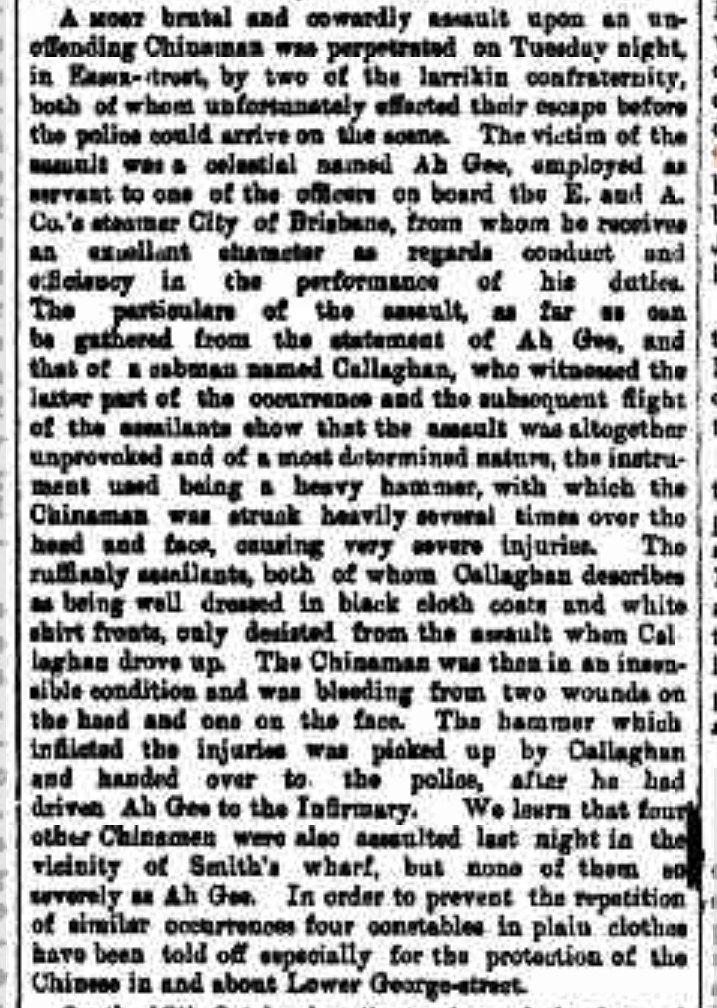
On the adjoining column is an account of an incident the same week when two well-dressed men in black coats and white shirt-fronts brutally attacked a Chinese man in Essex Street in the Rocks with a hammer:
This wasn't an isolated incident. In fact, racist anti-Chinese agitation in November 1878 in Sydney was a crucial turning point in Australia's Federation as a unified country.
There had been periodic race riots against Chinese miners on the goldfields of Victoria and Queensland since the 1850s but the 1878 Seamen's Strike was the first time this came to urban Australia.
The Seamen's Union started agitating against the Australasian Steam Navigation Company in July 1878 about its hiring of Chinese labourers as ship crew. By November it had turned into a mass strike.
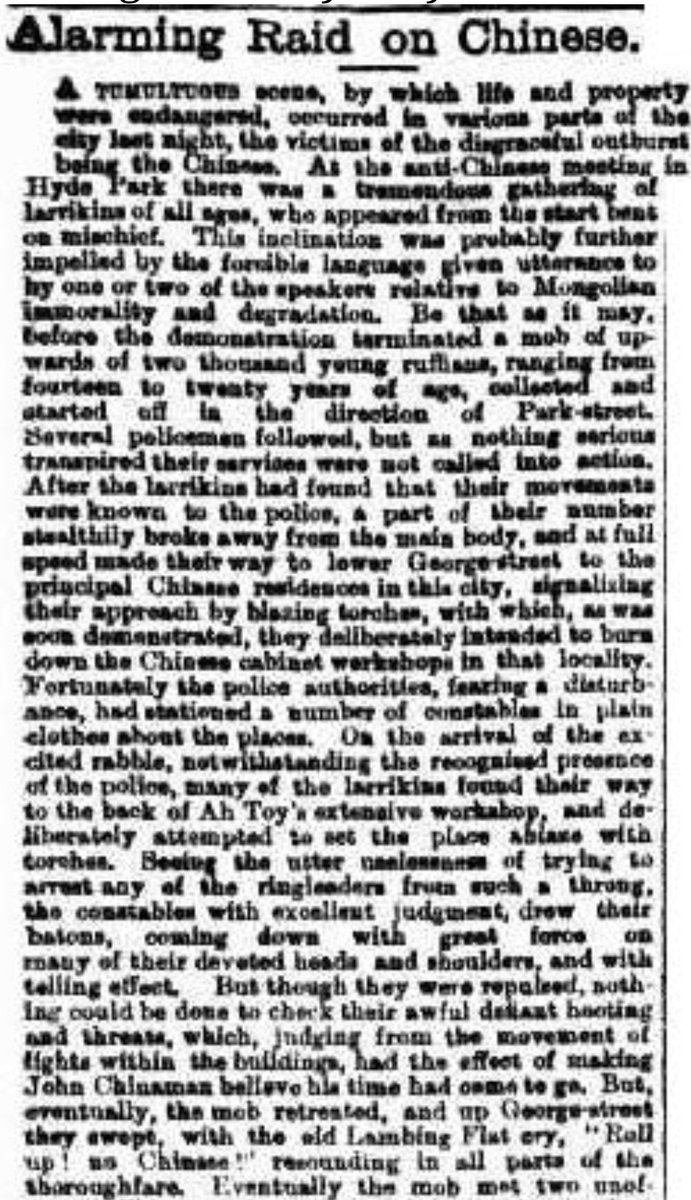
There was very serious unrest. After a meeting in Hyde Park on 4 December a few days after "Advance Australia Fair" debuted, a mob of 2,000 people carrying torches attempted to burn down a Chinese-owned business and attacked people in the street:

https://t.co/Y8Ktav0ZmD
The agitation spread like wildfire.

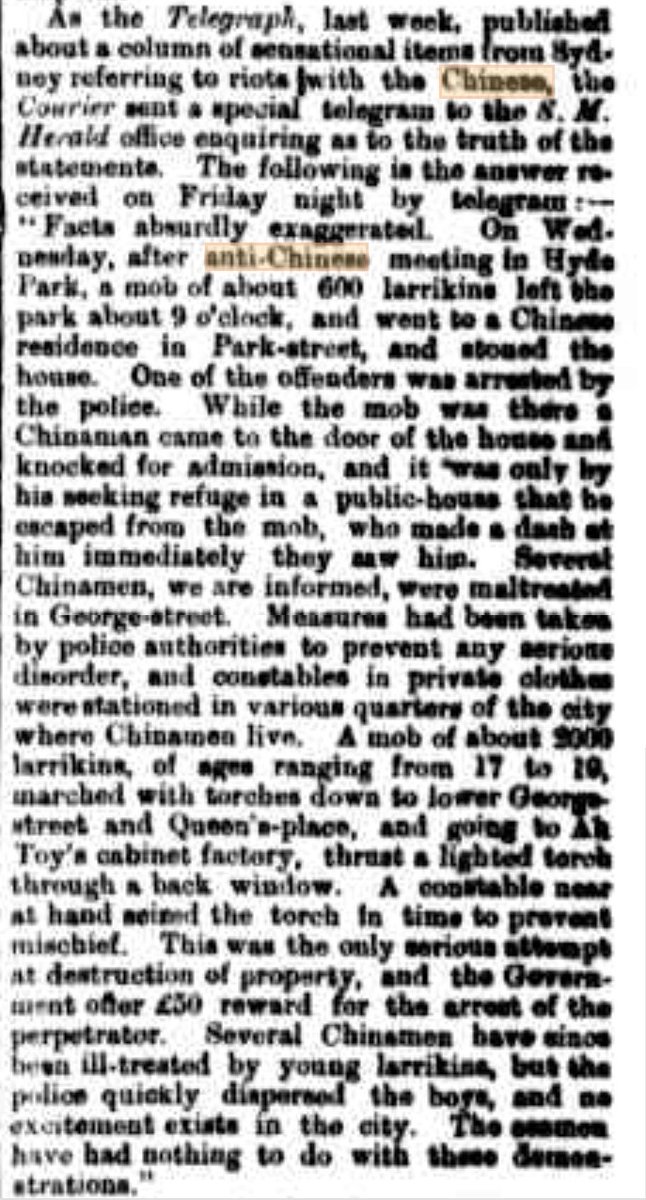
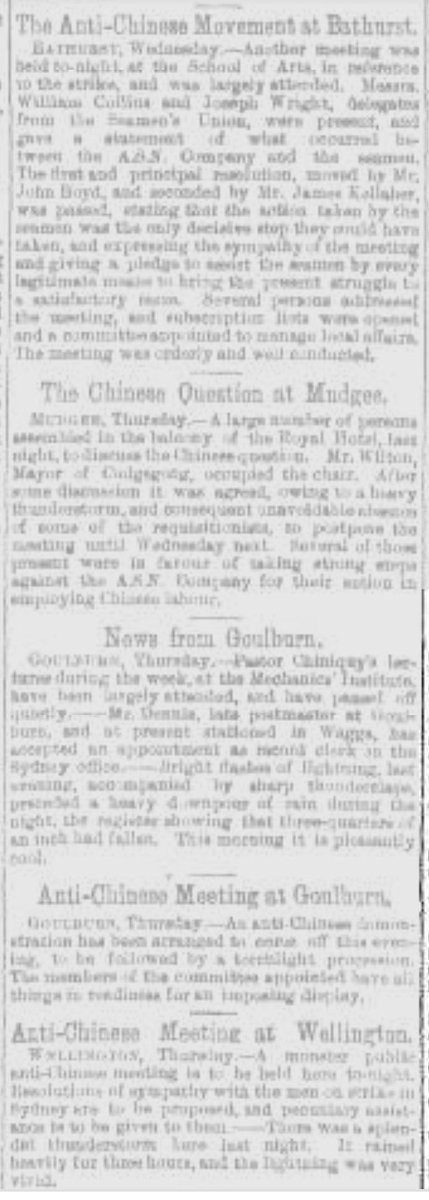
The Sydney Evening News edition reporting another early performance of "Advance Australia Fair" in early December 1878 records anti-Chinese meetings in Bathurst, Mudgee, Goulburn, Wellington and Brisbane:

https://t.co/kOsHmp4nAH
The Seamen's Strike was arguably the start of the union movement in Australia. It also led to 1881 legislation restricting Chinese migration into New South Wales.
The reluctance of most states to pass such legislation in line with NSW and Victoria was one of the driving forces behind Federation.
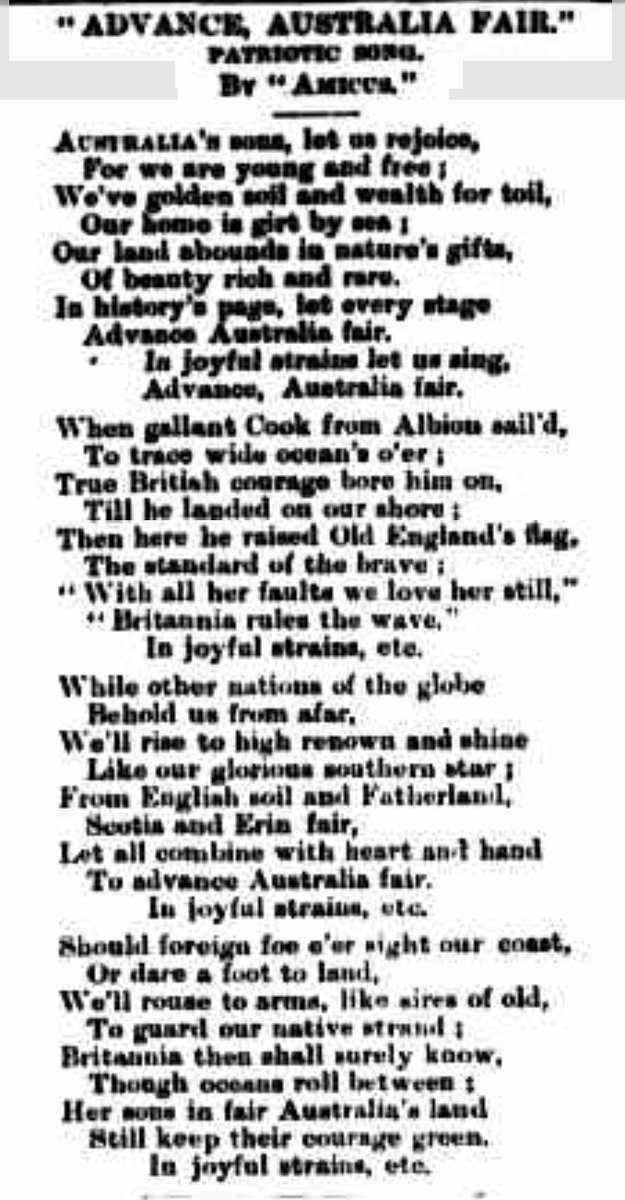
Read the original four-verse text of the song – with its lines about "English soil and fatherland" and promises to "rouse to arms" against "foreign foe" — and consider the race riots that were playing out in the same city when it was first performed.

https://t.co/jH9k2jqEm3
There aren't many good national anthems IMO, but that history does leave a particularly bad taste in my mouth, regardless of how much the lyrics are cleaned up.

More from Culture

.@bellingcat's attempt in their new book, published by
@BloomsburyBooks, to coverup the @OPCW #Douma controversy, promote US and UK gov. war narratives, and whitewash fraudulent conduct within the OPCW, is an exercise in deception through omission @marydejevsky @freddiesayers


1) 2000 words are devoted to the OPCW controversy regarding the alleged chemical weapon attack in #Douma, Syria in 2018 but critical material is omitted from the book. Reading it, one would never know the following:

2) That the controversy started when the original interim report, drafted and agreed by Douma inspection team members, was secretly modified by an unknown OPCW person who had manipulated the findings to suggest an attack had occurred. https://t.co/QtAAyH9WyX… @RobertF40396660


3) This act of attempted deception was only derailed because an inspector discovered the secret changes. The manipulations were reported by @ClarkeMicah
and can be readily observed in documents now available https://t.co/2BUNlD8ZUv….

4) .@bellingcat's book also makes no mention of the @couragefoundation panel, attended by the @opcw's first Director General, Jose Bustani, at which an OPCW official detailed key procedural irregularities and scientific flaws with the Final Douma Report:

You May Also Like

1/ Here’s a list of conversational frameworks I’ve picked up that have been helpful.

Please add your own.

2/ The Magic Question: "What would need to be true for you


3/ On evaluating where someone’s head is at regarding a topic they are being wishy-washy about or delaying.

“Gun to the head—what would you decide now?”

“Fast forward 6 months after your sabbatical--how would you decide: what criteria is most important to you?”

4/ Other Q’s re: decisions:

“Putting aside a list of pros/cons, what’s the *one* reason you’re doing this?” “Why is that the most important reason?”

“What’s end-game here?”

“What does success look like in a world where you pick that path?”

5/ When listening, after empathizing, and wanting to help them make their own decisions without imposing your world view:

“What would the best version of yourself do”?
“We don’t negotiate salaries” is a negotiation tactic.

Always. No, your company is not an exception.

A tactic I don’t appreciate at all because of how unfairly it penalizes low-leverage, junior employees, and those loyal enough not to question it, but that’s negotiation for you after all. Weaponized information asymmetry.

Listen to Aditya


And by the way, you should never be worried that an offer would be withdrawn if you politely negotiate.

I have seen this happen *extremely* rarely, mostly to women, and anyway is a giant red flag. It suggests you probably didn’t want to work there.

You wish there was no negotiating so it would all be more fair? I feel you, but it’s not happening.

Instead, negotiate hard, use your privilege, and then go and share numbers with your underrepresented and underpaid colleagues. […]