What's in the EU-UK Brexit deal on energy?

It may be Boxing day, but I've had a quick look

Title VIII: Energy is the key section (page 156 onwards)

▶️ Standard stuff on commitment to competition, unbundling and customer choice

▶️ UK Capacity Market no longer needs to try to integrate overseas Capacity providers & vice versa

(Article ENER.6, Clause 3, page. 160)

2/
▶️ Existing "exemptions" for selected interconnectors will continue to apply.

This means that these interconnectors can continue to sell capacity rights ahead of time, rather than all through close to real-time markets.

(Article ENER.11, page 162)

3/
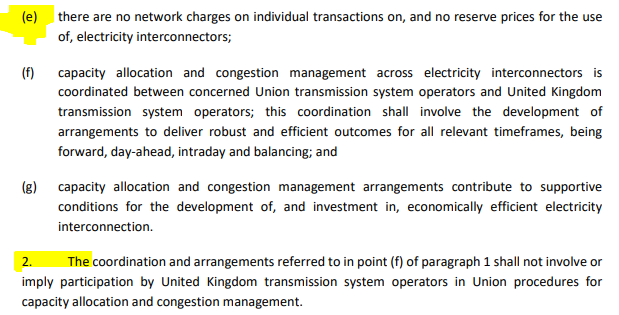
▶️ No network charges on individual interconnector transactions (as now)

▶️ But, UK cannot participate in EU procedures for capacity allocation and congestion management (more on this later)

(Article ENER.13, page 163)

4/
Gas trading: looks like the UK stays in the existing PRISMA gas trading platform.

Not my specialist area, but is this because PRISMA isn't an EU institution (unlike electricity market coupling)?

https://t.co/5GQJtZDpTa

(Article ENER. 15, page 164)

5/
▶️ Network development: Parties to cooperate, including on interconnectors, but not much detail.
▶️ Security of Supply: Parties to cooperate, again not much detail. Can't see any references to a solidarity principle.

(Articles ENER. 16 and ENER. 17, page 165)

6/
Cooperation between TSOs & Regulators:
- UK TSOs (i.e. National Grid) to cooperate with EU TSOs through cooperation with ENTSO-E and ENTSOG but not membership
- UK regulator (@Ofgem) to cooperate with EU regulators through ACER. Again, no UK membership

(Articles ENER.19+20)

7/
New cooperation forum between UK and EU on offshore renewable energy.

Looks like UK no longer a member of North Seas Energy Cooperation, so a new forum is needed.

(Article ENER 23, page 169-170).

See summary of our report on Future of North Sea :
https://t.co/Qgh8b2p0yZ

8/
Final provisions, incl. termination (!)

Title on Energy ceases on 30 June 2026. Although can be extended to 31 March 2027 & again to 31 March 2028.

Seems linked to general termination provisions of the deal, including a reference to 🐟🐟 (Article FISH.17)

(ENER 33, p.172)

9/
Onto Annexes. Only Annex ENER-4 is interesting. Covers day-ahead market coupling over interconnectors.

Market coupling ceases on 1 Jan 2021. Will be replaced by April'22 with "Multi-region loose volume coupling"

New term for many https://t.co/oSVDDiWFw9

Annex ENER-4 p.784

10/
If I understand it correctly, new system will produce net flows on the interconnectors, rather than prices.

Creates a risk that interconnectors flow the "wrong way" (i.e. from high prices to low prices).

Algorithm is separate to EU day-ahead market coupling (EUPHEMIA)

11/
Timeline to develop new system:
▶️ By April 2021: CBA and outline technical proposals
▶️ By November 2021: Technical proposals
▶️ By April 2022: System starts operating

p.785

12/
Other provisions in the deal:

▶️ New Specialised Committee on Energy to discuss/implement some bits of the energy title and annexes (page 12)

▶️ Commitment to carbon pricing in the section on "level playing field"

[Title XI, Article 7.3, page 202]

13/
Overall:
▶️ Lots of sensible provisions, much to gain for both sides
▶️ Market coupling will be weaker, even with new system (Apr 2022)
▶️ Welcome focus on North Sea
▶️ Need to understand more on termination provisions

See more in our recent paper:
https://t.co/KEXNIWvAHJ

14/14

More from Brexit

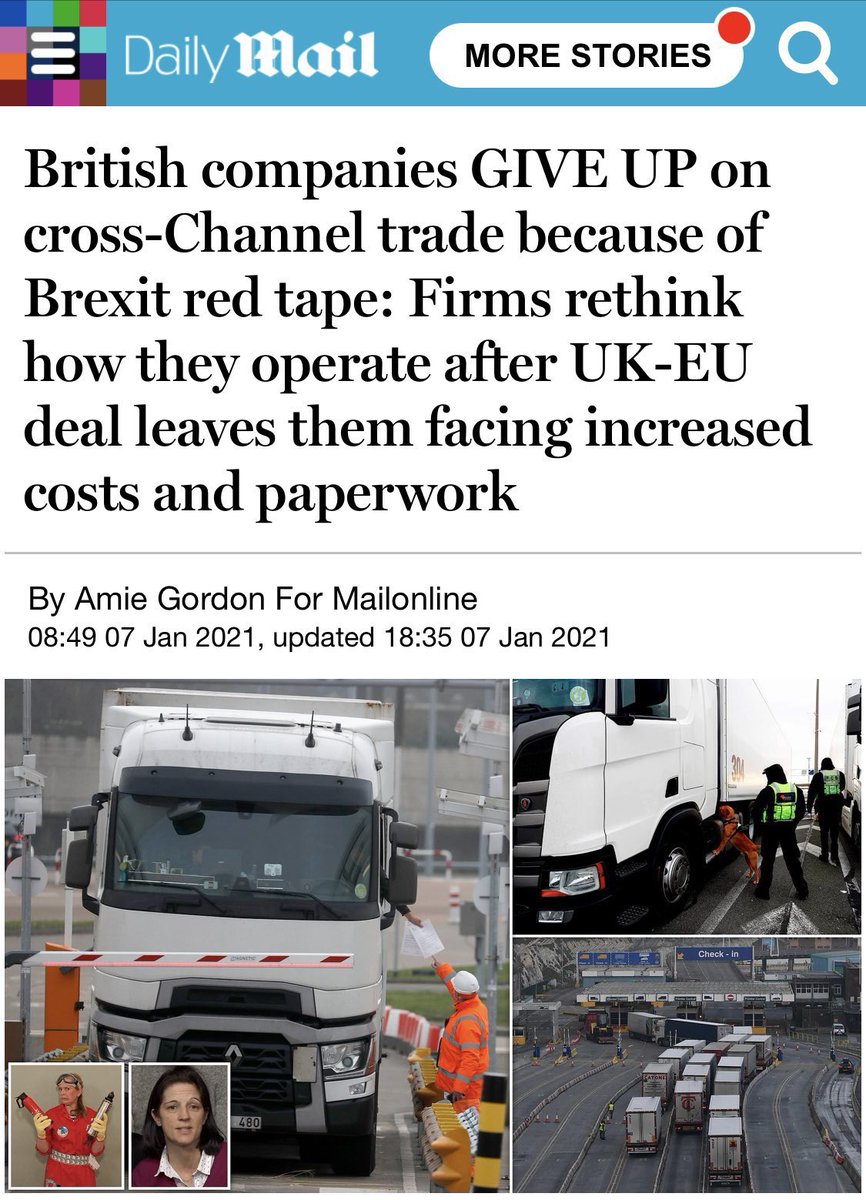
1/ A challenge in parsing Brexit news is that businesses are facing overlapping types of challenges that can be difficult to separate.

The key questions are:
1⃣ Given the model of Brexit chosen, could this have been prevented, and by whom?
2⃣ Can it get better?


2/ To put those another way:

"If you knew everything you needed to know and did everything right, is your existing business and delivery model still viable and competitive?"

The answer to that question determines if for you the problem is Brexit, or how Brexit was delivered.

3/ Some of the challenges at borders could have been prevented while still having the exact same model of Brexit (No Single Market, No Customs Union, but an FTA).

That they're appearing is an implementation failure and you can fully support Brexit but still be pissed about them.

4/ Examples include:

1) Government guidance and IT systems being ready earlier and/or easier to navigate;

2) More support for businesses, and more affordable bespoke help;

3) More time to prepare and better government communication about what preparation actually requires.

5/ This thread you've all seen from Daniel Lambert the wine merchant (primarily) deals with problems in this category.

There's no policy reason he can't export his product, but the procedures are a nightmare to navigate and he's badly under-supported.
On this, I think it’s highly unlikely to occur in the timeframe given. For several reasons, I don’t think it’s realistic for Scotland to secede, and then join the EU, in 9 years.

For that, thanks goes to Brexit.

A thread because why not...


Two important dates: March 2016 and January 1st 2021.

Firstly, prior to the 2014 referendum, the Nationalists proposed a date of March 2016 to secede.

Secondly, today - the end completion of Brexit five-and-a-half years after Cameron’s majority in 2015.

Brexit has demonstrated many things, primarily that splitting unions is not easy. The UKs membership of the EU was 47 years and by the end it was not at the heart of the EU. The Union has existed for over 300 as a unitary state.

Dividing a unitary state, like the UK, will not be easy. Frankly, it will make Brexit look simple. Questions of debt, currency, defence, and more will need to be resolved ... something not addressed with Brexit.

Starting with debt. Scotland will end up with its proportionate share of the UKs national debt. It’s not credible to suggest otherwise. Negotiating what is proportionate won’t be easy when both sides disagree.

It’s importance will be seen shortly.

You May Also Like

https://t.co/6cRR2B3jBE
Viruses and other pathogens are often studied as stand-alone entities, despite that, in nature, they mostly live in multispecies associations called biofilms—both externally and within the host.

https://t.co/FBfXhUrH5d


Microorganisms in biofilms are enclosed by an extracellular matrix that confers protection and improves survival. Previous studies have shown that viruses can secondarily colonize preexisting biofilms, and viral biofilms have also been described.


...we raise the perspective that CoVs can persistently infect bats due to their association with biofilm structures. This phenomenon potentially provides an optimal environment for nonpathogenic & well-adapted viruses to interact with the host, as well as for viral recombination.


Biofilms can also enhance virion viability in extracellular environments, such as on fomites and in aquatic sediments, allowing viral persistence and dissemination.