Unique evolution,
On getting a license, it was created out of a demerger of infrastructure financing business followed by the merger of erstwhile Capital First;
Stress build-up and franchise investment resulted in a weak Return profile during the transition phase;
2/25
After merger of Capital First, with Mr. V. Vaidyanathan at the helm, management is focused on building a high-yielding retail banking franchise (average retail yield at >15%);
Infrastructure loans to be completely run down, selective lending in non-infra corporate segment:
3/25
Of the wholesale exposure, infra book has been almost halved since merger to Rs108bn and will be further rationalized to a very negligible proportion in 3-5 years;
4/25
Remarkable transition in asset and liability profile post the merger:
After having rolled out a 5-year strategic roadmap towards targeted RoA and RoE of 1.4-1.6% and 13-15% respectively, it has made significant strides on most operating parameters:-
5/25
1) Realization of assets (>30% CAGR over FY19-FY21, constituting 63% of assets);
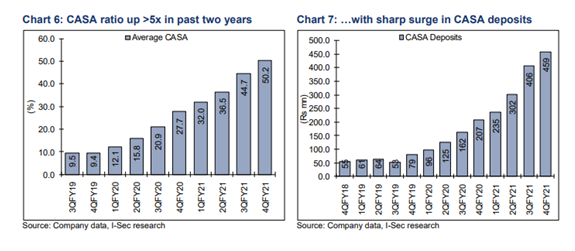
2) Granularity of deposits – average CASA deposits surged to ~50% & deposits of
3) Sharp spike in NIM from <2% in FY18 to ~5% in FY21 and very much on track towards 5.0 - 5.5%.
Retail GNPAs rise amidst disruption; wholesale portfolio adequately covered:
With FY21 slippage run-rate of >5% (>7% for retail), GNPAs rose to 4.15% (from 2.6% in FY20);
Retail GNPAs at 4.01% are higher by 175bps from the pre-covid average.
7/25
Restructured pool is equivalent to 1.3% of retail assets.
Despite the incremental stress in FY21, credit cost was contained at 250bps for FY21 supported from adequately covered and write-back in wholesale portfolio;
8/25
Quarterly run-rate accretion of Rs 50bn-70bn of retail assets suggests it is on track towards the targeted Rs 1trn of retail assets By FY23/FY24. On overall loan base of Rs1.4trn -1.7trn by then, it would contribute 70-75% to the overall AUM.
9/25
Coming from a high-growth phase in retail (>25% in FY21), the impact of covid second wave disruption needs to be closely monitored.
Post becoming a bank, the erstwhile IDFC Bank took early steps to diversify away from infrastructure into corporate and retail banking;
10/25
Bank has actively invested in people, processes, products, infrastructure and technology to put together all the necessary building blocks towards a stronger foundation Essential for a long-term sustainable growth engine;
11/25
However, this has come at a cost, and the cost structure hovers much higher compared to peers (IDFCFB’s ‘cost to income’ at >70%);
Current return profile is dragged by higher ‘cost to income’, lower fee income, and elevated credit cost;
12/25
Rapid progress in realization of liabilities:
It has devised a strategy to build CASA deposit franchise that has scaled up more than 5x since FY19
Average CASA deposits in FY21 surged to ~50% (from less than 10% in FY19); this compares with the target of 30% set for FY24
13/25
Reduced concentration of bulk deposits/borrowings:
Bank has successfully replaced wholesale deposits/borrowings with retail customer deposits – proportion of core retail deposits is now up to 77% (targeted to breach target of 80% by FY24);
14/25
Consequently, concentration of the top 10 depositors is down to mere 6% (from 29% during merger) as wholesale deposits have contracted more than 25% in a single year;
Bank is still carrying a legacy long-term/infra & other bonds of Rs 240bn at a higher cost of 8.5-9.0%;
15/25
Replacement of the same with low-cost retail deposits will itself support reduction in the cost of funding lower even from the current level.
16/25
Bank added more than 350 branches in past 24 months taking total tally to 596 branches;
Medium-term plan is to take it to 800-900 branches in 3-4 years; However, it will now allow churning & productivity ramp-up of the existing network before aggressively adding more branches.
Two consecutive savings rate cut of 100bps each (in Feb’21 and May’21) to 5% will further cushion average savings deposit cost that hovered high at 6.8% in 9MFY21;
18/25
Passing the benefit of this lowered cost, the bank is planning to participate in the prime home loan market at competitive rates – though this will not entirely offset the benefit and reflect in an uptick in NIM.
19/25
Retail GNPA & NNPA as of FY21 are higher by 175bps & 77bps respectively from pre-covid average GNPA & NNPA;
Bank restructured loans worth Rs10.7bn of which, Rs9.6bn was in retail segment & Rs1bn in corporate; This is equivalent to 1.3% of retail assets & 0.9% of the overall AUM.
The quality of customer profile has improved with ‘new to credit’ customers constituting 10% of the disbursals (By value) in Q4FY21 vs 18% in Q4FY19. Also, 83% of the customers sourced (by value) in Q4FY21 had credit bureau score above 700 as compared to 61% in Q4FY19.
21/25
Cost efficiency and retail fee enhancers– triggers to RoA improvement:
22/25
Despite the incremental stress in FY21, credit cost was contained at 250bps for FY21;
In the context of covid second wave and coming from a high growth phase in retail (>25% in FY21), the impact of disruption needs to be closely monitored.
23/25
RoE profile still low; incremental unit economics superior:
Incremental retail disbursements have potential RoE profile of >20%- albeit currently retail liabilities (due to huge investments), corporate centre cost (due to legacy borrowings) are dragging it down;
24/25
Key risk factors:
👉Strategy execution
👉Retailisation of liabilities- Behavior of SA deposits in the coming deposits will be key to garner confidence on the strength of the liability franchise foundation it has built over past 2-3 years;
End of Thread 🧵
25/25