
#ApolloHospitals
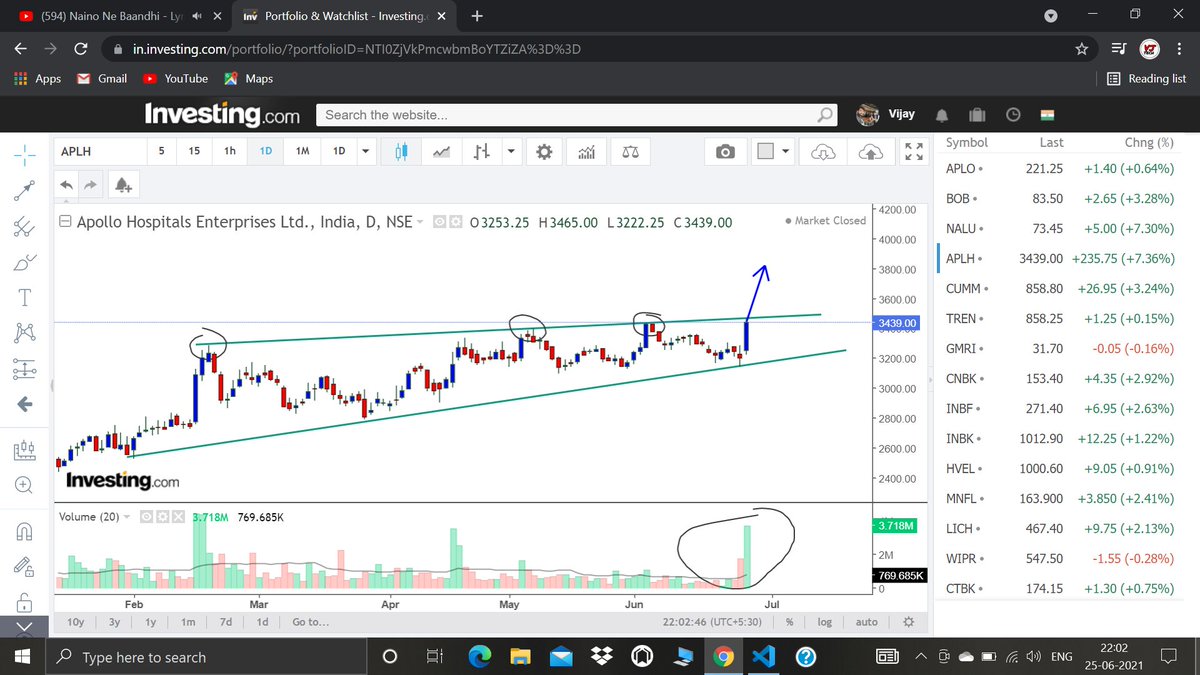
Ready to break the rising channel.
Closing above 3490 will unfold the next leg of rally towards 4000 and 4500.
Sl will be 3140 on daily clbs
@Rishikesh_ADX @Ankiit001 @kuttrapali26 @Stockstudy8
More from Apollohospitals




This is way faster than I had thought. At 3170.
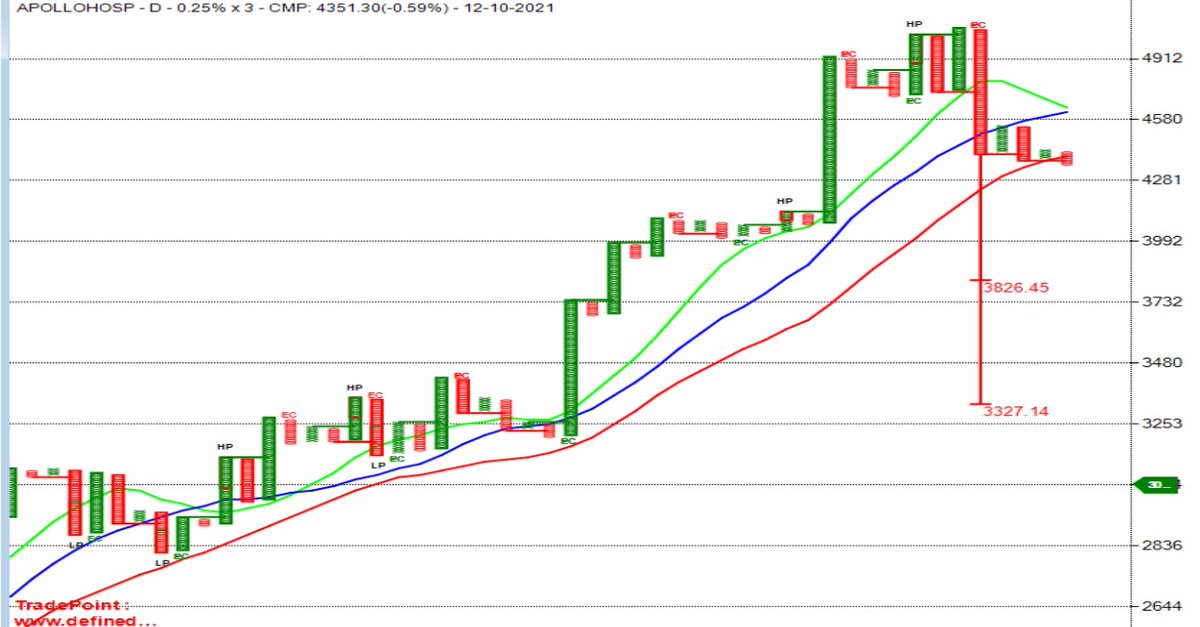
#APOLLOHOSP @ 2110 - Long Term Chart.
— Piyush Chaudhry (@piyushchaudhry) November 12, 2020
I see a fair possibility of the stock rising to 3500-5000 zone over next few years and an open possibility of the next zone of 5000-7500 as well.
Invalidation on break below Blue TL. pic.twitter.com/QJ5aY4eTT8

Almost 3 months taken.
Apollo Hospitals 2915 to 3450, near target.
SL of just 2.5% was not breached for 3 months, imagine the strength in this counter since then.
Net returns nearly 20% in 3 months.
Apollo Hospitals 2915 to 3450, near target.
SL of just 2.5% was not breached for 3 months, imagine the strength in this counter since then.
Net returns nearly 20% in 3 months.
Apollo Hospitals
— Prem Doshi \U0001f1ee\U0001f1f3 (@StocksResearch) April 5, 2021
CMP 2915
SL of 2840
Target 3500+
Covid wave 2 causing a sharp rally in diagnostic lab stocks, should spill over to hospital stocks too, apollo the only F&O stock in hospital sector. pic.twitter.com/F6tS8TX1s2
You May Also Like


I just finished Eric Adler's The Battle of the Classics, and wanted to say something about Joel Christiansen's review linked below. I am not sure what motivates the review (I speculate a bit below), but it gives a very misleading impression of the book. 1/x
The meat of the criticism is that the history Adler gives is insufficiently critical. Adler describes a few figures who had a great influence on how the modern US university was formed. It's certainly critical: it focuses on the social Darwinism of these figures. 2/x
Other insinuations and suggestions in the review seem wildly off the mark, distorted, or inappropriate-- for example, that the book is clickbaity (it is scholarly) or conservative (hardly) or connected to the events at the Capitol (give me a break). 3/x
The core question: in what sense is classics inherently racist? Classics is old. On Adler's account, it begins in ancient Rome and is revived in the Renaissance. Slavery (Christiansen's primary concern) is also very old. Let's say classics is an education for slaveowners. 4/x
It's worth remembering that literacy itself is elite throughout most of this history. Literacy is, then, also the education of slaveowners. We can honor oral and musical traditions without denying that literacy is, generally, good. 5/x
As someone\u2019s who\u2019s read the book, this review strikes me as tremendously unfair. It mostly faults Adler for not writing the book the reviewer wishes he had! https://t.co/pqpt5Ziivj
— Teresa M. Bejan (@tmbejan) January 12, 2021
The meat of the criticism is that the history Adler gives is insufficiently critical. Adler describes a few figures who had a great influence on how the modern US university was formed. It's certainly critical: it focuses on the social Darwinism of these figures. 2/x
Other insinuations and suggestions in the review seem wildly off the mark, distorted, or inappropriate-- for example, that the book is clickbaity (it is scholarly) or conservative (hardly) or connected to the events at the Capitol (give me a break). 3/x
The core question: in what sense is classics inherently racist? Classics is old. On Adler's account, it begins in ancient Rome and is revived in the Renaissance. Slavery (Christiansen's primary concern) is also very old. Let's say classics is an education for slaveowners. 4/x
It's worth remembering that literacy itself is elite throughout most of this history. Literacy is, then, also the education of slaveowners. We can honor oral and musical traditions without denying that literacy is, generally, good. 5/x
