"Noah" is at the point where it's a common enough name where there are lots of Noahs around, but still uncommon enough that people get us confused a lot.
More from Noah Smith
1/OK, data mystery time.
This New York Times feature shows China with a Gini Index of less than 30, which would make it more equal than Canada, France, or the Netherlands. https://t.co/g3Sv6DZTDE
That's weird. Income inequality in China is legendary.
Let's check this number.
2/The New York Times cites the World Bank's recent report, "Fair Progress? Economic Mobility across Generations Around the World".
The report is available here:
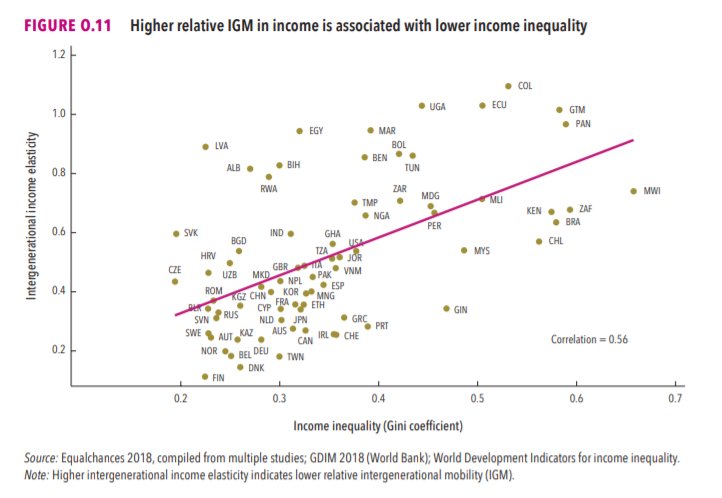
3/The World Bank report has a graph in which it appears to show the same value for China's Gini - under 0.3.
The graph cites the World Development Indicators as its source for the income inequality data.
4/The World Development Indicators are available at the World Bank's website.
Here's the Gini index: https://t.co/MvylQzpX6A
It looks as if the latest estimate for China's Gini is 42.2.
That estimate is from 2012.
5/A Gini of 42.2 would put China in the same neighborhood as the U.S., whose Gini was estimated at 41 in 2013.
I can't find the <30 number anywhere. The only other estimate in the tables for China is from 2008, when it was estimated at 42.8.
This New York Times feature shows China with a Gini Index of less than 30, which would make it more equal than Canada, France, or the Netherlands. https://t.co/g3Sv6DZTDE
That's weird. Income inequality in China is legendary.
Let's check this number.
2/The New York Times cites the World Bank's recent report, "Fair Progress? Economic Mobility across Generations Around the World".
The report is available here:
3/The World Bank report has a graph in which it appears to show the same value for China's Gini - under 0.3.
The graph cites the World Development Indicators as its source for the income inequality data.
4/The World Development Indicators are available at the World Bank's website.
Here's the Gini index: https://t.co/MvylQzpX6A
It looks as if the latest estimate for China's Gini is 42.2.
That estimate is from 2012.
5/A Gini of 42.2 would put China in the same neighborhood as the U.S., whose Gini was estimated at 41 in 2013.
I can't find the <30 number anywhere. The only other estimate in the tables for China is from 2008, when it was estimated at 42.8.
This is so dumb and incorrect and wrong it's unbelievable.
Facts.
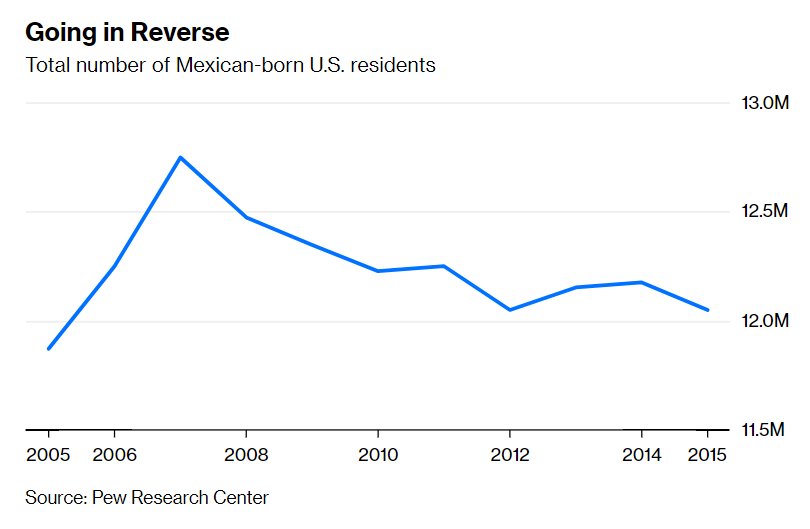
Facts!!
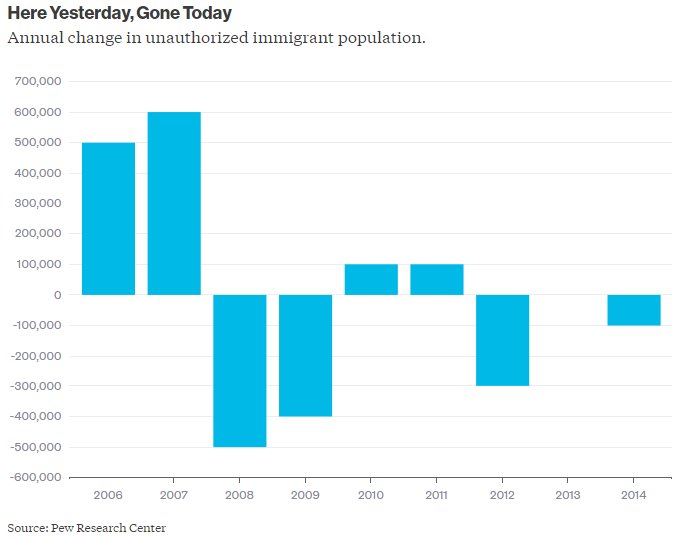
FACTS FACTS
Moar
Secretary of State Mike Pompeo said the U.S. is quickly approaching \u201ca moment of crisis\u201d because of the \u201crecord number of migrants\u201d spilling into the country https://t.co/QuiWPcXswA
— POLITICO (@politico) October 20, 2018
Facts.
Facts!!
FACTS FACTS
Moar
1/I'm thinking about the end of Apu in the context of the national debates on immigration and diversity.
2/Apu's presence in Springfield represented a basic reality of America in the late 20th and early 21st century: the presence of nonwhite immigrants.
3/As Tomas Jimenez writes in "The Other Side of Assimilation", for my generation, immigrants from India, China, Mexico, and many other countries aren't strange or foreign. On the contrary, they're a
4/But that America I grew up with is fundamentally ephemeral. The kids of immigrants don't retain their parents' culture. They merge into the local culture (and, as Jimenez documents, the local culture changes to reflect their influence).
5/Simpsons character don't change. But real people, and real communities, do. So a character who once represented the diversity that immigrants brought to American towns now represents a stereotype of Indian-Americans as "permanent foreigners".
\u2018The Simpsons\u2019 producer confirms Apu is being written out of show following controversy https://t.co/lKzFCe1wFa pic.twitter.com/s34IUDUtqs
— NME (@NME) October 26, 2018
2/Apu's presence in Springfield represented a basic reality of America in the late 20th and early 21st century: the presence of nonwhite immigrants.
3/As Tomas Jimenez writes in "The Other Side of Assimilation", for my generation, immigrants from India, China, Mexico, and many other countries aren't strange or foreign. On the contrary, they're a
4/But that America I grew up with is fundamentally ephemeral. The kids of immigrants don't retain their parents' culture. They merge into the local culture (and, as Jimenez documents, the local culture changes to reflect their influence).
5/Simpsons character don't change. But real people, and real communities, do. So a character who once represented the diversity that immigrants brought to American towns now represents a stereotype of Indian-Americans as "permanent foreigners".