Creators: Content creation SUCKS.

Me in 5 months:

26,000 followers on Twitter
13,000 followers on LinkedIn
5,000 newsletter subscribers

Here's my dead-simple content strategy (steal it for free):

Tweets: 3x per day

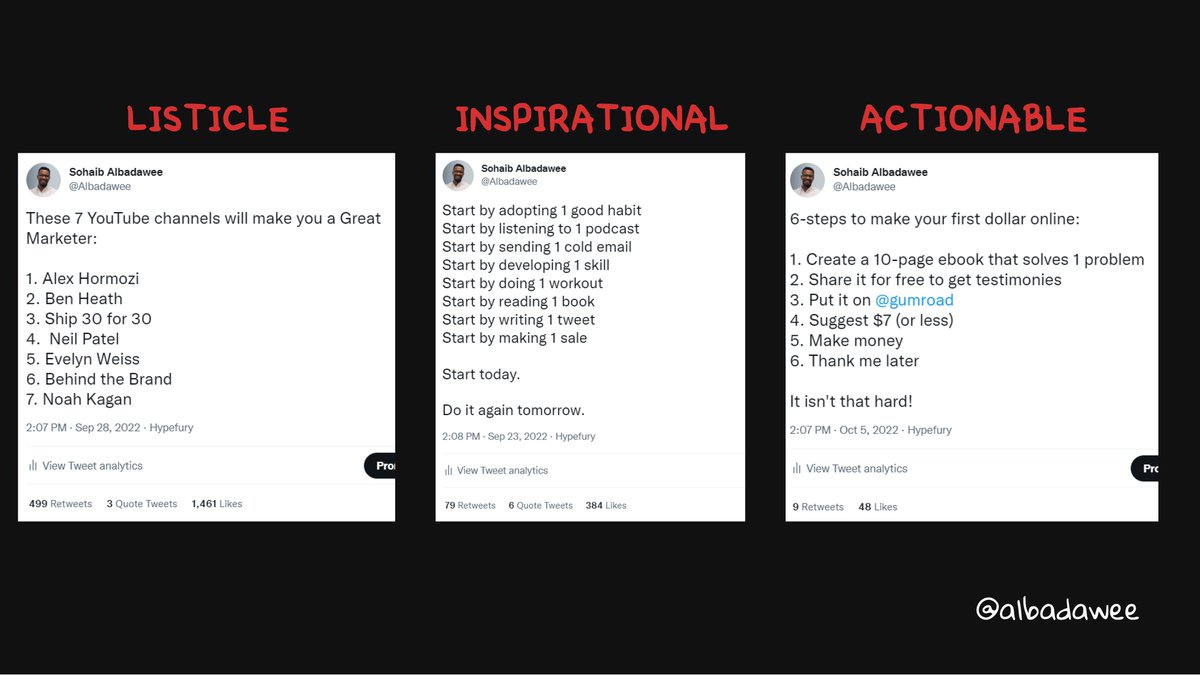
11 am: Inspirational
2 pm: How to/advice
8 pm: Opinion/ Build in public

→ Balance your Tweets between authority & authenticity.
Threads: 3x per week

Tuesday: Process breakdown

Thursday: Listicle/ lessons

Saturday: In-depth systems

→ Use threads to attract new followers & nurture existing ones
LinkedIn posts: 1x per day

Monday: Tweet screenshot

Tuesday/Thursday/Saturday: Carousel

Wednesday: High-value tip

Friday: Newsletter trailer

Sunday: Newsletter article

→ Pro tip: Repurpose your threads into carousels for LinkedIn

How?
How to repurpose threads into Carousels:

1. Use taplio .com/carousel (free).

2. Use contentdrips. com (paid product).

3. Hire someone on Fiverr to create a Canva template.
Engagement: 45 - 60 mins per day

AM: Twitter (15 mins)
AM: LinkedIn (15 mins)

PM: Twitter (15 mins)
PM: LinkedIn (15 mins)

→ Block 15 mins slots on your calendar.

→ Don't do it all in one go, break it down for better results.
Growth Tribe Newsletter: 1x per week

Rules for my newsletter:

•Read under 6 mins
•Actionable
•No-fluff

→ Pick & follow a strategy for your Newsletter.

https://t.co/nPxw0nech0
Growth Tribe Newsletter Promo

Friday: Newsletter Trailer (Twitter/LinkedIn)

Sunday: Newsletter(Twitter/LinkedIn)

→ Promote your newsletter and entice others to join https://t.co/n97JcumgHk
TLDR: My content strategy:

Tweets: 3x per day
Threads: 2x per week
LinkedIn posts: 1x per day
Engagement: 60 mins per day
Growth Tribe Newsletter: 1x per week
Growth Tribe Newsletter Promos: Trailer & Review.

That's it.
If you enjoyed this thread:

• Follow me @albadawee on my journey from 0 to $1M.
• Like/Comment/ RT to help your friends up their content game. https://t.co/6fadsbGx5C

More from All

🌺श्री गरुड़ पुराण - संक्षिप्त वर्णन🌺

हिन्दु धर्म के 18 पुराणों में से एक गरुड़ पुराण का हिन्दु धर्म में बड़ा महत्व है। गरुड़ पुराण में मृत्यु के बाद सद्गती की व्याख्या मिलती है। इस पुराण के अधिष्ठातृ देव भगवान विष्णु हैं, इसलिए ये वैष्णव पुराण है।


गरुड़ पुराण के अनुसार हमारे कर्मों का फल हमें हमारे जीवन-काल में तो मिलता ही है परंतु मृत्यु के बाद भी अच्छे बुरे कार्यों का उनके अनुसार फल मिलता है। इस कारण इस पुराण में निहित ज्ञान को प्राप्त करने के लिए घर के किसी सदस्य की मृत्यु के बाद का समय निर्धारित किया गया है...

..ताकि उस समय हम जीवन-मरण से जुड़े सभी सत्य जान सकें और मृत्यु के कारण बिछडने वाले सदस्य का दुख कम हो सके।
गरुड़ पुराण में विष्णु की भक्ति व अवतारों का विस्तार से उसी प्रकार वर्णन मिलता है जिस प्रकार भगवत पुराण में।आरम्भ में मनु से सृष्टि की उत्पत्ति,ध्रुव चरित्र की कथा मिलती है।


तदुपरांत सुर्य व चंद्र ग्रहों के मंत्र, शिव-पार्वती मंत्र,इन्द्र सम्बंधित मंत्र,सरस्वती मंत्र और नौ शक्तियों के बारे में विस्तार से बताया गया है।
इस पुराण में उन्नीस हज़ार श्लोक बताए जाते हैं और इसे दो भागों में कहा जाता है।
प्रथम भाग में विष्णुभक्ति और पूजा विधियों का उल्लेख है।

मृत्यु के उपरांत गरुड़ पुराण के श्रवण का प्रावधान है ।
पुराण के द्वितीय भाग में 'प्रेतकल्प' का विस्तार से वर्णन और नरकों में जीव के पड़ने का वृत्तांत मिलता है। मरने के बाद मनुष्य की क्या गति होती है, उसका किस प्रकार की योनियों में जन्म होता है, प्रेत योनि से मुक्ति के उपाय...
How can we use language supervision to learn better visual representations for robotics?

Introducing Voltron: Language-Driven Representation Learning for Robotics!

Paper: https://t.co/gIsRPtSjKz
Models: https://t.co/NOB3cpATYG
Evaluation: https://t.co/aOzQu95J8z

🧵👇(1 / 12)


Videos of humans performing everyday tasks (Something-Something-v2, Ego4D) offer a rich and diverse resource for learning representations for robotic manipulation.

Yet, an underused part of these datasets are the rich, natural language annotations accompanying each video. (2/12)

The Voltron framework offers a simple way to use language supervision to shape representation learning, building off of prior work in representations for robotics like MVP (
https://t.co/Pb0mk9hb4i) and R3M (https://t.co/o2Fkc3fP0e).

The secret is *balance* (3/12)

Starting with a masked autoencoder over frames from these video clips, make a choice:

1) Condition on language and improve our ability to reconstruct the scene.

2) Generate language given the visual representation and improve our ability to describe what's happening. (4/12)

By trading off *conditioning* and *generation* we show that we can learn 1) better representations than prior methods, and 2) explicitly shape the balance of low and high-level features captured.

Why is the ability to shape this balance important? (5/12)

You May Also Like

A brief analysis and comparison of the CSS for Twitter's PWA vs Twitter's legacy desktop website. The difference is dramatic and I'll touch on some reasons why.

Legacy site *downloads* ~630 KB CSS per theme and writing direction.

6,769 rules
9,252 selectors
16.7k declarations
3,370 unique declarations
44 media queries
36 unique colors
50 unique background colors
46 unique font sizes
39 unique z-indices

https://t.co/qyl4Bt1i5x


PWA *incrementally generates* ~30 KB CSS that handles all themes and writing directions.

735 rules
740 selectors
757 declarations
730 unique declarations
0 media queries
11 unique colors
32 unique background colors
15 unique font sizes
7 unique z-indices

https://t.co/w7oNG5KUkJ


The legacy site's CSS is what happens when hundreds of people directly write CSS over many years. Specificity wars, redundancy, a house of cards that can't be fixed. The result is extremely inefficient and error-prone styling that punishes users and developers.

The PWA's CSS is generated on-demand by a JS framework that manages styles and outputs "atomic CSS". The framework can enforce strict constraints and perform optimisations, which is why the CSS is so much smaller and safer. Style conflicts and unbounded CSS growth are avoided.