The Puranas and epics narrate the genealogies of kings and their achievements. But they are not arranged in a
What is Indian Literary Sources
The ancient Indian literature is mostly religious in nature.
The Puranic and Epic literature are considered as history by Indians, but it contains no definite dates for events and kingdoms.

The Puranas and epics narrate the genealogies of kings and their achievements. But they are not arranged in a
The Vedic literature contains mainly the four Vedas i.e. Rigveda, Yajurveda, Samaveda, and Atharvanaveda.
The Vedic literature is in a different language called as the Vedic language. Its vocabulary contains a wide range of meaning and is different in
The Vedas give reliable information about the culture and civilization of the Vedic period, but do not reveal the political history.
Six Vedangas are the important limbs
Siksha (Phonetics)
Kalpa (Rituals)
Vyakarna (Grammar)
Nirukta (Etymology)
Chhanda (Metrics) and
Jyotisha (Astronomy).
Vedanga has been written in the precepts (sutra) form.
Ashtadhyayi (eight chapters), written by Panini, is a book on grammar that gives excellent information on the art of writing in sutra (precepts).
The later
Brahmanas gives a description of Vedic rituals.
Aranyakas and Upanishads give speeches on different spiritual and philosophical problems.
The Ramayana and the Mahabharata are epics of great historical importance.
The Jain and the Buddhist literature had been written in Prakrit and Pali languages.
Early Jain literature is mostly written in
More from तहक्षी™






More from All










1. Mini Thread on Conflicts of Interest involving the authors of the Nature Toilet Paper:
https://t.co/VUYbsKGncx
Kristian G. Andersen
Andrew Rambaut
Ian Lipkin
Edward C. Holmes
Robert F. Garry
2. Thanks to @newboxer007 for forwarding the link to the research by an Australian in Taiwan (not on
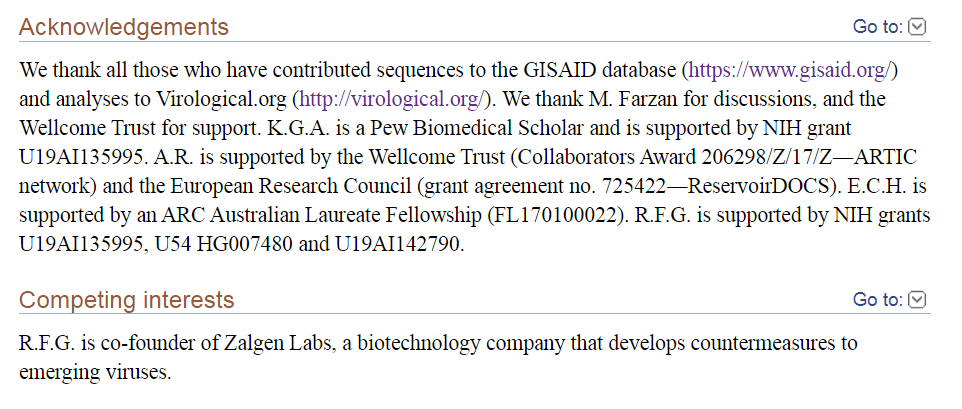
3. K.Andersen didn't mention "competing interests"
Only Garry listed Zalgen Labs, which we will look at later.
In acknowledgements, Michael Farzan, Wellcome Trust, NIH, ERC & ARC are mentioned.
Author affiliations listed as usual.
Note the 328 Citations!
https://t.co/nmOeohM89Q
4. Kristian Andersen (1)
Andersen worked with USAMRIID & Fort Detrick scientists on research, with Robert Garry, Jens Kuhn & Sina Bavari among
5. Kristian Andersen (2)
Works at Scripps Research Institute, which WAS in serious financial trouble, haemorrhaging 20 million $ a year.
But just when the first virus cases were emerging, they received great news.
They issued a press release dated November 27, 2019:
https://t.co/VUYbsKGncx
Kristian G. Andersen
Andrew Rambaut
Ian Lipkin
Edward C. Holmes
Robert F. Garry
2. Thanks to @newboxer007 for forwarding the link to the research by an Australian in Taiwan (not on
3. K.Andersen didn't mention "competing interests"
Only Garry listed Zalgen Labs, which we will look at later.
In acknowledgements, Michael Farzan, Wellcome Trust, NIH, ERC & ARC are mentioned.
Author affiliations listed as usual.
Note the 328 Citations!
https://t.co/nmOeohM89Q
4. Kristian Andersen (1)
Andersen worked with USAMRIID & Fort Detrick scientists on research, with Robert Garry, Jens Kuhn & Sina Bavari among
Our Hans Kristian Andersen working with Jens H. Kuhn, Sina Bavari, Robert F. Garry, Stuart T. Nichol,Gustavo Palacios, Sheli R. Radoshitzky from USAMRIID and Fort Detrick to tell more fairy tales? Full emails listed for queries...https://t.co/kLRoQTxiGD pic.twitter.com/uHNuGraPP2
— Billy Bostickson \U0001f3f4\U0001f441&\U0001f441 \U0001f193 (@BillyBostickson) August 26, 2020
5. Kristian Andersen (2)
Works at Scripps Research Institute, which WAS in serious financial trouble, haemorrhaging 20 million $ a year.
But just when the first virus cases were emerging, they received great news.
They issued a press release dated November 27, 2019: