Once @chamath explained how they put Facebook on the path to 1 billion users. 🚀

He ignored the idea of ‘making it viral’. Instead, he decided to focus on making the product useful for the user.

Find more below 👇

Understand core product value i.e. define ‘a-ha moment’.

At Facebook, it was creating a real connection with someone.

PS: Core product value is really elusive and most products don’t have any. 🤷‍♂️
A massive amount of complexity compressed in simplicity can be extremely useful.

The growth team created a framework in which they applied 3 very simple principles:

1⃣ Measuring
2⃣ Testing
3⃣ Trying
However, at some point, viral actions started driving growth. Chamath strongly opposed.

You need to know where the real growth comes from.

‘Do not focus on viral actions. Don’t touch it.’
Instead, they focused on the 3 most difficult and hard problems that any consumer product has to deal with:

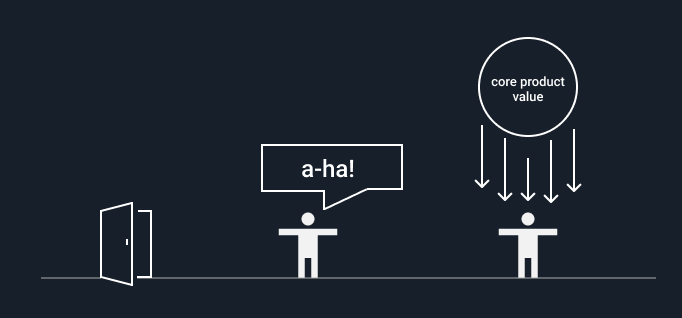
✅ How to get people at the front door
✅ How to get them to ‘a-ha moment’ as quickly as possible
✅ How to deliver them core product value as often as possible
You have to figure out the metrics for the above and then ignore the urge to just 'go with your gut' without testing. This is usually due to ego: someone wants to feel that their 'gut' is right.
So, figure out the above metrics and figure out how to improve them. 📈

Things that scale understand that principle, intuitively or explicitly.
‘After all of this is done, you can think about how to make people get more people.

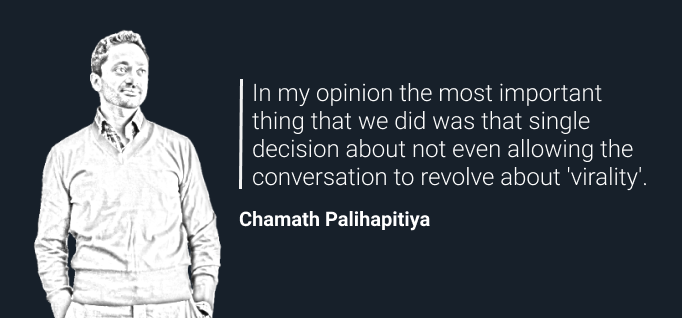
That single decision about not even allowing the conversation to revolve about 'virality' in my opinion was the most important thing that we did.’
It is the discipline to not optimize for short things that give you the shortest and most immediate ROI. It is never sustainable that allows you to build something useful.
1⃣ Give up ego. You have to be comfortable not being rewarded in the short-term.
2⃣ Invalidate all of the lore. Disapprove all of the random anecdotal nonsense. Do not believe in the ‘gut feeling’. Most people are wrong.
Most people don’t have a culture that allows those two things to happen in the company. 🤷‍♂️

Don’t believe in BS. Otherwise, you start to compound two massively structural mistakes:

❌ Don’t expose core product value
❌ Don’t allow real engagement and real product value to emerge
Important footnote ❗️
Don’t alienate long tail. They trust you and use the product. It is the biggest risk.

It is not visible in top-level metrics. 👀
After all the testing and the iterating single biggest thing they realized was to get any individual to 7 friends in 10 days. Keystone. Not much more complexity.
From that point, nothing else was important. Every meeting was all about it. No monetization. Nothing else. Full focus.

With the potential for huge network effects, they didn't want to do anything to slow down until they got the network effects.
'Everything else was easy after we understood the core strategy.'

The most important framework you can organize on an entire company.
When you look at big companies now that often face stock fluctuations and you may think it is a growth problem.

It seems numerically as a growth problem.

What it really is is product value and culture problem.

They should come back to the basics 👇
https://t.co/enVMovDfFQ

More from All

MASTER THREAD on Short Strangles.

Curated the best tweets from the best traders who are exceptional at managing strangles.

• Positional Strangles
• Intraday Strangles
• Position Sizing
• How to do Adjustments
• Plenty of Examples
• When to avoid
• Exit Criteria

How to sell Strangles in weekly expiry as explained by boss himself. @Mitesh_Engr

• When to sell
• How to do Adjustments
• Exit


Beautiful explanation on positional option selling by @Mitesh_Engr
Sir on how to sell low premium strangles yourself without paying anyone. This is a free mini course in


1st Live example of managing a strangle by Mitesh Sir. @Mitesh_Engr

• Sold Strangles 20% cap used
• Added 20% cap more when in profit
• Booked profitable leg and rolled up
• Kept rolling up profitable leg
• Booked loss in calls
• Sold only


2nd example by @Mitesh_Engr Sir on converting a directional trade into strangles. Option Sellers can use this for consistent profit.

• Identified a reversal and sold puts

• Puts decayed a lot

• When achieved 2% profit through puts then sold
1. Mini Thread on Conflicts of Interest involving the authors of the Nature Toilet Paper:
https://t.co/VUYbsKGncx
Kristian G. Andersen
Andrew Rambaut
Ian Lipkin
Edward C. Holmes
Robert F. Garry

2. Thanks to @newboxer007 for forwarding the link to the research by an Australian in Taiwan (not on

3. K.Andersen didn't mention "competing interests"
Only Garry listed Zalgen Labs, which we will look at later.
In acknowledgements, Michael Farzan, Wellcome Trust, NIH, ERC & ARC are mentioned.
Author affiliations listed as usual.
Note the 328 Citations!
https://t.co/nmOeohM89Q


4. Kristian Andersen (1)
Andersen worked with USAMRIID & Fort Detrick scientists on research, with Robert Garry, Jens Kuhn & Sina Bavari among


5. Kristian Andersen (2)
Works at Scripps Research Institute, which WAS in serious financial trouble, haemorrhaging 20 million $ a year.
But just when the first virus cases were emerging, they received great news.
They issued a press release dated November 27, 2019:

You May Also Like

The YouTube algorithm that I helped build in 2011 still recommends the flat earth theory by the *hundreds of millions*. This investigation by @RawStory shows some of the real-life consequences of this badly designed AI.


This spring at SxSW, @SusanWojcicki promised "Wikipedia snippets" on debated videos. But they didn't put them on flat earth videos, and instead @YouTube is promoting merchandising such as "NASA lies - Never Trust a Snake". 2/


A few example of flat earth videos that were promoted by YouTube #today:
https://t.co/TumQiX2tlj 3/

https://t.co/uAORIJ5BYX 4/

https://t.co/yOGZ0pLfHG 5/
A THREAD ON @SarangSood

Decoded his way of analysis/logics for everyone to easily understand.

Have covered:
1. Analysis of volatility, how to foresee/signs.
2. Workbook
3. When to sell options
4. Diff category of days
5. How movement of option prices tell us what will happen

1. Keeps following volatility super closely.

Makes 7-8 different strategies to give him a sense of what's going on.

Whichever gives highest profit he trades in.


2. Theta falls when market moves.
Falls where market is headed towards not on our original position.


3. If you're an options seller then sell only when volatility is dropping, there is a high probability of you making the right trade and getting profit as a result

He believes in a market operator, if market mover sells volatility Sarang Sir joins him.


4. Theta decay vs Fall in vega

Sell when Vega is falling rather than for theta decay. You won't be trapped and higher probability of making profit.
This is a pretty valiant attempt to defend the "Feminist Glaciology" article, which says conventional wisdom is wrong, and this is a solid piece of scholarship. I'll beg to differ, because I think Jeffery, here, is confusing scholarship with "saying things that seem right".


The article is, at heart, deeply weird, even essentialist. Here, for example, is the claim that proposing climate engineering is a "man" thing. Also a "man" thing: attempting to get distance from a topic, approaching it in a disinterested fashion.


Also a "man" thing—physical courage. (I guess, not quite: physical courage "co-constitutes" masculinist glaciology along with nationalism and colonialism.)


There's criticism of a New York Times article that talks about glaciology adventures, which makes a similar point.


At the heart of this chunk is the claim that glaciology excludes women because of a narrative of scientific objectivity and physical adventure. This is a strong claim! It's not enough to say, hey, sure, sounds good. Is it true?