but now I get that option in the titlebar of "search twitter self-search" which is the name of the search"
if I just type "foone blah" now...
it ignores the search I have had defined for years and just googles it.
and this is definitely on purpose because they didn't just break it, they changed it. it's now "foone
blah"
there doesn't seem to be an option to make this stop and get the old behavior back :(
I could mostly fix it by hacking around it: write my own "search engine" which redirects to google if the text doesn't start with "foone "
but
1. this will break the "searched from the address bar" magic, which means google will make me do captchas if I search too fast
2. it will break search suggestions too
this workaround works. although from the comments on the bug that might also be a bug and they'll "fix" that workingness later.
https://t.co/KShHdCMzeT
I like the bullshittery of the developer question of "What appeals to you about space vs. tab?"
which I can't accurately reply to because twitter doesn't let me use 72pt font
here's why it appeals to me:
1. this is how it's been for years. I can type "foone blah" faster than you can blink, man. it's the #1 thing I DO in my browser. what appeals to me is THIS IS HOW IT FUCKING WORKS, DIPSHIT. CHANGING THINGS BECAUSE YOU FEEL LIKE IT IS NOT FUN
2. the space key is placed under one of my fingers while typing, because, and this may shock you, it's heavily used when typing english text.
it's a very common key to press. the tab key is not so centrally located, because it's rare.
AND I SAY THAT AS A PYTHON PROGRAMMER
why don't we change it to ctrl-alt-F12?
What appeals to you about space over ctrl-alt-f12, dipshit?
3. and probably most importantly:
SPACE IS HOW IT WORKS IN OTHER BROWSERS MOTHERFUCKER
I don't just use Chrome. I use Firefox almost as much. Hell, if I go into IE, which I haven't since like 2006, I bet it works using space over there too
Are you just trying to make it incompatible with firefox to punish people who dare use more than one browser?
Because having used multiple OSes/Browsers/Etc for years I can tell you one thing I've learned is that while muscle memory is 100% a thing and it can be retrained, what it's very much NOT good at is the idea of having muscle memory that's contextual.
it's way harder to remember "type foo blah on firefox, and type foo
blah on chrome" than it would be to switch from "type foo blah" to "type fooblah" everywhere, for example.
this is why I have a set of hotkeys on my keyboard which do things like open a terminal and they were carefully set up to work exactly the same on my windows machine and my linux machine, so that I don't have to remember "ctrl-alt-t for a terminal on windows, and meta-T on linux"
so this "just use foone
blah!" solution would only work (and I say "work" very loosely. I wouldn't be happy with this solution) if I never used firefox ever again.
WHICH I'M SURE YOU'D LOVE
my favorite example of "no contextual muscle memory" is when I have to switch between a "classic layout" keyboard and one with a function key in the lower-left, like a thinkpad or that BTC-compact keyboard I use so much
every time that happens you WILL end up doing function-C and wondering why it doesn't copy and/or kill the program
That's why, for my Thinkpad, I've got the BIOS option to swap the keys turned on, and I even got stickers to relabel them.
Haven't yet figured out a solution for my BTC-5100.
Maybe I could swap the keycaps and mod the key matrix or reflash the controller?
think about that for a second.
I have a keyboard from the mid-90s and I'm thinking about dumping a 8051 firmware, reverse engineering it, modifying it, and reflashing it onto the keyboard just to eliminate a tiny source of friction in using it.
THAT'S HOW MUCH WORK I'M WILLING TO DO JUST TO AVOID THE PROBLEM OF OCCASIONALLY HITING FUNCTION-C ACCCIDENTALLY
EXACTLY HOW PISSED DO YOU THINK I AM THAT YOU BROKE ONE OF THE MAIN THINGS I DO IN YOUR BROWSER?
hmmm. It's definitely an 8051 but it's a custom-made one:
C32191AE or 1001000220 have no results.
maybe I should just stick it in my EEPROM reader and see if it can dump it as a generic 8051, then flash the modded code onto a replacement flash-enabled 8051?
Gah, this is going to be a pain to mod.
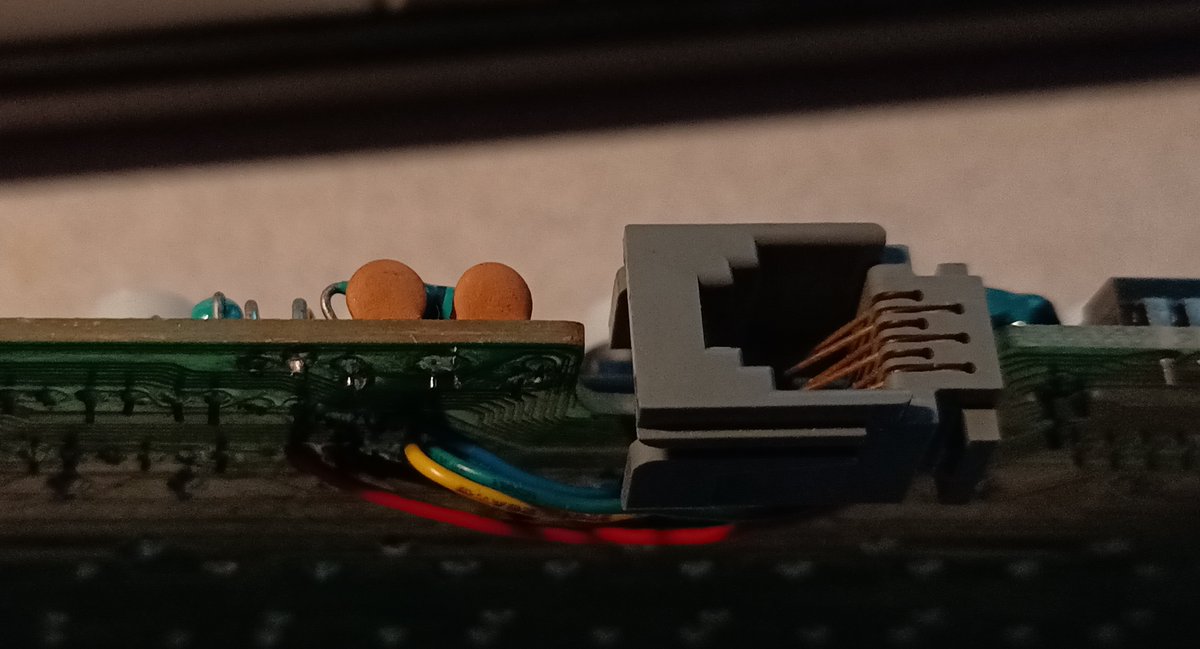
I'd want to desolder the 8051, but look, this controller PCB is basically sitting on top of the main keyboard PCB
And you can sorta see here that there's no connector between the two boards. They just soldered some pins onto the bottom board and then soldered them into the top board.
I assume they did this (rather than just making the bottom PCB double-sided and including all the components on it) is that either they needed more room to route the top components, or they use the bottom PCB for multiple "keyboards"
like this is the PS/2 version but I bet there was an AT version (which is just a different cable, really) and an XT/AT switchable version. and if they ever wanted to make like a Sun version of an ADB version, they could just swap the controller board.
still.
connectors, man. use connectors.
otherwise some punk yelling about web browsers is gonna get annoyed at you 28 years later.
what's a web browser? OH, YOU'LL SEE!
(although to be accurate, Mosaic was released in 1993 so there's every possibility they could have known what a web browser was)
the first major web browser is older than Doom. That's not something that feels like it should be true.
and the first FIRST web browser is older than The Legend of Zelda: A Link to the Past.
It's older than the US release of the Super Nintendo.
That was WorldWideWeb (aka Nexus), launched in December 1990.
it was released to the general public in August 1991.
Zelda: A Link To The Past, The US release of the Super Nintendo, and the dissolution of the USSR hadn't happened yet, but would later that year.
WHEN THE FIRST BROWSER WAS MADE, THE TWO MAIN FOUNDERS OF GOOGLE WEREN'T OLD ENOUGH TO VOTE YET
Oh hey, its's a Foam-and-Foil keyboard.
This use a capacitive method to detect key presses. These seem to have been liked by some companies as a better feeling keyboard than a membrane, but the foam sometimes completely disintegrates so they don't last forever.
Here's the other side. This one seems to be still doing fine after 28 years, though.
You can see there's a little foam pad under the foil.
This is apparently for "overtravel". The key actually is detected shortly after you start pushing it down, but to make it feel like you can push it down farther, the foam is there and gets compressed.
Several companies made these, like Cherry and Key Tronic and, of course, BTC.
https://t.co/syXLRu6Rly
TexElec makes replacements in case you need to fix one of these. THANKFULLY I don't, at least not yet.
https://t.co/8xEis5WHID
Anyway I was looking at the key matrix to see if I could easily just adjust these to make ctrl and function switch. Not really, no.
The two pins in the middle go off to other keys (since it's a matrix) so I can't really swap them without affecting other ones
What I could do is chop the traces here, scrape off the solder max, and cross-connect them.
This would be hard because they'd have to cross, so I'd either have to use insulating layers or drill through to the other side.
plus, this is capacitive, and who knows what the tolerances are on that? it's entirely possible that doing all this modding will change the capacitance and now the keys don't work.
so I don't think that's a very good solution. Changing the controller is probably a much better one.
I'm also not sure what those two solder blobs are about.
The ones on top are for a reverse-side jumper connection.
But if you look at the opposite side (I mirrored it so they'll match) you can see that those aren't vias, there's no hole here. It's solely on the top, not the bottom.
by the way, BTC is still around! They just don't make keyboards anymore:
https://t.co/vh3qJTKdSs