
20 Things I've Learned (Or Had Confirmed) About Humanity During The 'Pandemic' (THREAD):
1/ Most people would rather be in the majority, than be right.
21/ Most people are fairly compassionate and have good intentions (this is good)
As a result, most people deeply struggle to understand that some people, including our 'leaders', CAN have malicious or perverse intentions (this is bad).
New guests and insightful conversations every week!
https://t.co/eYOm80ptdH
You May Also Like


1/Politics thread time.
To me, the most important aspect of the 2018 midterms wasn't even about partisan control, but about democracy and voting rights. That's the real battle.
2/The good news: It's now an issue that everyone's talking about, and that everyone cares about.
3/More good news: Florida's proposition to give felons voting rights won. But it didn't just win - it won with substantial support from Republican voters.
That suggests there is still SOME grassroots support for democracy that transcends
4/Yet more good news: Michigan made it easier to vote. Again, by plebiscite, showing broad support for voting rights as an
5/OK, now the bad news.
We seem to have accepted electoral dysfunction in Florida as a permanent thing. The 2000 election has never really
To me, the most important aspect of the 2018 midterms wasn't even about partisan control, but about democracy and voting rights. That's the real battle.
2/The good news: It's now an issue that everyone's talking about, and that everyone cares about.
3/More good news: Florida's proposition to give felons voting rights won. But it didn't just win - it won with substantial support from Republican voters.
That suggests there is still SOME grassroots support for democracy that transcends
4/Yet more good news: Michigan made it easier to vote. Again, by plebiscite, showing broad support for voting rights as an
5/OK, now the bad news.
We seem to have accepted electoral dysfunction in Florida as a permanent thing. The 2000 election has never really
Bad ballot design led to a lot of undervotes for Bill Nelson in Broward Co., possibly even enough to cost him his Senate seat. They do appear to be real undervotes, though, instead of tabulation errors. He doesn't really seem to have a path to victory. https://t.co/utUhY2KTaR
— Nate Silver (@NateSilver538) November 16, 2018




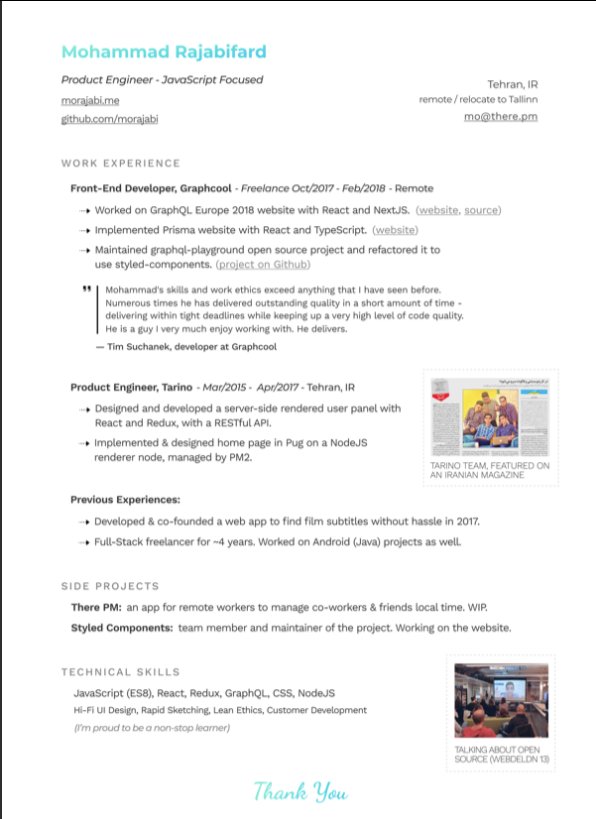
👨💻 Last resume I sent to a startup one year ago, sharing with you to get ideas:
- Forget what you don't have, make your strength bold
- Pick one work experience and explain what you did in detail w/ bullet points
- Write it towards the role you apply
- Give social proof
/thread
"But I got no work experience..."
Make a open source lib, make a small side project for yourself, do freelance work, ask friends to work with them, no friends? Find friends on Github, and Twitter.
Bonus points:
- Show you care about the company: I used the company's brand font and gradient for in the resume for my name and "Thank You" note.
- Don't list 15 things and libraries you worked with, pick the most related ones to the role you're applying.
-🙅♂️"copy cover letter"
"I got no firends, no work"
One practical way is to reach out to conferences and offer to make their website for free. But make sure to do it good. You'll get:
- a project for portfolio
- new friends
- work experience
- learnt new stuff
- new thing for Twitter bio
If you don't even have the skills yet, why not try your chance for @LambdaSchool? No? @freeCodeCamp. Still not? Pick something from here and learn https://t.co/7NPS1zbLTi
You'll feel very overwhelmed, no escape, just acknowledge it and keep pushing.
- Forget what you don't have, make your strength bold
- Pick one work experience and explain what you did in detail w/ bullet points
- Write it towards the role you apply
- Give social proof
/thread
"But I got no work experience..."
Make a open source lib, make a small side project for yourself, do freelance work, ask friends to work with them, no friends? Find friends on Github, and Twitter.
Bonus points:
- Show you care about the company: I used the company's brand font and gradient for in the resume for my name and "Thank You" note.
- Don't list 15 things and libraries you worked with, pick the most related ones to the role you're applying.
-🙅♂️"copy cover letter"
"I got no firends, no work"
One practical way is to reach out to conferences and offer to make their website for free. But make sure to do it good. You'll get:
- a project for portfolio
- new friends
- work experience
- learnt new stuff
- new thing for Twitter bio
If you don't even have the skills yet, why not try your chance for @LambdaSchool? No? @freeCodeCamp. Still not? Pick something from here and learn https://t.co/7NPS1zbLTi
You'll feel very overwhelmed, no escape, just acknowledge it and keep pushing.