
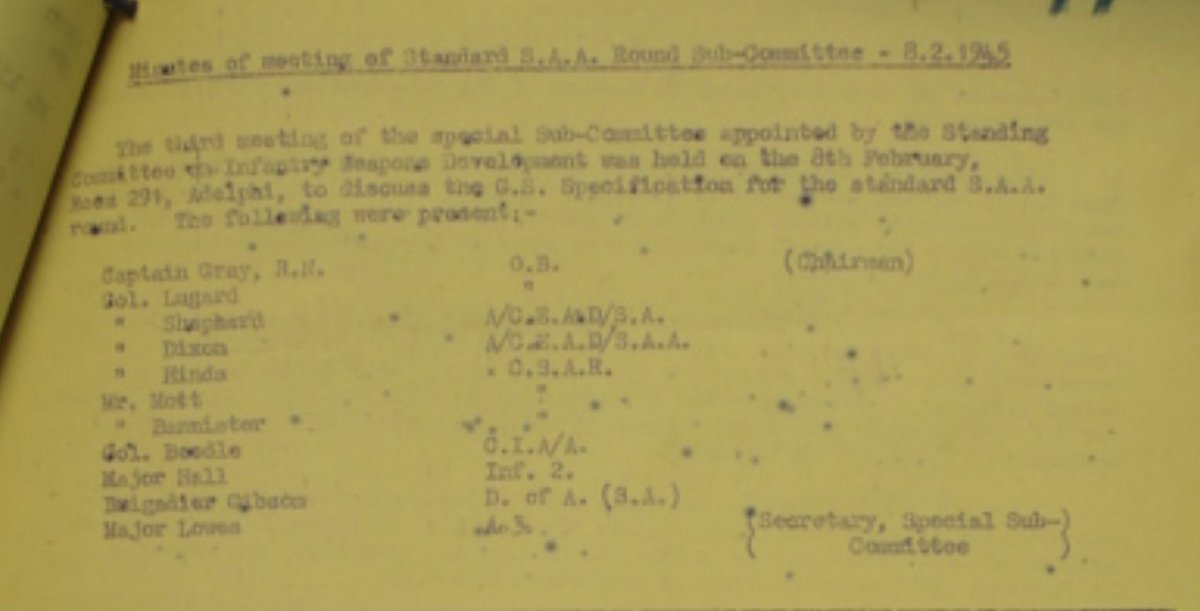
This was a sub-committee of the Standing Committee on Infantry Weapons Development, that was created following the GS policy to adopt rimless SAA.
1b/
So I said that I'd pick up the story of Brigadier Barlow in a subsequent thread.
— Dr Matthew Ford (@warmatters) January 3, 2021
Alongside Colonel Ren\xe9 Studler of the US Ordnance Corps, Brigader Barlow was instrumental in the post-war discussions of small arms ammunition and weapon standardisation.
1/ https://t.co/enkgmY40W4
A thread on the Armament Design Establishment (SA).
— Dr Matthew Ford (@warmatters) December 31, 2020
If we're going to talk post-war small arms & NATO small arms and ammunition standardisation then we also have to talk about the ADE(SA).
This is a photo of the entire Cheshunt establishment in 1945.
1/ pic.twitter.com/HHeap7Imq2
Before I write on engineers we must do some conceptual ground clearing.
— Dr Matthew Ford (@warmatters) December 30, 2020
This is important because my gun threads have led to several questions that have a whiff of determinism about them.
So this is a thread on technological determinism & why it is kryptonite for academics.
1/
He's even more instrumental than the "Ideal Calibre Panel" which was chaired by the operational researcher Dr Richard Beeching, also of the 1963, Reshaping of British Railways, report that Brits regularly go on about.
— Dr Matthew Ford (@warmatters) January 3, 2021
2/ pic.twitter.com/4PzcjfyZm9


(A mini) THREAD:
— Dr Matthew Ford (@warmatters) January 5, 2021
On rimless and standardised small arms ammunition. https://t.co/SGdLbB1loL

A thread outlining my thoughts on Second World War tactics.
— Dr Matthew Ford (@warmatters) December 29, 2020
For me tactics only makes sense when looked at as a socio-technical system. This thread reflects that way of thinking.
Again I'll be using British examples but there are some US crossovers later on.
1/ pic.twitter.com/RKIzj67rj7
*one horrible doctor does a horrible thing* "oh I guess gender is horrible" miss me with that transphobic nonsense
— Goob \u26a1 (@Goob999) February 17, 2021
Here's a video to even disprove your take on sex (not gender) and the binary:https://t.co/bpmqqJWoJX
A THREAD:
— Aditya Todmal (@AdityaTodmal) November 28, 2020
7 FREE OPTION TRADING COURSES FOR BEGINNERS.
Been getting lot of dm's from people telling me they want to learn option trading and need some recommendations.
Here I'm listing the resources every beginner should go through to shorten their learning curve.
(1/10)
The absolute best 15 scanners which experts are using.
— Aditya Todmal (@AdityaTodmal) January 29, 2021
Got these scanners from the following accounts:
1. @Pathik_Trader
2. @sanjufunda
3. @sanstocktrader
4. @SouravSenguptaI
5. @Rishikesh_ADX
Share for the benefit of everyone.
12 TRADING SETUPS which experts are using.
— Aditya Todmal (@AdityaTodmal) February 7, 2021
These setups I found from the following 4 accounts:
1. @Pathik_Trader
2. @sourabhsiso19
3. @ITRADE191
4. @DillikiBiili
Share for the benefit of everyone.
Curated tweets on How to Sell Straddles
— Aditya Todmal (@AdityaTodmal) February 21, 2021
Everything covered in this thread.
1. Management
2. How to initiate
3. When to exit straddles
4. Examples
5. Videos on Straddles
Share if you find this knowledgeable for the benefit of others.


