"You don't see radio changing gradually and suddenly become radar. #Darwin's theory doesn't work for #technology, and we have to make a new observation."

- W Brian Arthur at SFI today

#evolution #innovation #invention

"Novel technologies are constructed from existing technologies. These offer themselves as components for the construction of further technologies."

- W Brian Arthur at SFI today

#evolution #innovation #invention #technology #engineering #design
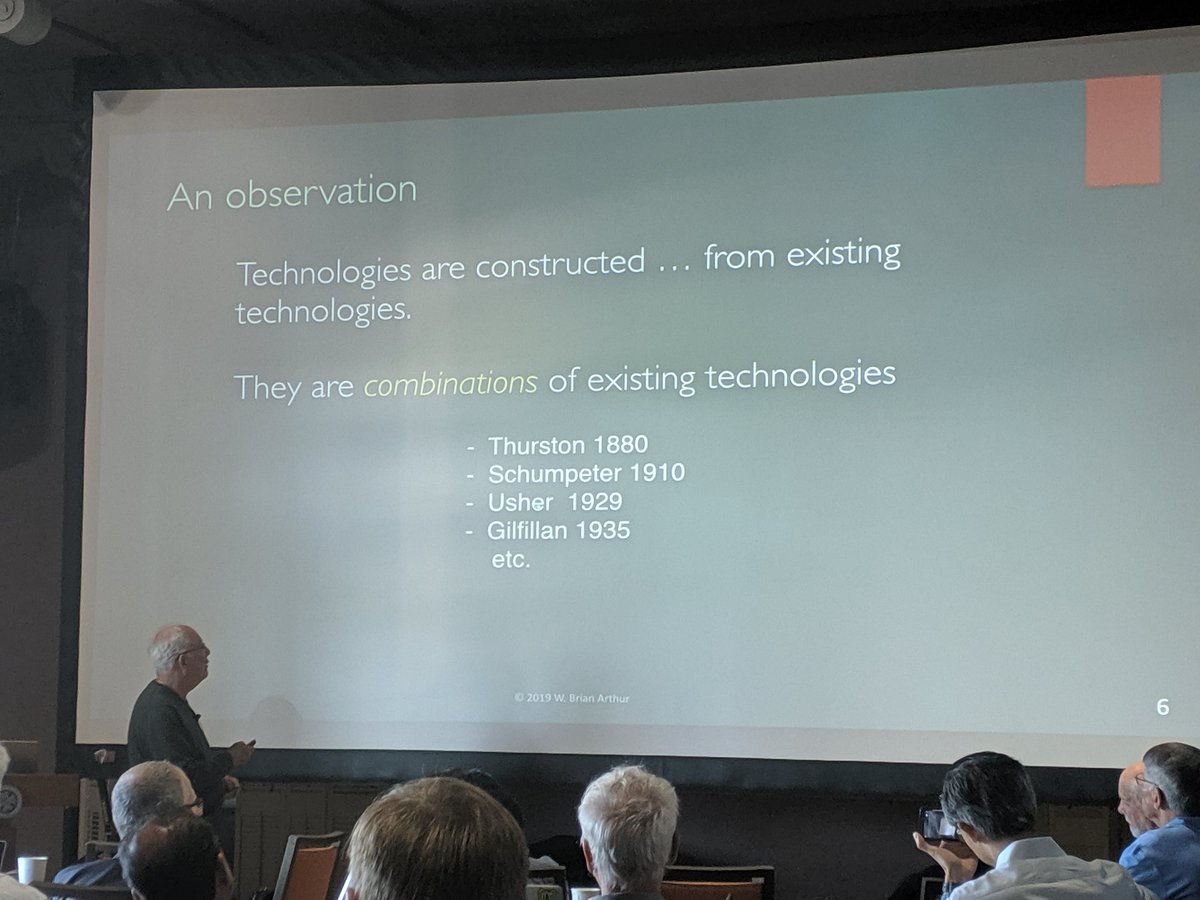
Unlike the two-parent #inheritance typical to (but not ubiquitous among) #complex organisms, #technology inherits features from n parents - a "vast ancestral #network" more like horizontal gene transfer networks in #bacteria.

W Brian Arthur on sumulating #invention on a chip:
Does #Archaeology support the Theory of the #AdjacentPossible - that #innovation is combinatorial, persistent, cumulative?

In short, yes. SFI's Tim Kohler on the #Paleolithic data of #technology #evolution & the #prehistory of the infamous "hockeystick" curve:

😉 @SAPIENS_org
#Economist Roger Koppl of @SyracuseU presents a model for the #AdjacentPossible at SFI.

Output = "a combinatorial explosion" or #singularity, albeit one that arguably occurred millions of years ago, or in the distant future (since the model doesn't specify t = 0):
"We can't have universal models if organisms differ. But most of our models are universal. So how do our models need to differ for species-specific #search?"

- @toppofelin (@UniofOxford) reminds listeners at SFI today that we live in worlds, plural:
#umwelt #suchbild #affordance

More from Science

An interesting thing about carp is that they can go into anoxic hibernation and switch to an anaerobic metabolism based on converting glycogen to ethanol.

The waste ethanol is diffused out the gills

https://t.co/V3D1umHf04

Carp can switch over to an anaerobic metabolism and quietly exhale booze until the situation gets better.

They basically evolved the same metabolic pathway as yeast, independently.

In theory, if you spent a few thousand years breeding carp for it, you could use them to make booze.

They'd be enormous, almost entirely glycogen deposits with a fish added as an afterthought.

The really interesting thing about anaerobic carp, is that they can go 4-5 months without oxygen by relying on liver glycogen.

You, a human, have only about 100 grams of glycogen in your liver, about 400 more grams in your skeletal muscles. Call it 500 grams total.

In humans, glycogen is also burned for energy. This is where the marathon runner's bonk comes from: you only have about 2,000 calories worth, and running a marathon burns those 2,000 calories.

You May Also Like