We therefore changed our strategy"
1. (On politics) I was once in a conversation with an elderly friend of mine who is American. He is deeply involved in politics in the States and I asked about what he had learnt. He said, "our movement pushed and mobilised and we got (.........) into the white house."
We therefore changed our strategy"
There is a lot of space for influence in positions that are non elective. Every executive leader leans on people to help in developing ideas and in executing them.
More from Politics

I think a plausible explanation is that whatever Corbyn says or does, his critics will denounce - no matter how much hypocrisy it necessitates.
Corbyn opposes the exploitation of foreign sweatshop-workers - Labour MPs complain he's like Nigel
He speaks up in defence of migrants - Labour MPs whinge that he's not listening to the public's very real concerns about immigration:
He's wrong to prioritise Labour Party members over the public:
He's wrong to prioritise the public over Labour Party
One of the oddest features of the Labour tax row is how raising allowances, which the media allowed the LDs to describe as progressive (in spite of evidence to contrary) through the coalition years, is now seen by everyone as very right wing
— Tom Clark (@prospect_clark) November 2, 2018
Corbyn opposes the exploitation of foreign sweatshop-workers - Labour MPs complain he's like Nigel
He speaks up in defence of migrants - Labour MPs whinge that he's not listening to the public's very real concerns about immigration:
He's wrong to prioritise Labour Party members over the public:
He's wrong to prioritise the public over Labour Party

THREAD:
Good afternoon, followers of frivolous election litigation. There's a last-minute entry in the competition for dumbest pre-inauguration lawsuit - a totally loony effort to apparently leave the entire USA without a government.
We'll start with the complaint in a minute.
But first, I want to give you a quick explanation for why I'm going to keep talking about these cases even after the inauguration.
They're part of an ongoing effort - one that's not well-coordinated but is widespread - to discredit our fundamental system of government.
It's a direct descendent, in more ways than one, of birtherism. And here's the thing about birtherism. It might have been a joke to a lot of people, but it was extremely pernicious. It obviously validated the racist "not good enough to be President" crowd. But that wasn't all.
Don't get me wrong, that was bad enough. Validating racism helped put the kind of shitbird who would tweet this from an official government account into power. But it didn't stop
(Also, if you agree with Pompeo about multiculturalism - the legendary melting pot - not being what this country is all about, you need to stop following me now. And maybe go somewhere and think about your life choices and what made you such a tool.)
Good afternoon, followers of frivolous election litigation. There's a last-minute entry in the competition for dumbest pre-inauguration lawsuit - a totally loony effort to apparently leave the entire USA without a government.
We'll start with the complaint in a minute.
But first, I want to give you a quick explanation for why I'm going to keep talking about these cases even after the inauguration.
They're part of an ongoing effort - one that's not well-coordinated but is widespread - to discredit our fundamental system of government.
It's a direct descendent, in more ways than one, of birtherism. And here's the thing about birtherism. It might have been a joke to a lot of people, but it was extremely pernicious. It obviously validated the racist "not good enough to be President" crowd. But that wasn't all.
Don't get me wrong, that was bad enough. Validating racism helped put the kind of shitbird who would tweet this from an official government account into power. But it didn't stop
Woke-ism, multiculturalism, all the -isms \u2014 they're not who America is. They distort our glorious founding and what this country is all about. Our enemies stoke these divisions because they know they make us weaker. pic.twitter.com/Mu97xCgxfS
— Secretary Pompeo (@SecPompeo) January 19, 2021
(Also, if you agree with Pompeo about multiculturalism - the legendary melting pot - not being what this country is all about, you need to stop following me now. And maybe go somewhere and think about your life choices and what made you such a tool.)


Here's why I bother to do the search, and even take the time to check.
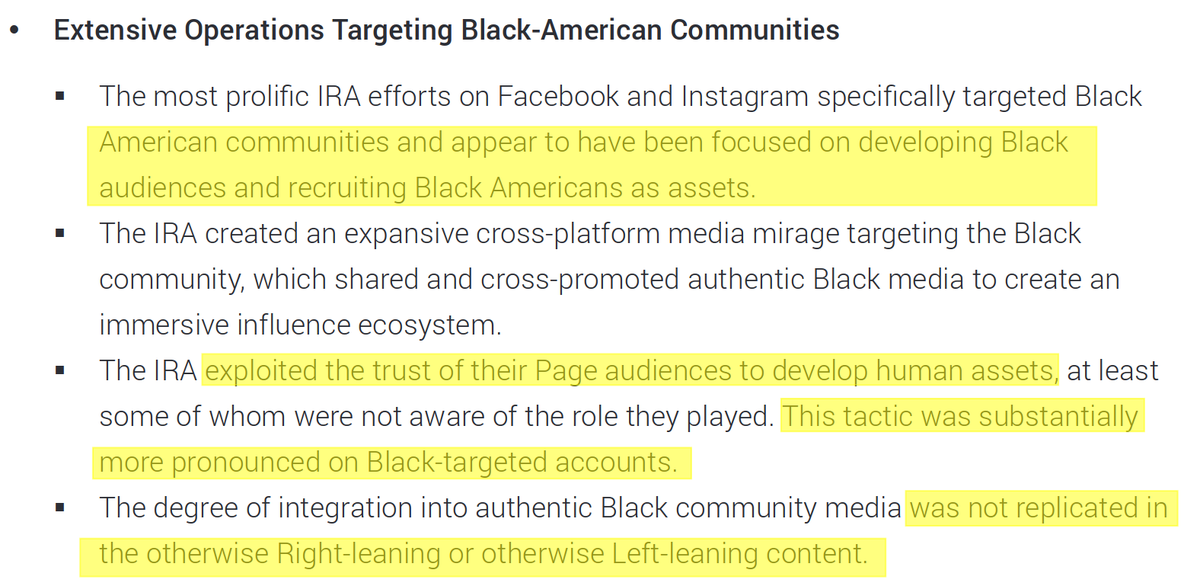
This is part of a pattern that as detailed by Mueller, and has been proven by reputable studies since then. Here are parts of an Oxford report on the goals of the ongoing social media operations of Russia. https://t.co/qapD8Eh2SQ
https://t.co/nJPPOwF1MA
The full report can be found here.
https://t.co/1q525xWYZE
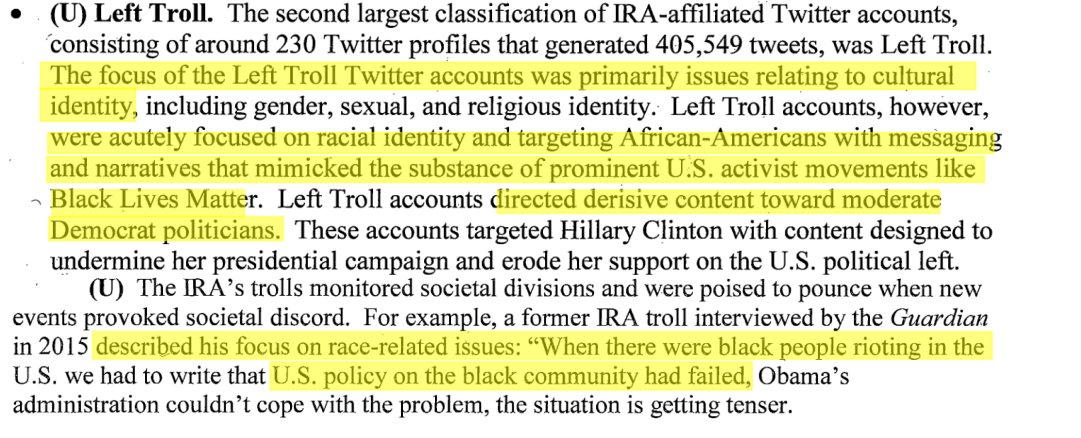
Excertps from the 2019 Senate Intelligence Committee Report on Russian Actove Measures Campaigns and Interference:
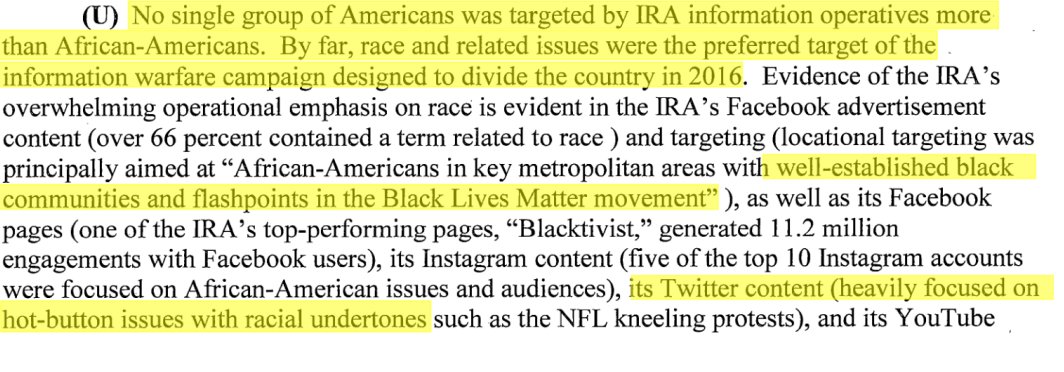
Also form the Senate Intelligence Committee report
This is part of a pattern that as detailed by Mueller, and has been proven by reputable studies since then. Here are parts of an Oxford report on the goals of the ongoing social media operations of Russia. https://t.co/qapD8Eh2SQ
Here's some from a search of your TL
— \U0001d679\U0001d698\U0001d691\U0001d697 \U0001d686\U0001d68e\U0001d69c\U0001d695\U0001d68e\U0001d6a2 (@thepalemoonlt) April 21, 2021
Uses of the word prison before today: 13.
Tweets for specifically suggesting abolishing prison prior to today: 1 on 06/03/2020
Mentions of prison and abolishing it today: 8
Of all the times to speak out, Why did you choose to now? https://t.co/kl7gx7ky2H
https://t.co/nJPPOwF1MA
The full report can be found here.
https://t.co/1q525xWYZE
Excertps from the 2019 Senate Intelligence Committee Report on Russian Actove Measures Campaigns and Interference:
Also form the Senate Intelligence Committee report