There are 2 paths to success:
1. Be Top 1% in the world at 1 thing
2. Be Top 25% in the world at 3 things
Top 25% is achievable by most people.
The problem is most people focus on being Top 1%.
Work on combining “3 pretty goods” and stay at it.
It’ll pay off big.
More from Romeen Sheth
Why do companies like Quibi raise billions, while companies like Peloton get nothing?
Because fundraising is a GAME
And the insiders keep the rules to themselves.
Here are 100 tips the insiders don’t want you to see but will help you win the game:
1. You can’t play the game without nailing the basics.
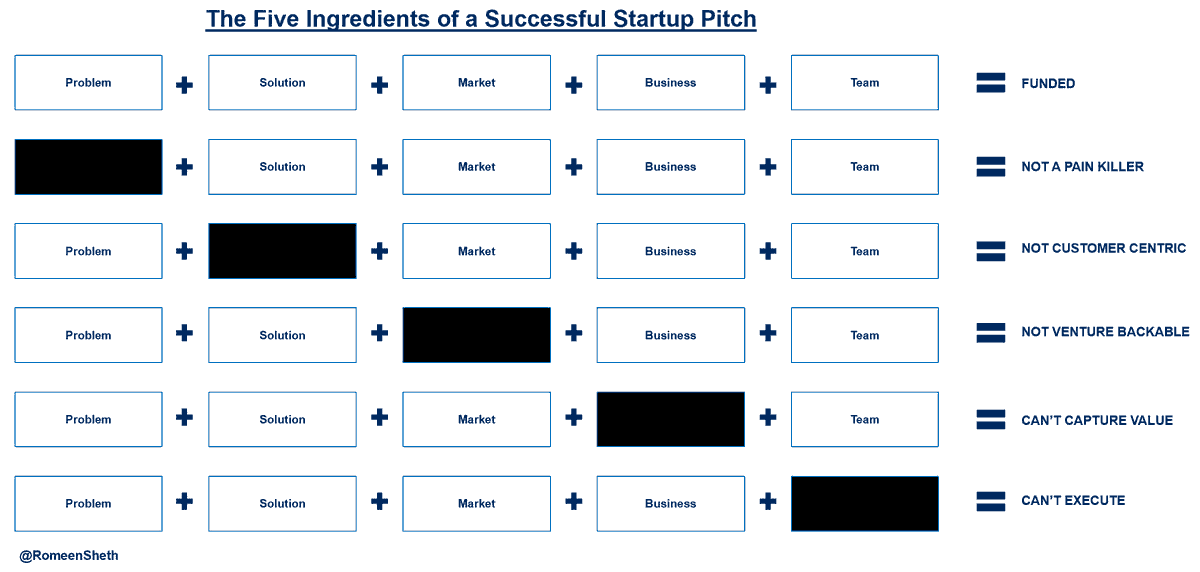
There are 5 core ingredients to a startup pitch.
Most have 2.
Good ones have 4.
The best have all 5.
There\u2019s a lot of bad advice out there on how to pitch your startup.
— Romeen Sheth (@RomeenSheth) April 10, 2021
Last year, I invested $1M+ and heard 200 companies pitch.
Every great pitch I've heard nails 5 ingredients.
In this thread, we'll go through each to help maximize your chances when fundraising
Let's dig in\U0001f447 pic.twitter.com/FBaUUWHz8L
2. Now that you have a grasp of the basics, it’s time to level up.
Good news - most founders make the same mistakes as each other.
Bad news - these mistakes are really easy to make.
Here's what not to do:
0/ After evaluating 200+ startups this year, I've been in some awesome and not so awesome pitches.
— Romeen Sheth (@RomeenSheth) December 28, 2020
Here are the top 10 mistakes I see Founders make that routinely derail fundraising \U0001f447\U0001f447\U0001f447
3. Ok so you told me what not to do.
So what should I do?
Read below.
0/ Last night I tweeted about the top 10 things Founders do that derail fundraising. It struck a chord. 2,500+ liked the tweet.
— Romeen Sheth (@RomeenSheth) December 30, 2020
I got a ton of DMs asking the opposite question: \u201cWhat are the top things Founders do well when fundraising?\u201d
Here's my top 10 \U0001f447\U0001f447\U0001f447
4. We’re in a really unique fundraising environment right now.
It’s important to contextualize all these tips in the “here and now” of what’s going on in the landscape.
Raising money for startups is wild right now. I\u2019ve never seen anything like it.
— Romeen Sheth (@RomeenSheth) May 5, 2021
Lots of Founders are wondering how to approach it and who they should partner with.
Here are 10 observations / practical tips I've shared with 100+ Founders in the last few months \U0001f447\U0001f447\U0001f447
More from Personal growth
You May Also Like
i wonder if you can make a thread bout witchcraft in malaysia.. or list of our own local gods/deites..
— r a y a \U0001f319 (@lcvelylilith) February 20, 2020
Before I begin, it might be worth explaining the Malay conception of the spirit world. At its deepest level, Malay religious belief is animist. All living beings and even certain objects are said to have a soul. Natural phenomena are either controlled by or personified as spirits
Although these beings had to be respected, not all of them were powerful enough to be considered gods. Offerings would be made to the spirits that had greater influence on human life. Spells and incantations would invoke their
Animist ceremonies of a religious or magical nature were normally held for the purpose of divination or making a request. This would either be done at a keramat or at a shrine similar to the Thai spirit houses or Chinese roadside shrines pic.twitter.com/I1hliyi0x3
— \u2745\u1710\u170b\u1713\u170e (@uglyluhan) June 16, 2019
Two known examples of such elemental spirits that had god-like status are Raja Angin (king of the wind) and Mambang Tali Arus (spirit of river currents). There were undoubtedly many more which have been lost to time
Contact with ancient India brought the influence of Hinduism and Buddhism to SEA. What we now call Hinduism similarly developed in India out of native animism and the more formal Vedic tradition. This can be seen in the multitude of sacred animals and location-specific Hindu gods