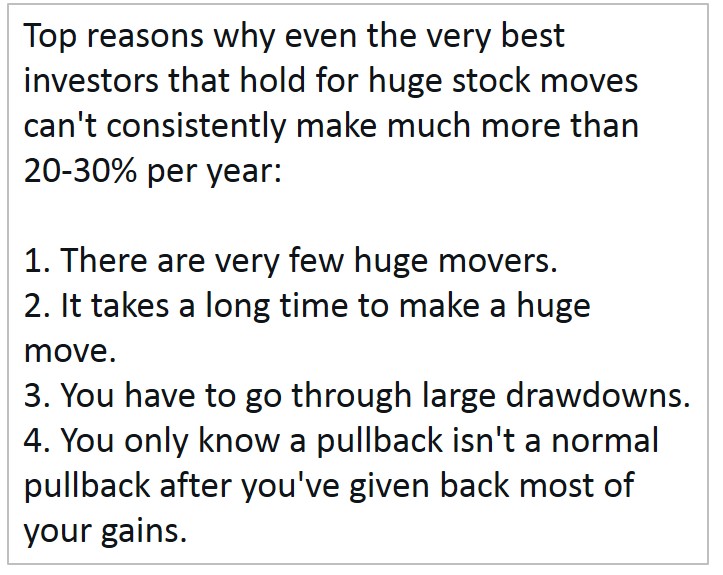
There are many ways to trade and invest in the stock market. In my experience, buying and holding can take advantage of a big move, but it has a number of disadvantages over a nimble approach. To compound and avoid large drawdowns, big consistent returns require turnover.
More from Mark Minervini

More from Markminervinilearnings
What is the single unavoidable thing you must do to be the best or great at one thing? One word?
— Mark Minervini (@markminervini) April 14, 2021
The word is sacrifice. You are not going to be the best at day trading, swing, value and growth investing. It will be amazing if you can master just one. And you only need one. So pick one and sacrifice the rest! There is no other way unless you want to suck at a bunch of things. https://t.co/QVI68eaNHQ
— Mark Minervini (@markminervini) April 14, 2021
You May Also Like

A thread 👇
https://t.co/xj4js6shhy
Entrepreneur\u2019s mind.
— James Clear (@JamesClear) August 22, 2020
Athlete\u2019s body.
Artist\u2019s soul.
https://t.co/b81zoW6u1d
When you choose who to follow on Twitter, you are choosing your future thoughts.
— James Clear (@JamesClear) October 3, 2020
https://t.co/1147it02zs
Working on a problem reduces the fear of it.
— James Clear (@JamesClear) August 30, 2020
It\u2019s hard to fear a problem when you are making progress on it\u2014even if progress is imperfect and slow.
Action relieves anxiety.
https://t.co/A7XCU5fC2m
We often avoid taking action because we think "I need to learn more," but the best way to learn is often by taking action.
— James Clear (@JamesClear) September 23, 2020