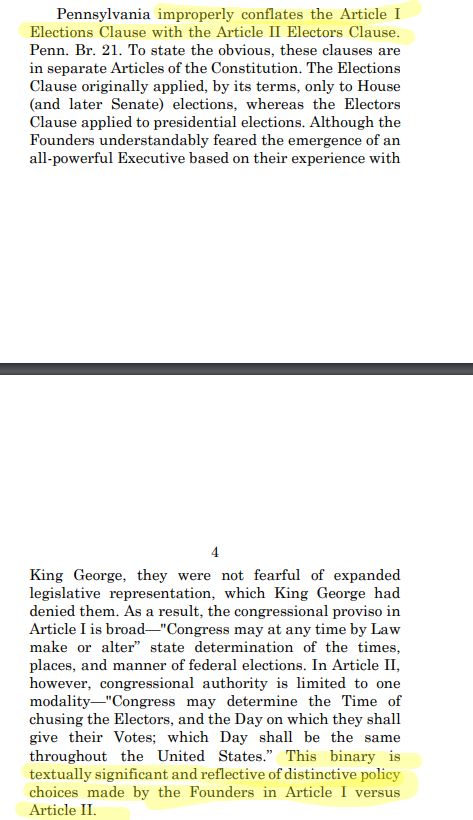
Dear Texas: When your argument is that election procedures were adopted in violation of the Electors clause, the only evidence you need to "marshal" is "what election procedures were adopted and how"

You don't need weeks, a magnifying glass, and Melissa Carone

Also, why is there no other forum? You couldn't have sued in Federal court in Georgia or PA in advance of the election because ...?

Oh, right. No standing. That's still a problem
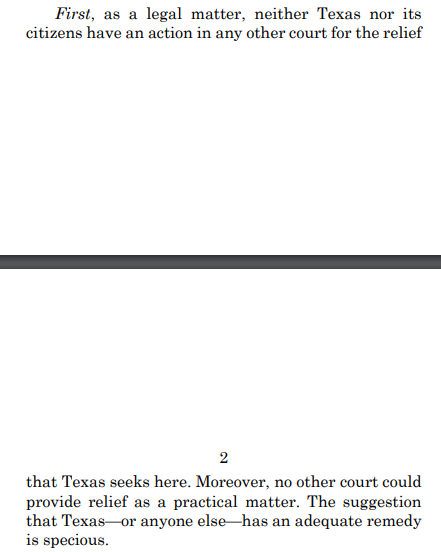
Also, Texas? I feel like you should take that up with ... Texas
I kind of feel like "look, what you meant by Purcell was let's just wait until after the election and then invalidate ALL the votes" isn't necessarily the *strongest* argument
Also, you don't just get to make up a new principle of constitutional and election law and just call it "a variant of" Purcell (or anything else).

You can tell it's made up by the total absence of any citation to ANY case, ANYWHERE, saying that
This is a very long-winded way of saying "no, our dumbass equal protection claims DON'T give you any basis to reverse the election, the Defendant States are right"
And saying in a footnote "yes, our case is worthless unless we've sufficiently alleged intentional fraud" is a bold strategy when your complaint doesn't actually allege intentional fraud at all, let alone meet the heightened pleading requirements for that claim
The argument that Texas' real interest here is in having Pence as the President of the Senate to break ties doesn't leave dumbfuckistan no matter how many times you use it, Ken
As someone else noted, Texas has taken "saying the quiet part loud" and made it into an art form.
The argument here is that Texas' claim that other states' election procedures violated the constitution wasn't "ripe" until Texas was harmed by that violation, so Texas had to wait until after the election.
In other words, Texas is EXPRESSLY telling the Supreme Court that "the harm to us wasn't other states 'breaching the contract' by not following the Constitution. We were only harmed when they picked a candidate we don't like"

More from Akiva Cohen

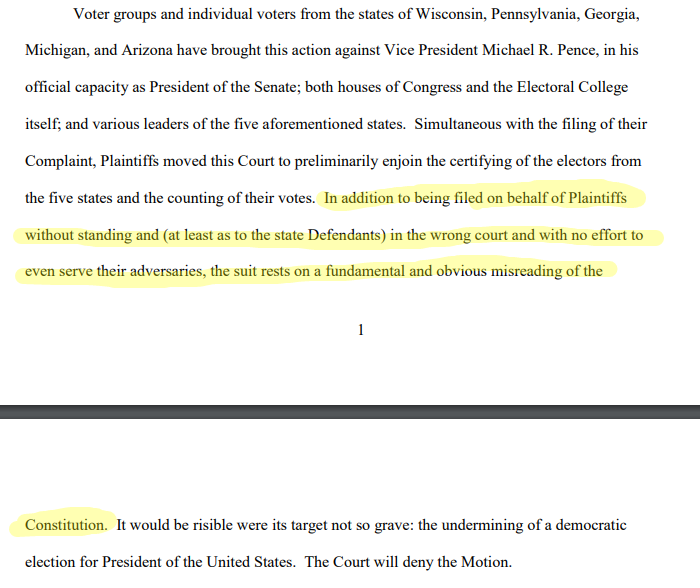
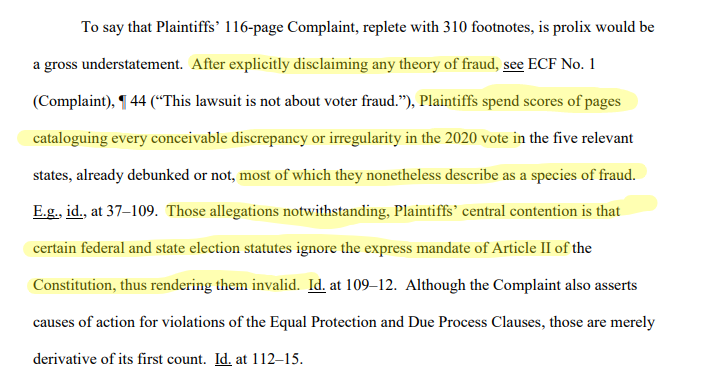
The judge in this case has now issued an absolutely brutal smackdown that you'll enjoy reading. It comes complete with a well-earned threat of sanctions.


Here's the decision. Some highlights follow

Pretty sure I said this, using slightly different words!


Hey, @questauthority, it sounds like Judge Boasberg was about as pleased about the long "none of this matters but we want to say it anyway" section as we expected him to be


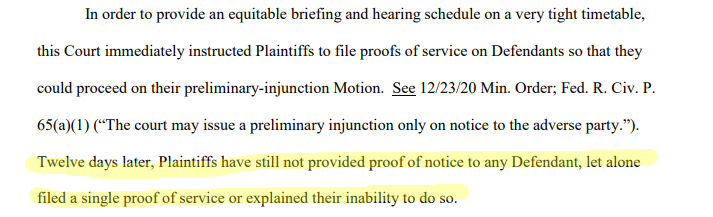
You CANNOT run into court claiming there's an emergency and you need an expedited schedule so you can be heard before 1/6 and then just not bother serving anyone for 12 days
So, quick rundown of the latest #Squidigation decision: It's very thorough; 36 pages of Judge Parker explaining that Powell and her merry band of fuckups lose for every conceivable reason


First: 11th Amendment Immunity. Basically, states (and their officials) have sovereign immunity; you can't sue them in Federal Court except to the extent that they agree to be sued there. Quick thumbnail of the doctrine here


There are only 3 exceptions to this: 1) Congress says "you can sue your state for this"; 2) the state agrees to be sued; 3) Younger, a case that said "you can sue your state if you are just seeking an order saying 'stop violating my rights'"

In other words, if the state passes a law that says "no talking politics in public" you can sue for an order saying "that's unconstitutional and can't be enforced" but not for damages from having your 1A rights violated in the past

I'm sure you can see where this is going: Exceptions 1 and 2 don't apply; Congress didn't say "no sovereign immunity" when it passed 42 USC 1983 (the civil rights statute the plaintiffs sued under) and Michigan hasn't waived it. That leave Younger as the only remaining option

More from Law

You May Also Like

"I lied about my basic beliefs in order to keep a prestigious job. Now that it will be zero-cost to me, I have a few things to say."


We know that elite institutions like the one Flier was in (partial) charge of rely on irrelevant status markers like private school education, whiteness, legacy, and ability to charm an old white guy at an interview.

Harvard's discriminatory policies are becoming increasingly well known, across the political spectrum (see, e.g., the recent lawsuit on discrimination against East Asian applications.)

It's refreshing to hear a senior administrator admits to personally opposing policies that attempt to remedy these basic flaws. These are flaws that harm his institution's ability to do cutting-edge research and to serve the public.

Harvard is being eclipsed by institutions that have different ideas about how to run a 21st Century institution. Stanford, for one; the UC system; the "public Ivys".