For example: the Beatles earned $0.01/record.
Split four ways.
But 15% of that was creamed off by the label to account for "promotional copies" that they later admitted they sold at full price without giving the Beatles their ONE PENNY of royalties.
2/
When Napster and other digital distribution platforms appeared, many musicians were angry about them, but many were hopeful: was this - finally - a way to be free of the labels?
It was!
For a while.
3/
The subsequent record industry lawsuits combined with runaway mergers and acquisitions in BOTH tech (5 giants) AND entertainment (4 studios, 4ish publishers, 3 labels) killed the dream of a pluralistic, fair alternative to the content oligarchy.
4/
This was confirmed when Youtube launched its music service in the early part of the past decade. After hammering out a deal with the Big Four (now three) labels, YT told all the independent artists and labels that this would be their deal too - or they could leave Youtube.
5/
In other words, Youtube was now an honorary member of the Big Four (now three) and every musician in the world who wanted access to the monopoly audio-video distribution platform would have to toe the Big Four's (now three) line...or else.
6/
The fusion of Youtube with the big entertainment companies includes a complete disregard for fair use - the limitations and exceptions to copyright that are so necessary to free speech, criticism, and new artistic expression.
7/
It's hard to square copyright with the First Amendment ("Congress shall make no law.. abridging the freedom of speech"). I wrote this, it attracted a copyright at the moment of fixation, and now the US government gives me to the power to bar you from repeating it.
8/
How can a government that is constitutionally barred from abridging your speech also have a law telling you what you're allowed to say?
The Supreme Court explored this in Eldred v Ashcroft, with RBG calling fair use copyright's "safety valve."
9/
Fair use is how you can ban people from saying stuff without abridging their free speech: it allows for transformation, criticism, commentary, education, parody, archiving and a host of other uses. Without fair use, copyright is unconstitutional censorship.
10/
In 2007, Viacom sued Youtube for $1b; the court released emails between Viacom execs admitting that their goal was to "steal" Youtube and take it over (the emails were VERY sweary and included vicious fights about which exec would get to run YT)
https://t.co/Y7Eq8W4F63 11/
As the suit was making its way through the courts, Youtube launched #ContentID, its automated takedown system. Content ID - which cost $100m to build and run - allowed select rightsholders to "claim" certain audio and video elements as their copyrights.
12/
Content ID scours uploaded videos for matches to claimed works, then (depending on rightsholders' preferences), Content ID either removes the matching video, takes the money it is generating, or (if it's ad-free) puts ads all over it and gives the money to the rightsholder.
13/
And Content ID can't figure out if a use is fair or not. No algorithm can. How software tell if something is parody? If it's commentary? If it's sufficiently transformative to constitute a fair use? It can't, and so Content ID doesn't.
14/
What do you get when you mix automated takedown, entertainment and tech monopolies and the absolute annihilation of fair use?
The contemporary arts world.
https://t.co/QmkdNSqVSC 15/
In a superb white paper, my
@EFF colleague
@k_trendacosta painstakingly documents how Youtube transfers gigantic sums from working artists to rent-collecting rightsholders in a system that incentivizes false copyright claims and punishes those who appeal automated verdicts.
16/
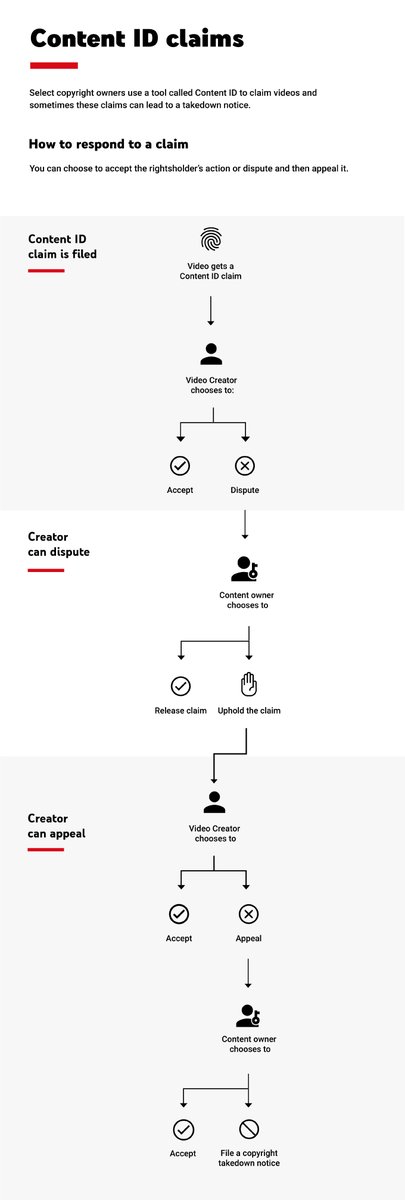
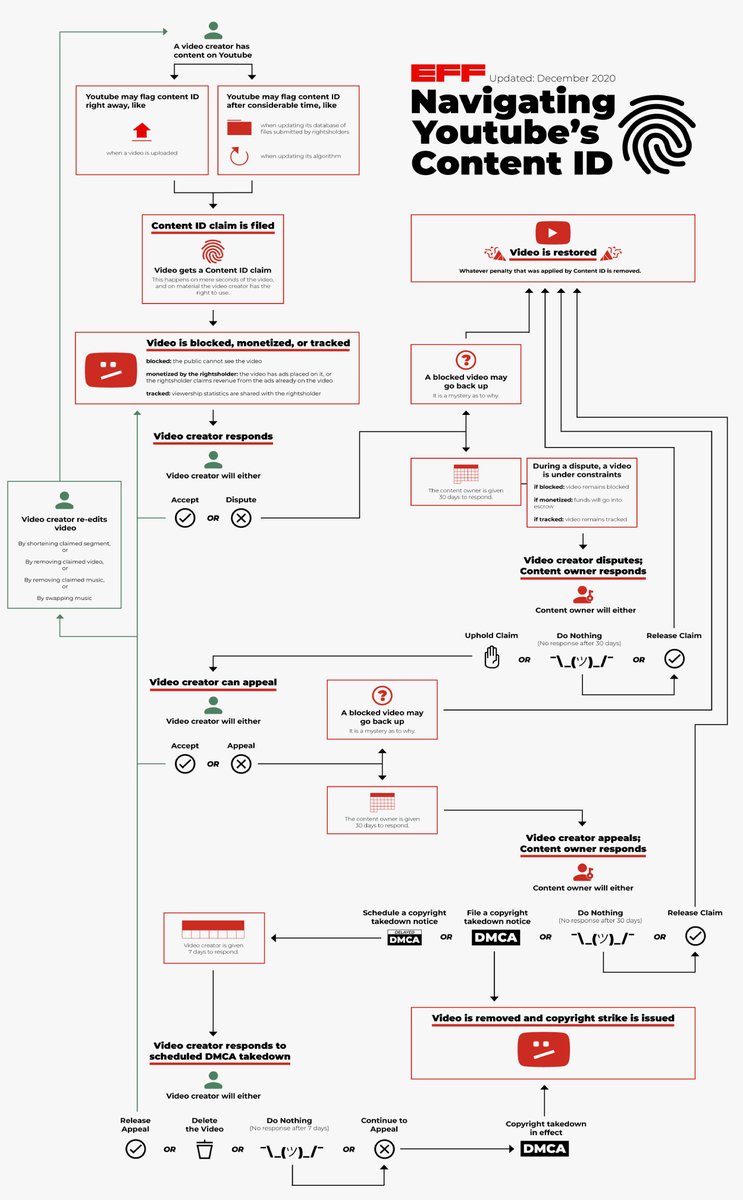
The paper starts by documenting how Content ID REALLY works, and shows how the pretty, streamlined, easy to follow flowcharts that YT publishes to prove that it has a fair and transparent systems are a sham.
17/
The reality is a gnarly hairball of rules, threats, ultimatums and dire punishments, where videos that pass muster one day can be taken down the next, and where challenging the robot (or a rightsholder) can annihilate your Youtube account - and thus your artistic career.
18/
It's a system where creators producing major video essays can upload them in five minute chunks to YT to check for copyright claims, find none, piece the whole feature together and upload it - only to get five copyright claims.
19/
It's a system where a ten-hour video of white noise attracts SIX copyright claims - one for an "infringement" that allegedly lasted for less than ONE SECOND.
Trendacosta's paper revolves around deep interviews with three very different Youtubers.
20/
The first is
@hbomberguy, a long-form video essayist with 600k subscribers, who spends weeks playing blind man's bluff with Content ID, slicing more and more sections out of his video to get rid of copyright claims (and doing it over again when the algorithm changes).
21/
The second is
@shadowtodd, a musicologist who produces videos that dive deep into one-hit wonders and other musical oddities. He has given up on getting any of the money his wildly popular videos generate through YT ads; it's impossible to fend off the Content ID robots.
22/
Instead, Nathanson relies on Patreon subscribers to pay his bills, and allows the rightholders who lay claim to the money from his legal, canonical-fair-use musical excerpts to simply steal the money he is entitled to.
23/
Finally, there's
@thelindsayellis, a bestselling novelist with 1m subscribers who has been shunted from one service to the next as all of Youtube's competitors were driven out of business, landing on Youtube after she ran out of alternatives.
24/
Ellis's high profile means she can sometimes actually reach a human being at Youtube to discuss copyright claims against her work, but they are monumentally unhelpful. Ellis knows an awful lot about copyright, but that's actually a detriment when it comes to Content ID.
25/
That's because defending yourself to the Content ID system means that rightsholders can deny your defense and generate "copystrikes" against your account. Rack up three strikes and your account gets suspended or even deleted.
26/
Ellis wonders "why I bothered playing by the rules all these years because fair use doesn’t matter. Content ID is all that matters."
27/
Youtube's Content ID statistics are opaque and out of date, but Trendacosta estimates that the system rendered automated judgements in 122,500,000 copyright claims in 2017, a number that has surely climbed since.
28/
Once, creators dreamed of the internet as an escape hatch from the airtight cell that the Big Four (now three) labels had crammed all the world's music into. Today, most creators been corralled into a single online platform.
29/
That platform colludes with the Big Three to misappropriate the incomes of artists who never signed their one-sided record deals, and the ripoff continues with a long tail of penny-ante grifters who claim copyrights over silence, white noise and birdsong.
eof/