Decent housing for workers in cities was expensive and this is why unions began to become interested in new ideas to solve this problem. This was not the only example of a union-based housing project during these years.
The Hosiery Workers’ sister union, the Amalgamated Clothing Workers of America, was already working on such a project and the International Ladies Garment Workers Union had worked to create a workers’ cooperative apartment building in the Bronx as early as 1925.
Philadelphia had a higher home ownership rate than other cities, but most of this was single-family and the rental market was very tight.
So the Hosiery Workers decided to target a union-sponsored housing complex for its members and other workers. It believed that big projects were better for workers and hoped to influence federal housing policy through its housing program.
In 1933, the Housing Division of the newly created Public Works Administration started to offer loans to private companies that would build and manage low-rent residential projects for limited profit.
Immediately, the American Federation of Hosiery Workers applied to open a housing complex for its workers. The Hosiery Workers had already articulated a sophisticated housing program.
Influenced by Karl Marx Hof in Vienna, the mass leftist housing project erected in the 1920s, it hoped to replicated this in the United States.
The Hosiery Workers, based in Philadelphia, was an organization heavily interested in larger left-leaning social and economic questions and hired many radicals.
It managed to not only survive the Great Depression but actually win good contracts even as consumer demand collapsed, including convincing companies to open its books to the union and working with consumer organizations for union-approved clothing companies.
The union’s leaders also opposed private home ownership. It understood why workers bought homes.
But it claimed that home ownership reinforced the strong privatized nature of American political culture that undermined collective solutions in favor of selfish individualism (a point with which I strongly agree).
Leading the project to create a housing project was Hosiery Workers research director John Edelman and Oskar Stororov, the Russian social democratic emigre and modernist architect who in 1970 was on the plane that killed Walter Reuther.
When Stonorov heard about the PWA Housing Division, he immediately called its head Robert Kohn, rousted him out of bed, made a pitch, and won the agency’s first loan of slightly more than $1 million.
The union acquired the land and overcame opposition from private realtors and the Philadelphia mayor thanks to its close relations with the city council.
It began building in February 1934, with a ceremony attended by Cornelia Bryce Pinchot, wife of Pennsylvania governor and legendary forester Gifford Pinchot.
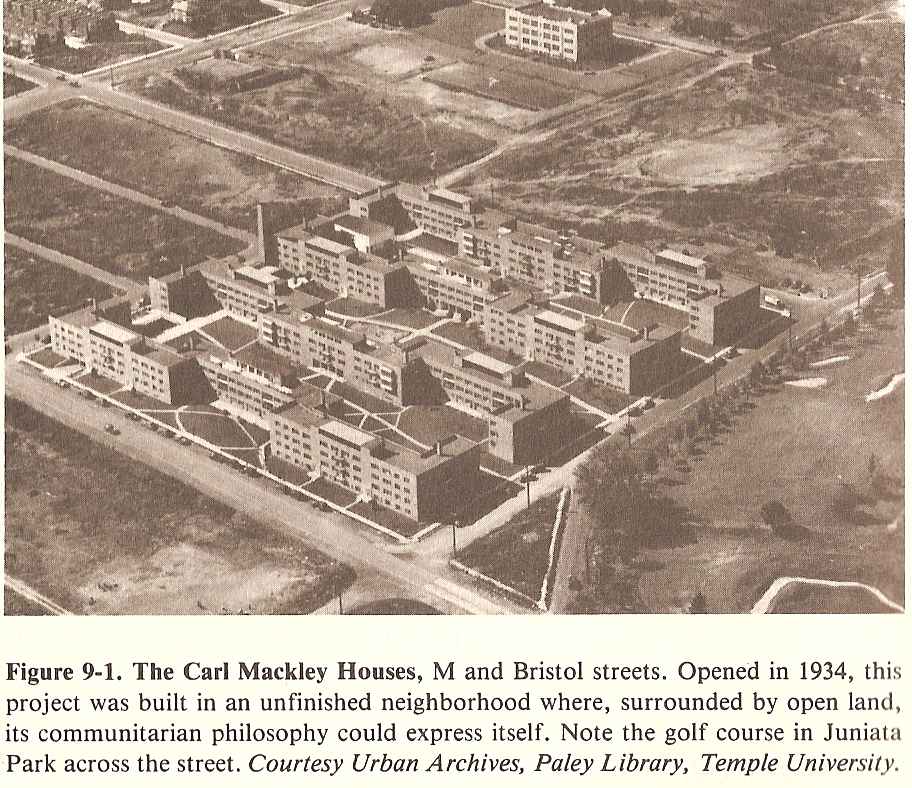
It named the housing project after Carl Mackley, a union member killed in a 1930 strike in Philadelphia who had become a hero to the city’s working classes, when 1500 cars followed the hearse carrying Mackley to his funeral.
The complex had nearly 300 apartments, a large swimming pool (the overwhelming recreational desire of the workers who lived there), a nursery school, a basement set up for tenant organizations, and laundry facilities.
It was the kind of self-contained community that leftists hoped would spawn working-class consciousness in the American working class.
The complex opened on January 1, 1935. The union made sure that a majority of the tenants were not Hosiery Workers’ members because it feared a strike could bankrupt the housing project.
But in fact the cost of the apartments were fairly high and so it ended up attracting a lot of white-collar workers. The PWA loan payments were steep and thus the rents were 20 percent more expensive than anticipated.
The tenants did receive good value for their rent, but it was simply pricier than most workers’ housing. The Hosiery Workers asked the PWA to renegotiate the terms of the loan but the agency refused.
But some workers did live there and the residents, working-class or middle-class, generally appreciated the project. The social space around the pool was highly valued by the residents and some workers moved in precisely because of that pool.
One worker signed a lease, hoping it would be Bellamyism in action.
The union itself did not really shape the communal life in the Mackley Homes as it hoped to, largely because it was fighting for its own survival through the 30s and 40s and the housing complex took a secondary role in the larger union strategy.
But an open atmosphere of organizing was quietly encouraged and residents took advantage of that.
Some residents put on a performance of “Waiting for Lefty,” while others took art classes, went to fundraisers for the left in the Spanish Civil War, or heard lectures about the need for socialized medicine (tell me about it).
The nursery school sought to provide support for women even if they did not work outside the home, bringing progressive ideas about childrearing to the complex. This all scared PWA administrators, who worried about being attacked over the political nature of life there.
Leading urban planners such as Catherine Bauer believed the Mackley Houses were the beginning of something much bigger, or as she wrote, “the first step in an movement which may sooner or later change the face of the country.” Of course, it didn’t work out that way.
Postwar housing plans would promote suburbanization and white flight, dooming most urban housing complexities to decline thanks to a funding model for public housing that assumed paying renters and not the poor, while private housing models now avoided these sorts of complexes.
The politics of the Mackley Homes declined with the Hosiery Workers after World War II, but the nursery school remained open until 1964 and as late as 1985, the tenets held a celebration to mark 50 years, even though the commemoration barely mentioned its union background.
I borrowed from Gail Radford, Modern Housing in America: Policy Struggles in the New Deal Era for the writing of this thread.
Back tomorrow for a brand new thread on the 2006 Sago Coal Mine disaster.