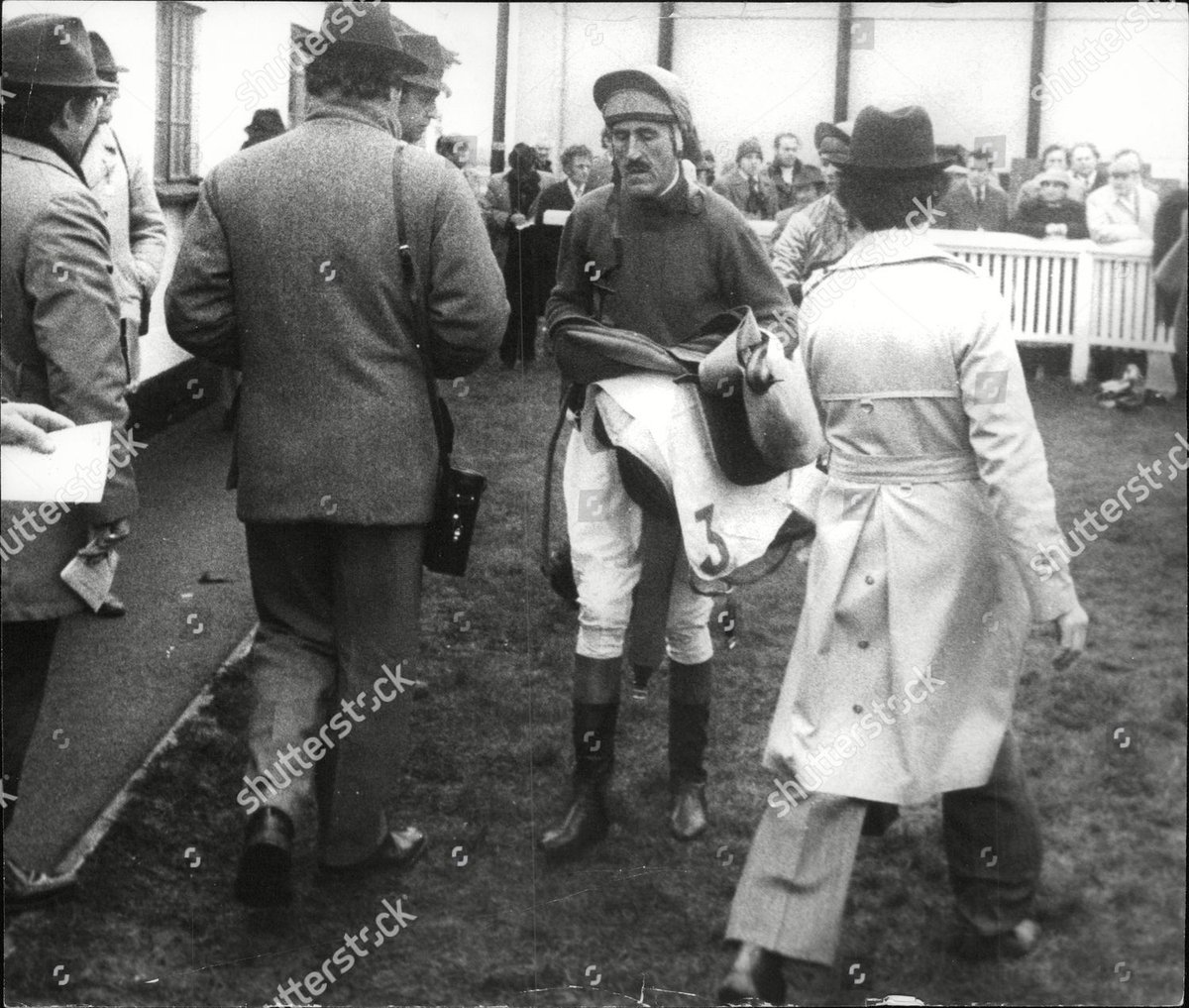
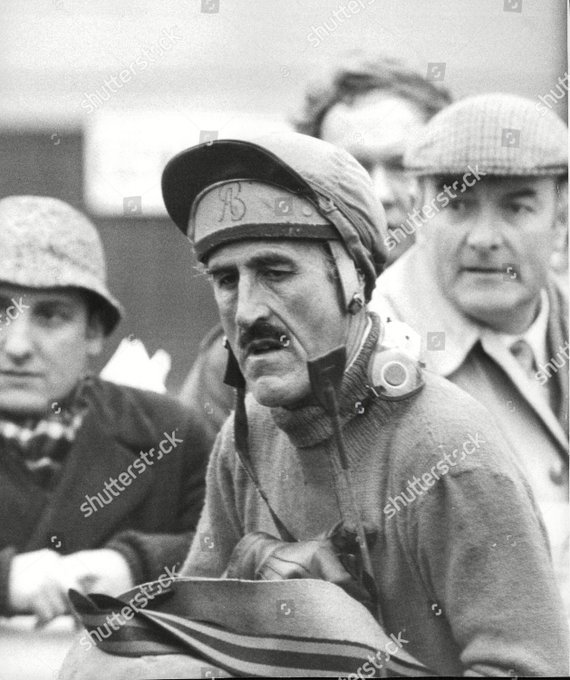
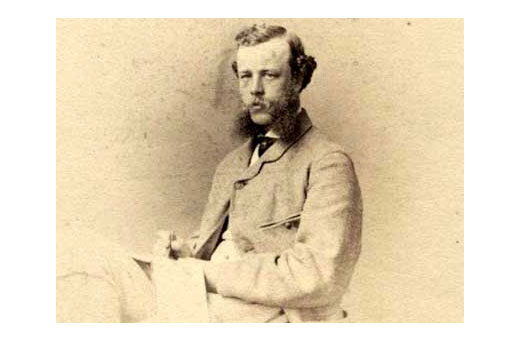
In 1927, a young Spanish boy, aged 8, - who would become the 18th Duque de Alberquerque - sat in a cinema watching a newsreel of the Grand National.
In that moment, an impossible dream was born.
Born on the 15 December 1918, the boy - Beltran de Osorio y Diez de Rivera

- was so enchanted that he resolved one day win to the great race himself.
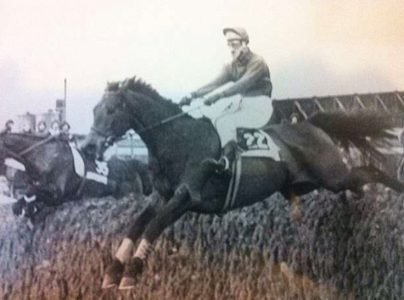
Aged 33, the Duke - having ridden in French steeplechases - made his Grand National debut in 1952, putting up ten pound overweight on his own eight-year-old Brown Jack lll (Pic), trained by Peter Cazalet.
The tall Spaniard fell at the sixth, sustaining cracked ribs and concussion

His second attempt came eleven years later aboard the Irish-bred Jonjo (named after its joint owners John O'Hagen and Joe Thompson).
Together the 44-year-old Duke and the 13-year-old Jonjo completed the
first circuit safely enough and were well up with the leaders when being unluckily brought down at the 21st.
In 1965 the Duke took a bad fall from Groomsman at Valentine's and was taken to Walton General Hospital with a broken leg

His ride in 1966 was on the doubtful stayer
L'Empereur who had to pulled up at the 26th

He was back again in 1973, pulling Nereo up at the Canal Turn. He finished 8th on the same horse the following year.

Yet another bad fall a week before the 1975 National resulted in yet another broken leg, ruling him out of the race,
and, in 1976, he was back once more on the faithful Nereo. He was thrown heavily at the 13th and was again rushed to Walton Hospital, this time unconscious. He had fractured his right thigh-bone, fractured vertebrae and broken seven ribs.
Understandably, for his own safety,
the Stewards stepped in
He was barred from riding again in Britain
The Duke was furious, saying: 'I don't understand it. It's my body, my horse and my responsibility."
A fortnight before riding Nereo in 1974, the Duke had 16 stitches removed from a patched-up leg. A week earlier
he had broken his collarbone.
In total, the Duke suffered 107 fractures in his quest to ride the National winner.
Aged 72, he completed the 721-mile pilgrimage to Santiago da Compostella - on foot.
The gallant Duke died On This Day February 18, 1994
Jeff King who was upsides when the Duke nearly jumped across Ron Barry on Straight Vulgan at the second Canal Turn tells this wonderful story
Ron Barry took avoiding action and shouted at the hapless Duke “What the f**k do you think you`re doing!” To which the Duke replied,
“My dear fellow, I haven’t a clue…I have never been this far before!”

More from History

This is THEFT!

Indians had Algebra BEFORE Mμslim prophet & religion was even born.

Here is Bakhshali Manuscript dating back to 3rd century CE. It is an Algebraic treatise. Have you anything like this from the Arabian desert? No, you simply plagiarized Algebra from Indians! https://t.co/cWXRNYMgDt


The Bakhshali manuscript, which has been carbon dated to 3rd century CE, is an ancient Hindu treatise on Arithmetic and Algebra.

The Algebraic problems deal with simultaneous equations, quadratic equations, arithmetic
geometric progressions & quadratic indeterminate equations.


Bakhshali isn't earliest Indian Algebraic treatise. Early Algebra is found in Shulba Sutras dating back to at least 800 BC. Traditional Algebra reached its pinnacle in the works of Aryabhata & Bhaskara.

What makes Bakhshali special is it offers mathematical proof to its theories


It is surprising to see that even after the ancient Indian algebraic treatise has been carbon dated to 3rd century CE by Oxford, they persist with "oh we invented Algebra. It is Halal".

A brief examination of the origins of "Halal Algebra" follows

https://t.co/eFIZ98FDrI


The earliest work of "Arabic Algebra" is the "Al-Kitāb Al-Jabr wal-muqābala" by Al Khwarizmi. The term "Algebra" comes from this book ("Al Jabr").

Before writing his treatise, Al Khwarizmi visited India. His book is a plagiarism from Indian Mathematics and an obvious one at that

You May Also Like

IMPORTANCE, ADVANTAGES AND CHARACTERISTICS OF BHAGWAT PURAN

It was Ved Vyas who edited the eighteen thousand shlokas of Bhagwat. This book destroys all your sins. It has twelve parts which are like kalpvraksh.

In the first skandh, the importance of Vedvyas


and characters of Pandavas are described by the dialogues between Suutji and Shaunakji. Then there is the story of Parikshit.
Next there is a Brahm Narad dialogue describing the avtaar of Bhagwan. Then the characteristics of Puraan are mentioned.

It also discusses the evolution of universe.(
https://t.co/2aK1AZSC79 )

Next is the portrayal of Vidur and his dialogue with Maitreyji. Then there is a mention of Creation of universe by Brahma and the preachings of Sankhya by Kapil Muni.


In the next section we find the portrayal of Sati, Dhruv, Pruthu, and the story of ancient King, Bahirshi.
In the next section we find the character of King Priyavrat and his sons, different types of loks in this universe, and description of Narak. ( https://t.co/gmDTkLktKS )


In the sixth part we find the portrayal of Ajaamil ( https://t.co/LdVSSNspa2 ), Daksh and the birth of Marudgans( https://t.co/tecNidVckj )

In the seventh section we find the story of Prahlad and the description of Varnashram dharma. This section is based on karma vaasna.
The first ever world map was sketched thousands of years ago by Indian saint
“Ramanujacharya” who simply translated the following verse from Mahabharat and gave the world its real face

In Mahabharat,it is described how 'Maharishi Ved Vyasa' gave away his divine vision to Sanjay


Dhritarashtra's charioteer so that he could describe him the events of the upcoming war.

But, even before questions of war could begin, Dhritarashtra asked him to describe how the world looks like from space.

This is how he described the face of the world:

सुदर्शनं प्रवक्ष्यामि द्वीपं तु कुरुनन्दन। परिमण्डलो महाराज द्वीपोऽसौ चक्रसंस्थितः॥
यथा हि पुरुषः पश्येदादर्शे मुखमात्मनः। एवं सुदर्शनद्वीपो दृश्यते चन्द्रमण्डले॥ द्विरंशे पिप्पलस्तत्र द्विरंशे च शशो महान्।

—वेद व्यास, भीष्म पर्व, महाभारत


Meaning:-

हे कुरुनन्दन ! सुदर्शन नामक यह द्वीप चक्र की भाँति गोलाकार स्थित है, जैसे पुरुष दर्पण में अपना मुख देखता है, उसी प्रकार यह द्वीप चन्द्रमण्डल में दिखायी देता है। इसके दो अंशो मे पीपल और दो अंशो मे विशाल शश (खरगोश) दिखायी देता है।


Meaning: "Just like a man sees his face in the mirror, so does the Earth appears in the Universe. In the first part you see leaves of the Peepal Tree, and in the next part you see a Rabbit."

Based on this shloka, Saint Ramanujacharya sketched out the map, but the world laughed