On this day in 1945 Soviet forces liberated Auschwitz-Birkenau. It was the largest concentration and death camp. 1.1 million people, 90% of them Jews, were murdered there. Today it is an international day of commemoration, to honor the memory of all victims of Nazi extermination.
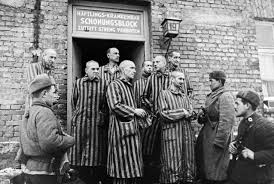
A few things to keep in mind on International Holocaust Remembrance Day:

1) The Soviet liberation of Auschwitz is a deeply symbolic event, but it is worth noting that allied forces were liberating Nazi camps until May of 1945. Unspeakable suffering and death continued for months
I bring this up because the popular perception of events is informed by primary school practices which present them with clean start and stop dates. Useful for repeating dates, but less useful for having an understanding of what forces you unleash and what it takes to unwind them
When we talk about the lessons of the Holocaust, too many fall into the trap of "if it's not identical to Auschwitz, it's not worth invoking the Holocaust."

The seeds for the Holocaust were laid long before Auschwitz was opened, and the Holocaust continued after its liberation.
2) Every year on this date you can reliably expect a debate on what it is we are commemorating. A small but loud group of people use this date as an opportunity to play suffering olympics. Resist the urge to engage with these fools.
On International Holocaust Remembrance Day we honor the memory of *all* victims of Nazism. That includes Jews who comprise the majority, but also gentiles including the Roma, Poles and Soviets, the LGBTQ, the disabled, and those who were murdered for opposing Nazism.
This is not an invitation to downplay the Nazi extermination of the Jews. The Nazis rose to power on demonizing Jews. It helped them recruit collaborators. At the height of the war with the Soviets they still prioritized killing Jews over getting supplies to their forces.
Put simply: the war of extermination against all "lesser" peoples in the eyes of the Nazis was organized around the belief that first the Jews must be exterminated. Every choice the Nazis made, including the murder of other peoples, was informed by this framework.
3) We need more than symbols. As @TimothyDSnyder wrote:

Auschwitz, generally taken to be an adequate or even a final symbol of the evil of mass killing, is in fact only the beginning of knowledge, a hint of the true reckoning with the past still to come.
https://t.co/FuqXkJj1Zk
For those who never click in, the above essay outlines why Westerners know about Auschwitz, but not about the actual majority of Jews who were murdered in the Holocaust.

Most were executed across what is today Poland, Belarus, Ukraine, and the Baltic states. Few ever saw a camp
The symbols we use to represent the Holocaust are too often the end of our education.

I wrote about this at some length the last time there was a controversy involving Anne Frank.
https://t.co/l1EI17uGiq
4) Due to superficial understandings, the simplistic idea is the Nazis were the bad guys and the people who fought them were the good guys.

The Nazis didn't see themselves as the bad guys. Neither did the Germans who voted for them or the people who collaborated with them.
Jews don't need you to identify with those of us who went through the Holocaust. Seeing yourself as the underdog is a tool to make yourself comfortable, not to challenge the injustice in the world you inhabit today.

Ask yourself what you have in common with our persecutors.
Are you equipped to recognize and oppose those who wish to persecute and exterminate others? Do you understand who in your own society today shares assumptions and motivations that drove people to Nazism?

Do you take ownership of your responsibility to oppose these forces?
If you're unsure, I encourage you to take the opportunity to learn more about the Holocaust. You will gain a better understanding of antisemitism, of racism, of those who wish to harness hate for power, and how to confront them.

That's how you can honor the legacy of this day.

More from History

This is THEFT!

Indians had Algebra BEFORE Mμslim prophet & religion was even born.

Here is Bakhshali Manuscript dating back to 3rd century CE. It is an Algebraic treatise. Have you anything like this from the Arabian desert? No, you simply plagiarized Algebra from Indians! https://t.co/cWXRNYMgDt


The Bakhshali manuscript, which has been carbon dated to 3rd century CE, is an ancient Hindu treatise on Arithmetic and Algebra.

The Algebraic problems deal with simultaneous equations, quadratic equations, arithmetic
geometric progressions & quadratic indeterminate equations.


Bakhshali isn't earliest Indian Algebraic treatise. Early Algebra is found in Shulba Sutras dating back to at least 800 BC. Traditional Algebra reached its pinnacle in the works of Aryabhata & Bhaskara.

What makes Bakhshali special is it offers mathematical proof to its theories


It is surprising to see that even after the ancient Indian algebraic treatise has been carbon dated to 3rd century CE by Oxford, they persist with "oh we invented Algebra. It is Halal".

A brief examination of the origins of "Halal Algebra" follows

https://t.co/eFIZ98FDrI


The earliest work of "Arabic Algebra" is the "Al-Kitāb Al-Jabr wal-muqābala" by Al Khwarizmi. The term "Algebra" comes from this book ("Al Jabr").

Before writing his treatise, Al Khwarizmi visited India. His book is a plagiarism from Indian Mathematics and an obvious one at that
Thank you so much to the incredible @gregjenner and his team for having me on "You're Dead to Me" and to @kaekurd for being so hilarious and bringing Gilgamesh the restaurant into my life!

Here’s a thread of some of the stuff referenced in the podcast for those interested


First of all, what even is cuneiform?

It’s a writing system from the ancient Middle East, used to write several languages like Sumerian and Akkadian. Cuneiform signs can stand for whole words or syllables. Here’s a little primer of its evolution
https://t.co/7CVjLCHwkS


What kinds of texts was cuneiform used to write?

Initially, accounting records and lists.

Eventually, literature, astronomy, medicine, maps, architectural plans, omens, letters, contracts, law collections, and more.


Texts from the Library of Ashurbanipal, who ruled the ancient Assyrian empire when it was at its largest in the 7th century BCE, represent many of the genres of cuneiform texts and scholarship.

Here’s a short intro to the library via @opencuneiform https://t.co/wjnaxpMRrC


The Library of Ashurbanipal has a complicated modern and ancient history, which you can read about in this brilliant (and open access) book by Prof @Eleanor_Robson

You May Also Like

Rig Ved 1.36.7

To do a Namaskaar or bow before someone means that you are humble or without pride and ego. This means that we politely bow before you since you are better than me. Pranipaat(प्राणीपात) also means the same that we respect you without any vanity.

1/9


Surrendering False pride is Namaskaar. Even in devotion or bhakti we say the same thing. We want to convey to Ishwar that we have nothing to offer but we leave all our pride and offer you ourselves without any pride in our body. You destroy all our evil karma.

2/9

We bow before you so that you assimilate us and make us that capable. Destruction of our evils and surrender is Namaskaar. Therefore we pray same thing before and after any big rituals.

3/9

तं घे॑मि॒त्था न॑म॒स्विन॒ उप॑ स्व॒राज॑मासते ।
होत्रा॑भिर॒ग्निं मनु॑षः॒ समिं॑धते तिति॒र्वांसो॒ अति॒ स्रिधः॑॥

Translation :

नमस्विनः - To bow.

स्वराजम् - Self illuminating.

तम् - His.

घ ईम् - Yours.

इत्था - This way.

उप - Upaasana.

आसते - To do.

स्त्रिधः - For enemies.

4/9

अति तितिर्वांसः - To defeat fast.

मनुषः - Yajman.

होत्राभिः - In seven numbers.

अग्निम् - Agnidev.

समिन्धते - Illuminated on all sides.

Explanation : Yajmans bow(do Namaskaar) before self illuminating Agnidev by making the offerings of Havi.

5/9
I just finished Eric Adler's The Battle of the Classics, and wanted to say something about Joel Christiansen's review linked below. I am not sure what motivates the review (I speculate a bit below), but it gives a very misleading impression of the book. 1/x


The meat of the criticism is that the history Adler gives is insufficiently critical. Adler describes a few figures who had a great influence on how the modern US university was formed. It's certainly critical: it focuses on the social Darwinism of these figures. 2/x

Other insinuations and suggestions in the review seem wildly off the mark, distorted, or inappropriate-- for example, that the book is clickbaity (it is scholarly) or conservative (hardly) or connected to the events at the Capitol (give me a break). 3/x

The core question: in what sense is classics inherently racist? Classics is old. On Adler's account, it begins in ancient Rome and is revived in the Renaissance. Slavery (Christiansen's primary concern) is also very old. Let's say classics is an education for slaveowners. 4/x

It's worth remembering that literacy itself is elite throughout most of this history. Literacy is, then, also the education of slaveowners. We can honor oral and musical traditions without denying that literacy is, generally, good. 5/x