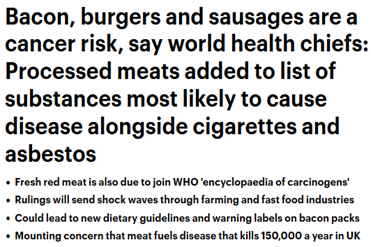
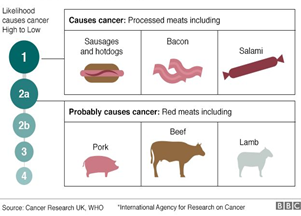
1/ Granted, some studies have pointed to ASSOCIATIONS of HIGH intake of red & processed meats with (slightly!) increased colorectal cancer incidence. Also,
@WHO/IARC is often mentioned in support (usually hyperbolically so).
But, let’s have a closer look at all this! 🔍
2/ First, meat being “associated” with cancer is very different from stating that meat CAUSES cancer.
Unwarranted use of causal language is widespread in nutritional sciences, posing a systemic problem & undermining credibility.
https://t.co/wnCfHTDBdg
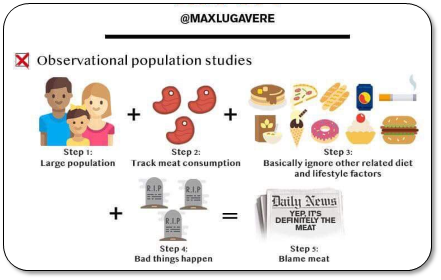
3/ That’s because observational data are CONFOUNDED (even after statistical adjustment).
Healthy user bias is a major problem. Healthy middle classes are TOLD to eat less red meat (due to historical rather than rational reasons, cf link). So, they obey.
https://t.co/7Zxlc3x81u
4/ What’s captured here is sociology, not physiology.
Health-focused Westerners eat less red meat, whereas those who don’t adhere to dietary advice tend to have unhealthier lifestyles.
That tells us very little about meat AS SUCH being responsible for disease.
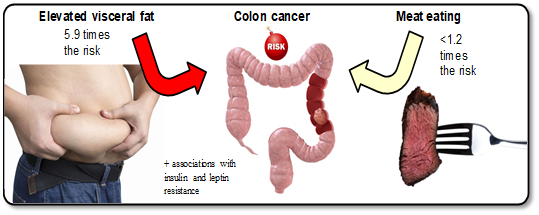
5/ At very small relative risks (<
Example: someone with elevated visceral fat needs indeed to be worried (6x risk of colon cancer!) For meat, however, risk level is so small (close to x1), that we’re out of business.
6/ Worse: the associations are likely mere artifacts.
Why?
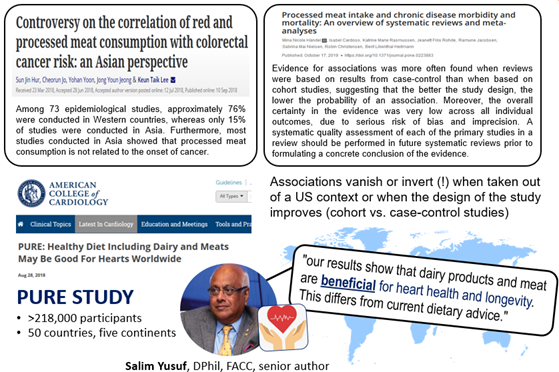
When we look at studies with better design or move out of a US context (e.g. Asia or worldwide), MORE meat is associated with BETTER health (!?) Indicative of a cultural construct rather than a paradox.
7/ To be fair, researchers are usually more nuanced than policy makers.
As stated in this highly cited study on meat & mortality, data 'should be interpreted with caution due to the high heterogeneity observed [&] the possibility of residual confounding'
https://t.co/1tOA2qglku
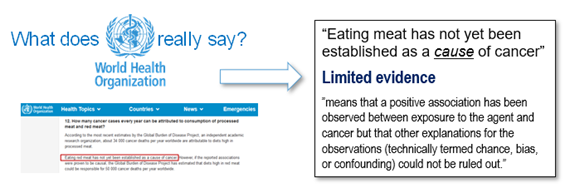
8/ Even the WHO/IARC panel looking into the colorectal cancer link declared that 'other explanations for the observations (chance, bias or confounding) could not be ruled out' while 'consumption of red meat has not been established as a cause of cancer'
https://t.co/0rvrgrTRZH
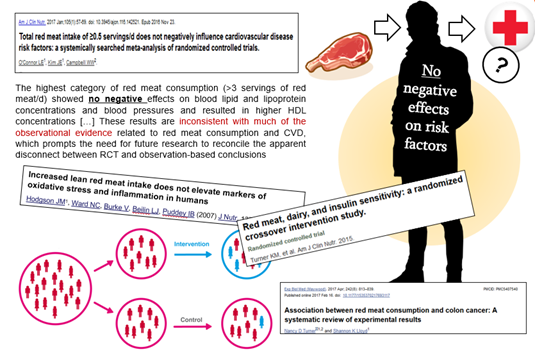
9/ Observational data yielding associations between meat intake and disease thus need to be CAREFULLY inspected. At best, this creates a HYPOTHESIS that needs to be validated in intervention studies.
But.... such studies fail to indicate harm!
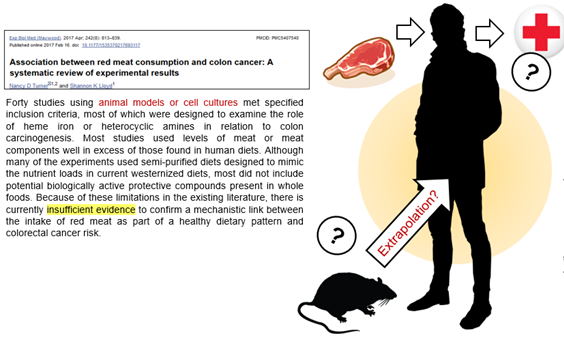
10/ It is true of course that such trials are difficult on the long term in humans & rely on biomarkers that are imperfect. Alternatively, one can use animal models or cell cultures.
Once more: INSUFFICIENT evidence (not to mention the extrapolation concerns)
11/ Another problem: 🍒-PICKING.
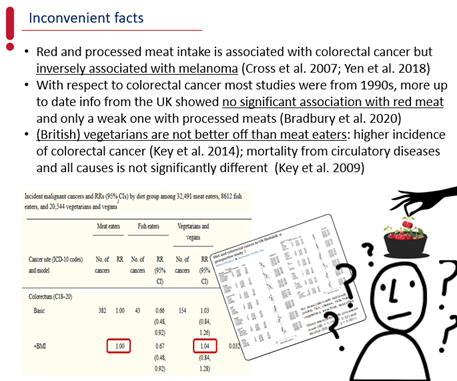
Although associated with colorectal cancer, why not mention as well that meat shows a PROTECTIVE association with melanoma? Or that vegetarians in the UK are not better off (maybe WORSE)? Or that newer studies show absence of effects?
Etc.
12/ Let's return to the WHO/IARC and its assignment of red meat to Group 2A (“probably carcinogenic to humans”).
Why did they do this and what does it mean?
13/ It’s good to have in mind that this is more controversial than it seems. One of the WHO/IARC's own experts, dr. Klurfeld, has severely criticized this.
For an overview of his objections, cf:
https://t.co/3BBr32pgSu
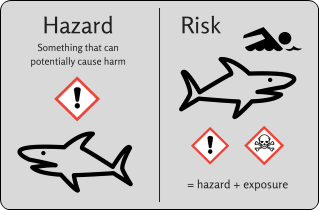
14/ Furthermore, it needs to be clear that such WHO/IARC classifications indicate HAZARDS, not risks.
To go from risk to hazard, we need… a risk assessment.
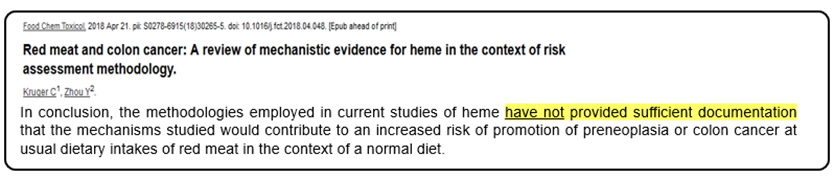
15/ Risk assessment indicates that there is no solid case for concern, especially in the context of a normal diet.
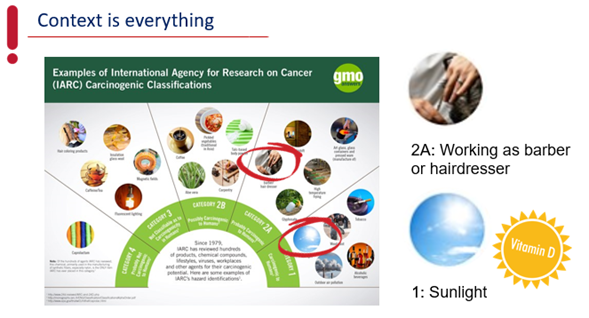
16/ Because, indeed, CONTEXT is everything.
Sunlight is a #hazard ("1"), more so than red meat ("2A", which is at the level of being a hairdresser) & also a #risk under certain conditions. But it's fair to say that sunlight is mostly beneficial (vitamin D being just one reason)
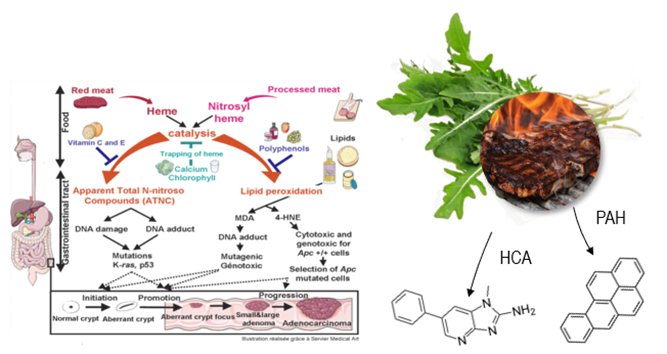
17/ Obviously, one shouldn’t consume all-too heavily processed meats, or overly charred steaks, all-too often.
Or blame the beef patty for the ultraprocessed bun, sauces, fries, & soda dietary background against which it is consumed.
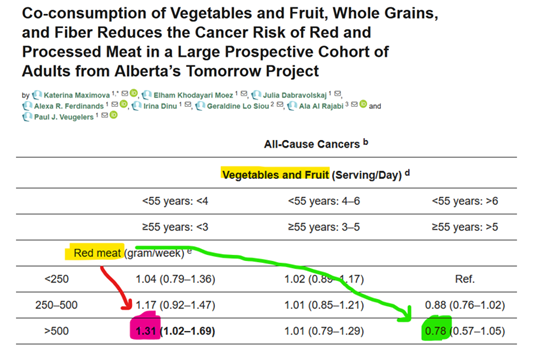
18/ So within an overall HEALTHY DIET, whatever potential cancer risk (if any; hard to tell due to confounding & bias) can reasonably be expected to be irrelevant.
In the study below, eg., more meat either parallels higher (veg-) or lower (!) (veg+) risk.
https://t.co/pqWI3u248Q
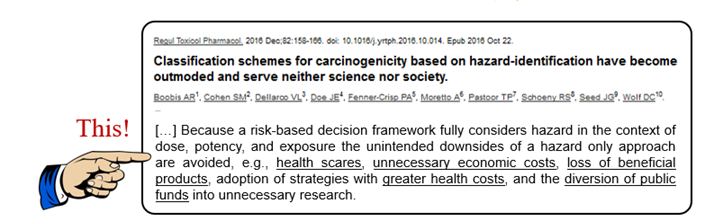
19/ Some authors are therefore starting to question the usefulness of IARC-type schemes to begin with. Especially because they also lead to scaremongering and loss of benefits (meat = valuable nutrition, etc.)
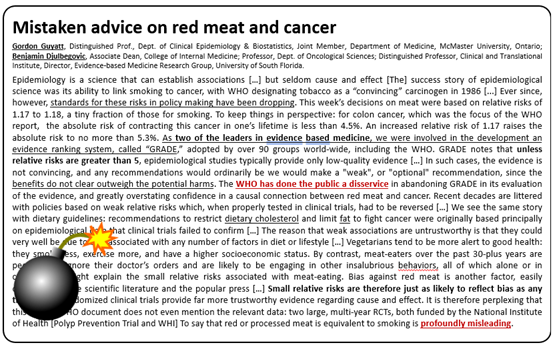
20/ No wonder that some top-level scientists, eg. Gordon Guyatt (leading expert in the field of evidence-based medicine), have criticized the WHO/IARC after the release of its report for “doing the public a disservice”.
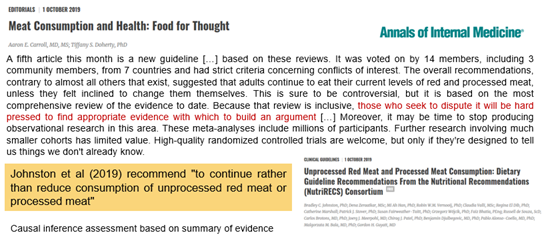
21/ Last year, Guyatt & others formalized their critique by COMPREHENSIVELY looking at the evidence.
When using proper standards of evidence, the case against red & processed meat looks slim (weak to very weak evidence).
https://t.co/n188G7T24z
22/ In the editorial of the journal, Carroll & Doherty argued that those who seek to dispute this [assessment] will be hard pressed to find appropriate evidence with which to build an argument”
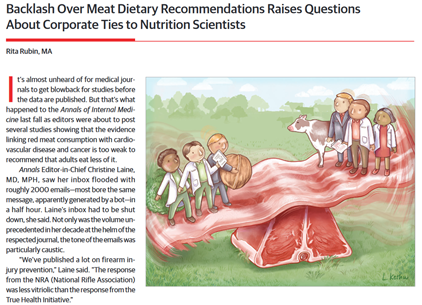
23/ What followed was indeed an incoherent rebuttal by anti-meat groups arguing that we should accept lower standards of evidence for nutrition, because... it can’t do better (?!)
Plus a vitriolic smear campaign.
INTERESTING READ! 👉
https://t.co/lxrXpzWUsR
24/ In any case, various other scientists have expressed similar concerns:
-
https://t.co/TdEeUIeskT -
https://t.co/YEYNup6Q6B -
https://t.co/ejVdqhqjoH -
https://t.co/O50BxmK0xJ - Etc, etc.
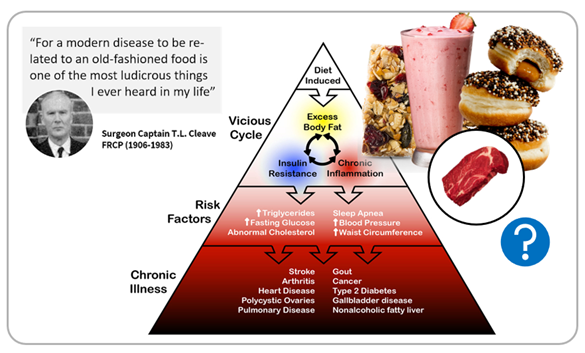
25/ Rather than ideological a “priori”, let’s return to common sense: “for a modern disease to be related to an old-fashioned food is one of the most ludicrous things I ever heard in my life”.
Let’s focus on ultraprocessed junk instead, when we blame the Western diet?
26/ I'll leave it here with the following statement: “we argue that claims about the health dangers of red meat are not only improbable in the light of our evolutionary history, they are far from being supported by robust scientific evidence”
https://t.co/UXiJqbW468
27/...and a link to our
@aleph2020 website (brought by a consortium of 35+ scientists). I invite you to visit the Health section where we not only argue that there's no good reason to avoid meat, but also that it may lead to the loss of valuable nutrition:
https://t.co/DrEcDJrfpr
28/ Meat, indeed, is an evolutionary food. It made us human. We’re *adapted* to it. It would be highly improbable that it harms us to such an extent that we would have to include its restriction in a #EUCancerPlan.
https://t.co/1nGQrGqqKn