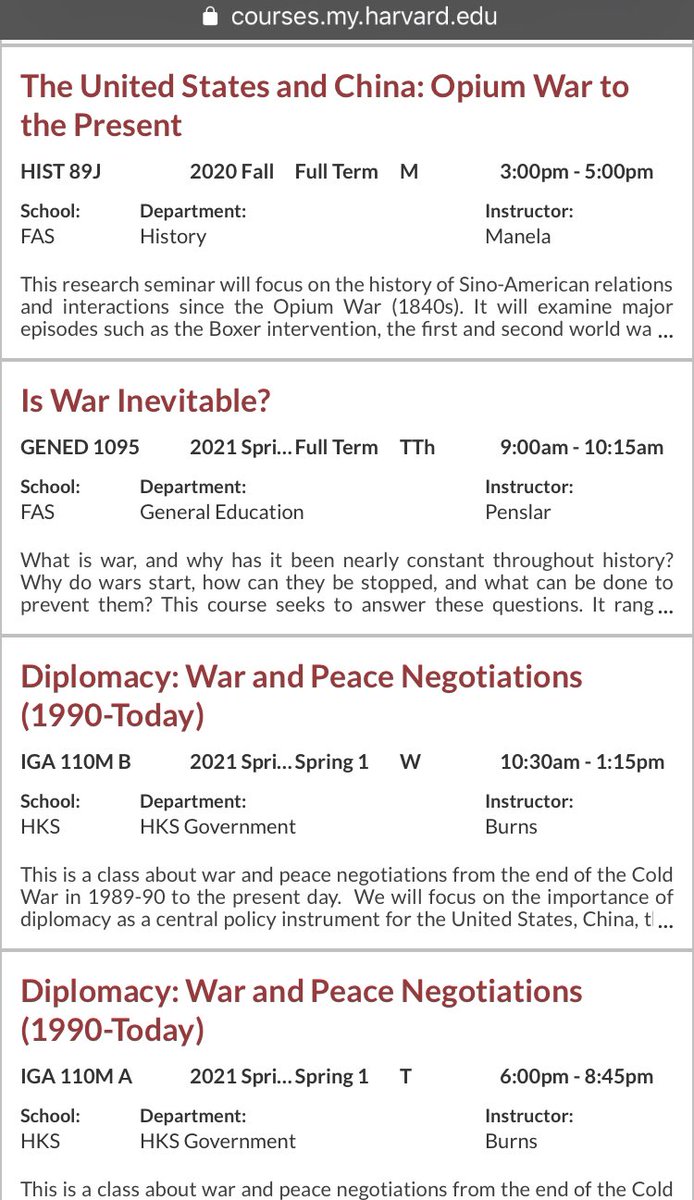
Now you know I love to sh-t in Harvard. But I also like accuracy. So I decided to go look at Harvard’s catalog to see its lack of military history that this article describes (they only teach history of pets it claims) and what I found shocked me! Shocked me! A thread: 1/

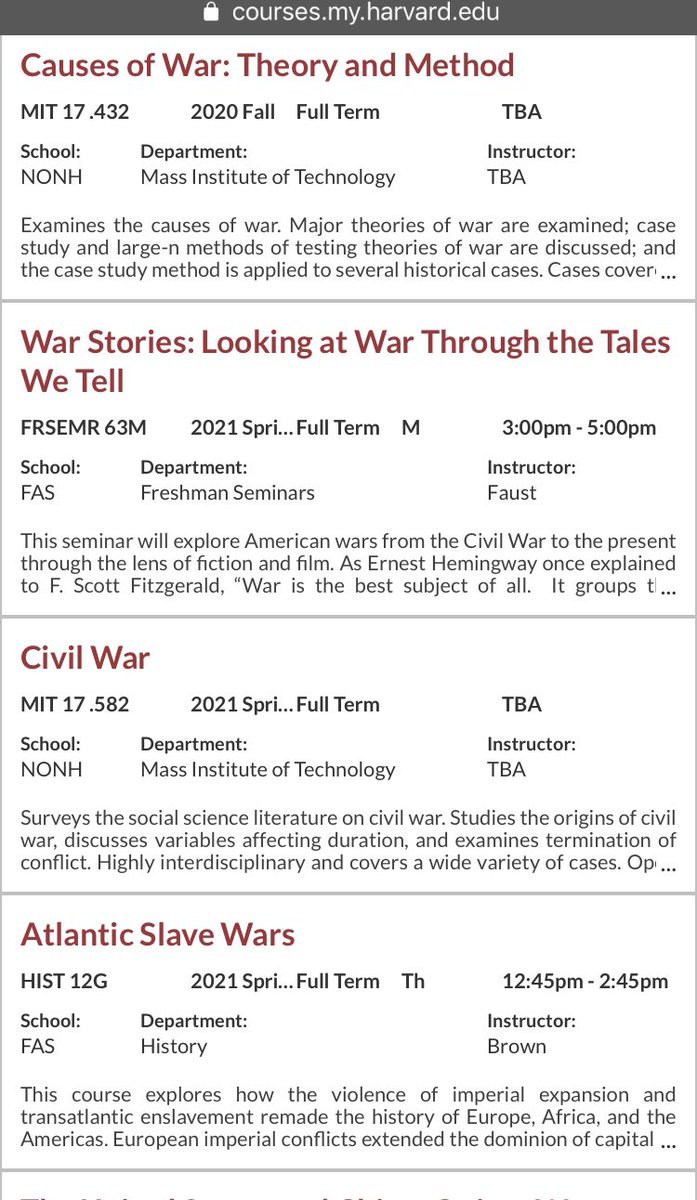
First off, Harvard students literally have multiple sections of military history that they can take listed. (It appears these ones are taught at MIT, so they might have to walk down the street for these) but... 2/
Say they want to stay on campus...they can only take numerous classes on war and diplomacy...3/
They have an entire class on Yalta. That’s right. An entire class on Yalta. 4/
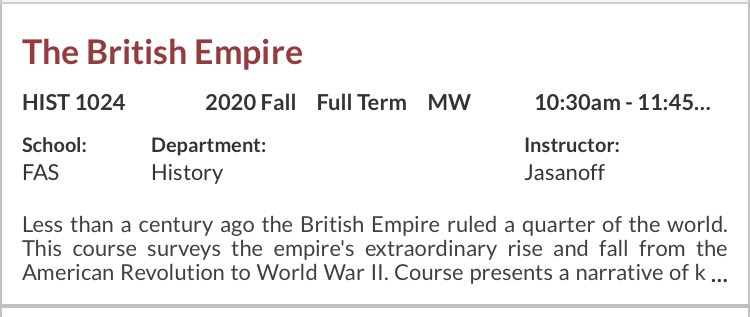
But wait! There is more! They can take the British Empire, The Fall of the Roman Empire for those wanting traditional topics... 5/
But it’s not over! This is my favorite. They literally have a class taught by @DrewFaust28 on war stories. That’s right. An entire class by one of the leading authorities on Civil War history and it’s reserved for Freshman! 6/
So I tried to find a history of pets. All I could find was this history of pests...the pets in history class is not being offered (and wasn’t from the history department in the first place) 7/
I could go on but I think I’ve shown it’s an article exaggerates. How did I know that everyone at Harvard doesn’t care about studying wars? Cause I’ve been invited to speak to Harvard classes and I study war. 8/
Perhaps the decrease in history majors doesn’t come from a decline in history major but the constant devaluing the humanities and obsessing over STEM for the past 30 years? Indeed attacking other forms of history than military as not valuable contributes to this problem. 9/
How many times have I heard military historians whine about gender historians, or historians of the body, or historians of pets being irrelevant? More than I hear anyone say military history is totally irrelevant. I hear people say it’s not their thing but not that its useless.10
Maybe instead of attacking subfields to puff ourselves up we should be remind folks all fields of history have something valuable to teach us. Scholars of diplomacy should realize historians of any field are their natural allies. 11
The issue isn’t devaluing of military history. It’s the devaluing of history and of the humanities more generally. 12
So to conclude while I still firmly believe that Harvard sucks (and Princeton doesn’t matter-sorry @KevinMKruse, but you understand college rivalries I know) Harvard actually has lots of military history options. And military history is not dead. 13/13
Of course the first tweet in my 13 tweet thread has a typo.
And it appears there are even more classes on war taught than I realized...(thank you @DrewFaust28 for letting me know about these classes) https://t.co/Koywhf3KP2
As @MilHist_Lee (who helped train me in *checks notes* military history) points out, other schools also have similar offerings. https://t.co/1mhpou8jwN
And another list of classes about war that are being offered. This one from @TomSugrue. https://t.co/ugwiQIAgrN

More from Health

I think @SamAdlerBell in his quest to be the contrarian on Fauci gets several things wrong here. 1/


First, the failure last year actually was driven by the White House, the #Trump inner circle. Watch what's happening now, the US' scientific and public health infrastructure is creaking back to life. 2/

I think Sam underestimates the decimation of many of our health agencies over the past four years and the establishment of ideological control over them during the pandemic. 3/

I also am puzzled why Tony gets the blame for not speaking up, etc. Robert Redfield, Brett Giroir, Deb Birx, Jerome Adams, Alex Azar all could have done the same. 4/

Several of these people Bob Redfield, Brett Giroir, Alex Azar were led by craven ambition, Jerome Adams by cowardice, but I do think Deb Birx and Tony tried as institutionalists, insiders to make a difference. 5/

You May Also Like

1/“What would need to be true for you to….X”

Why is this the most powerful question you can ask when attempting to reach an agreement with another human being or organization?

A thread, co-written by @deanmbrody:


2/ First, “X” could be lots of things. Examples: What would need to be true for you to

- “Feel it's in our best interest for me to be CMO"
- “Feel that we’re in a good place as a company”
- “Feel that we’re on the same page”
- “Feel that we both got what we wanted from this deal

3/ Normally, we aren’t that direct. Example from startup/VC land:

Founders leave VC meetings thinking that every VC will invest, but they rarely do.

Worse over, the founders don’t know what they need to do in order to be fundable.

4/ So why should you ask the magic Q?

To get clarity.

You want to know where you stand, and what it takes to get what you want in a way that also gets them what they want.

It also holds them (mentally) accountable once the thing they need becomes true.

5/ Staying in the context of soliciting investors, the question is “what would need to be true for you to want to invest (or partner with us on this journey, etc)?”

Multiple responses to this question are likely to deliver a positive result.