
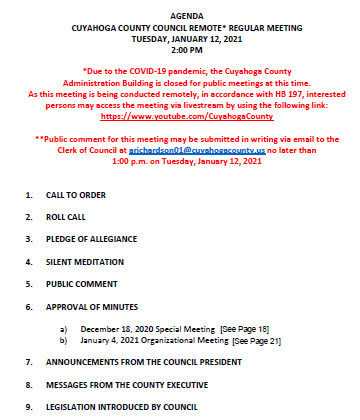
Hi, I'm Keith and I'll be live-tweeting today's Tuesday, Jan 12, 2021, Cuyahoga County Council's Remote Meeting that starts at 2:00 PM for #CLEDocumenters @cledocumenters @NeighborUpCle
https://t.co/LPExqSDIlP
Hi, I'm Keith and happy new year! I'll be live-tweeting today (Monday, January 4, 2021) Cuyahoga County Council's Remote Organizational Meeting at 2:00 PM for #CLEDocumenters @cledocumenters @NeighborUpCle
— Keifus (@Keifus4) January 4, 2021
More from Government




I don't normally do threads like this but I did want to provide some deeper thoughts on the below and why having a video game based on a real world war crime from the same people that received CIA funding isn't the best idea.
This will go pretty in depth FYI.
The core reason why I'm doing this thread is because:
1. It's clear the developers are marketing the game a certain way.
2. This is based on something that actually happened, a war crime no less. I don't have issues with shooter games in general ofc.
Firstly, It's important to acknowledge that the Iraq war was an illegal war, based on lies, a desire for regime change and control of resources in the region.
These were lies that people believed and still believe to this day.
It's also important to mention that the action taken by these aggressors is the reason there was a battle in Fallujah in the first place. People became resistance fighters because they were left with nothing but death and destruction all around them after the illegal invasion.
This is where one of the first red flags comes up.
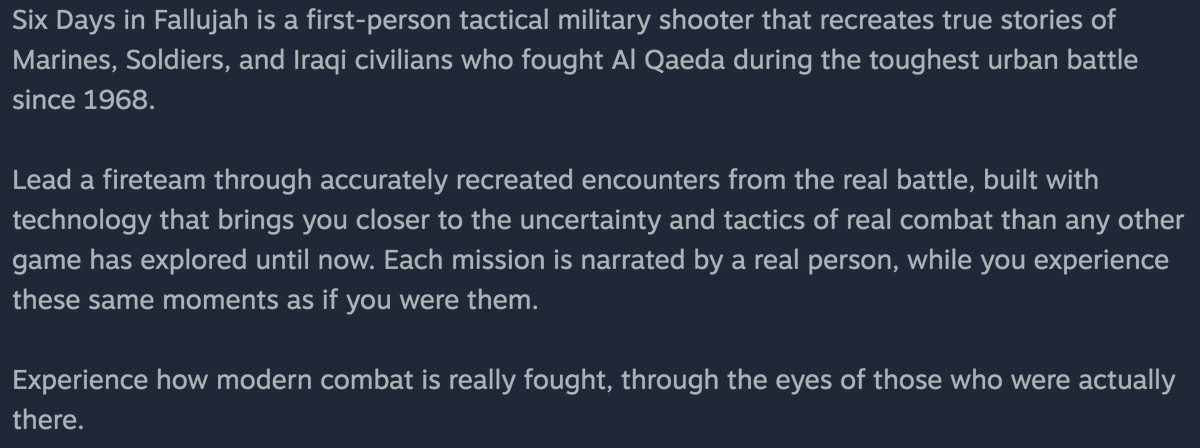
The game is very much from an American point of view, as shown in the description.
When it mentions Iraqi civilians, it doesn't talk about them as victims, but mentions them as being pro US, fighting alongside them.
This will go pretty in depth FYI.
I couldn't possibly guess why Six Days in Fallujah is being revived at a time when US army recruitment is at an all time low.
— Daniel Ahmad (@ZhugeEX) February 11, 2021
This reboot is from the same people that worked with the FBI and CIA on training systems and is basing its game on excusing US war crimes. pic.twitter.com/5H8vVqKh9s
The core reason why I'm doing this thread is because:
1. It's clear the developers are marketing the game a certain way.
2. This is based on something that actually happened, a war crime no less. I don't have issues with shooter games in general ofc.
Firstly, It's important to acknowledge that the Iraq war was an illegal war, based on lies, a desire for regime change and control of resources in the region.
These were lies that people believed and still believe to this day.
It's also important to mention that the action taken by these aggressors is the reason there was a battle in Fallujah in the first place. People became resistance fighters because they were left with nothing but death and destruction all around them after the illegal invasion.
This is where one of the first red flags comes up.
The game is very much from an American point of view, as shown in the description.
When it mentions Iraqi civilians, it doesn't talk about them as victims, but mentions them as being pro US, fighting alongside them.

Which metric is a better predictor of the severity of the fall surge in US states?
1) Margin of Democrat victory in Nov 2020 election
or
2) % infected through Sep 1, 2020
Can you guess which plot is which?
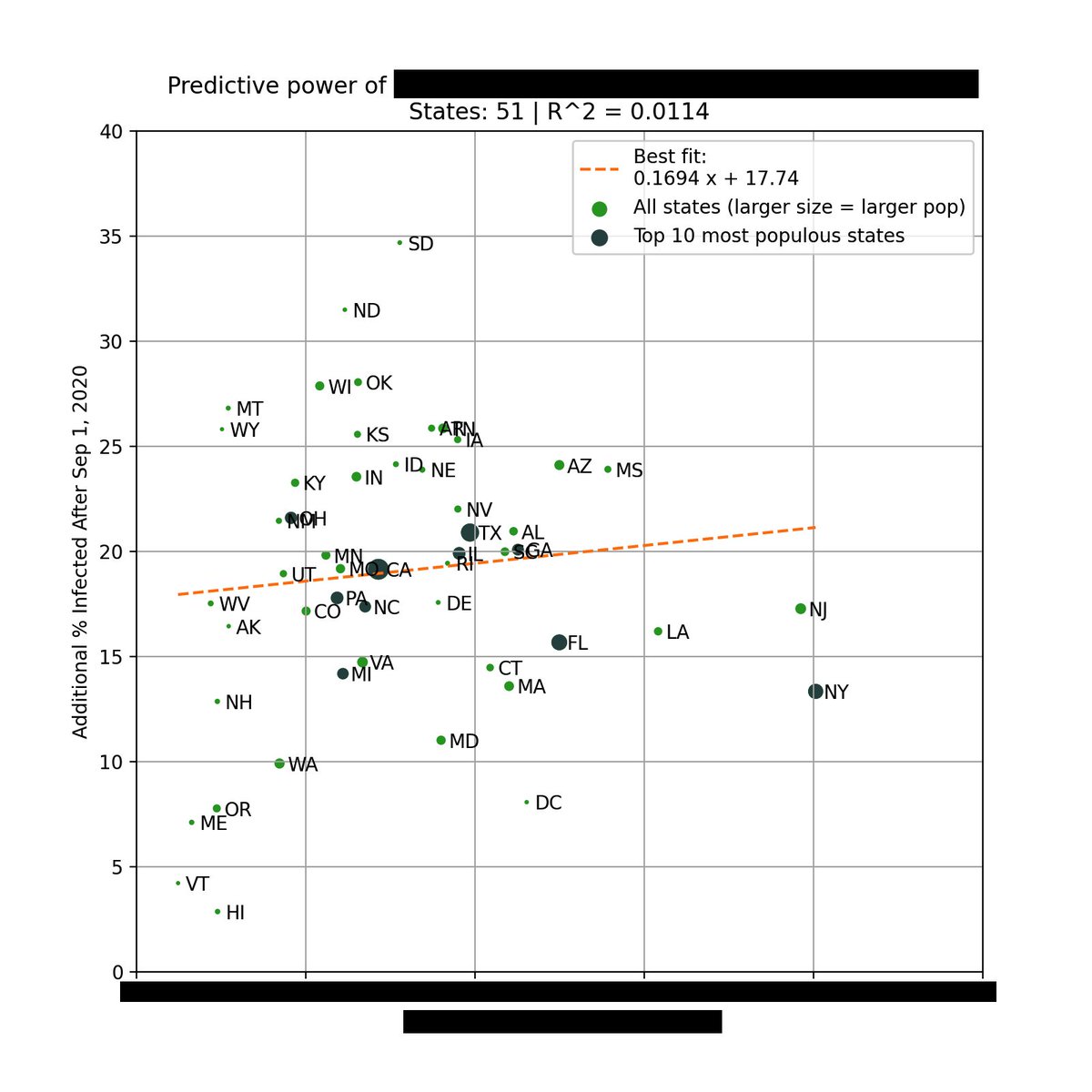
The left plot is based on the % infected through Sep 1, 2020. You can see that there is very little correlation with the % infected since Sep 1.
However, there is a *strong* correlation when using the margin of Biden's victory (right).
Infections % from https://t.co/WcXlfxv3Ah.

This is the strongest single variable I've seen in being able to explain the severity of this most recent wave in each state.
Not past infections / existing immunity, population density, racial makeup, latitude / weather / humidity, etc.
But political lean.
One can argue that states that lean Democrat are more likely to implement restrictions/mandates.
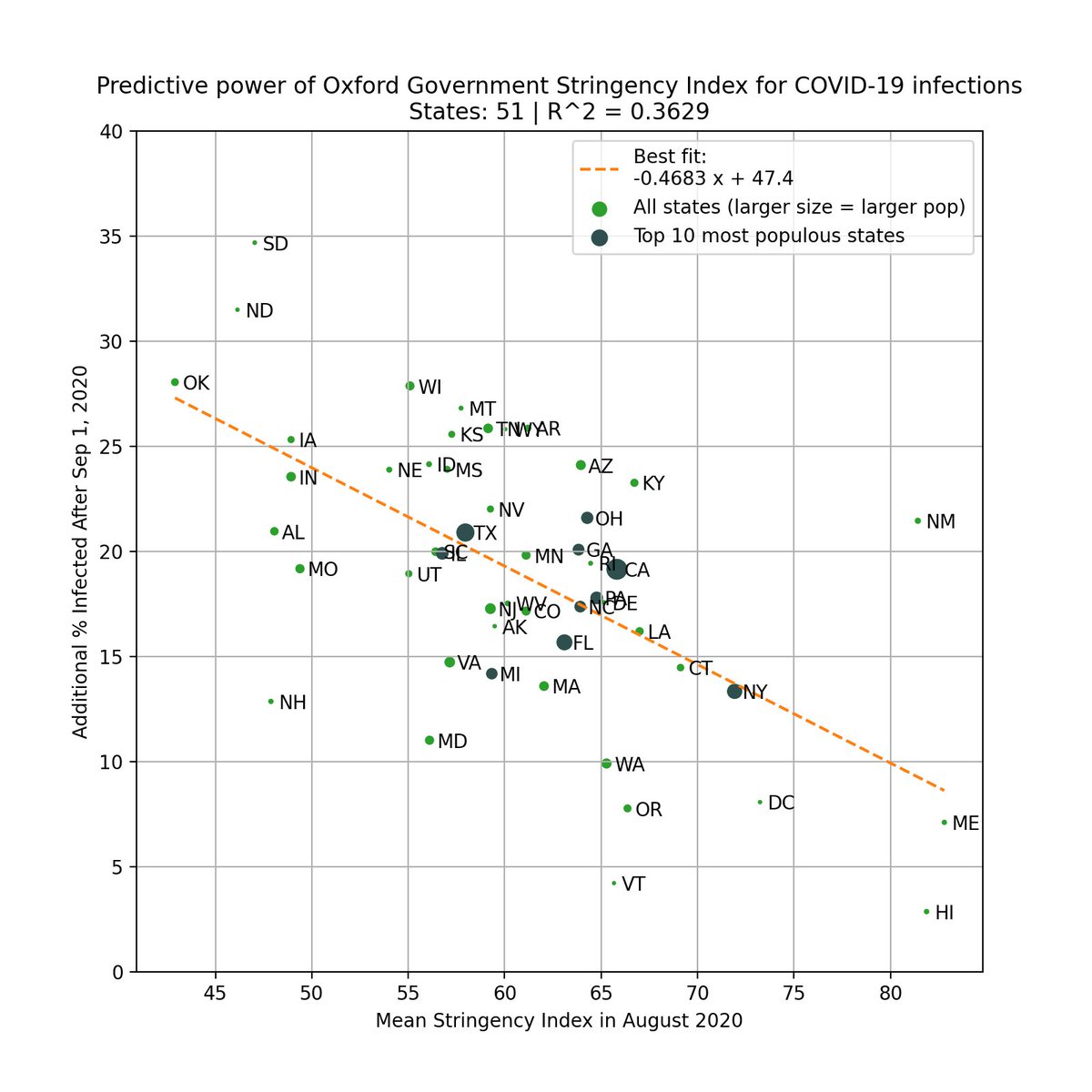
This is valid, so we test this by using the Government Stringency Index made by @UniofOxford.
We also see a correlation, but it's weaker (R^2=0.36 vs 0.50).
https://t.co/BxBBKwW6ta
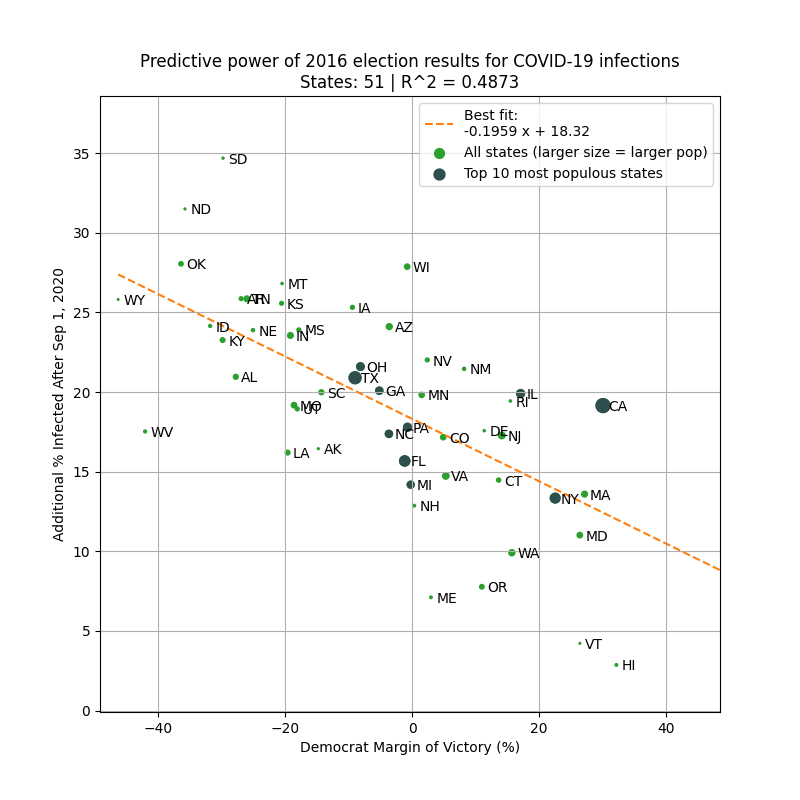
To avoid look-ahead bias/confounding variables, here is the same analysis but using 2016 margin of victory as the predictor. Similar results.
This basically says that 2016 election results is a better predictor of the severity of the fall wave than intervention levels in 2020!
1) Margin of Democrat victory in Nov 2020 election
or
2) % infected through Sep 1, 2020
Can you guess which plot is which?
The left plot is based on the % infected through Sep 1, 2020. You can see that there is very little correlation with the % infected since Sep 1.
However, there is a *strong* correlation when using the margin of Biden's victory (right).
Infections % from https://t.co/WcXlfxv3Ah.
This is the strongest single variable I've seen in being able to explain the severity of this most recent wave in each state.
Not past infections / existing immunity, population density, racial makeup, latitude / weather / humidity, etc.
But political lean.
One can argue that states that lean Democrat are more likely to implement restrictions/mandates.
This is valid, so we test this by using the Government Stringency Index made by @UniofOxford.
We also see a correlation, but it's weaker (R^2=0.36 vs 0.50).
https://t.co/BxBBKwW6ta
To avoid look-ahead bias/confounding variables, here is the same analysis but using 2016 margin of victory as the predictor. Similar results.
This basically says that 2016 election results is a better predictor of the severity of the fall wave than intervention levels in 2020!
You May Also Like








1/ Here’s a list of conversational frameworks I’ve picked up that have been helpful.
Please add your own.
2/ The Magic Question: "What would need to be true for you
3/ On evaluating where someone’s head is at regarding a topic they are being wishy-washy about or delaying.
“Gun to the head—what would you decide now?”
“Fast forward 6 months after your sabbatical--how would you decide: what criteria is most important to you?”
4/ Other Q’s re: decisions:
“Putting aside a list of pros/cons, what’s the *one* reason you’re doing this?” “Why is that the most important reason?”
“What’s end-game here?”
“What does success look like in a world where you pick that path?”
5/ When listening, after empathizing, and wanting to help them make their own decisions without imposing your world view:
“What would the best version of yourself do”?
Please add your own.
2/ The Magic Question: "What would need to be true for you
1/\u201cWhat would need to be true for you to\u2026.X\u201d
— Erik Torenberg (@eriktorenberg) December 4, 2018
Why is this the most powerful question you can ask when attempting to reach an agreement with another human being or organization?
A thread, co-written by @deanmbrody: https://t.co/Yo6jHbSit9
3/ On evaluating where someone’s head is at regarding a topic they are being wishy-washy about or delaying.
“Gun to the head—what would you decide now?”
“Fast forward 6 months after your sabbatical--how would you decide: what criteria is most important to you?”
4/ Other Q’s re: decisions:
“Putting aside a list of pros/cons, what’s the *one* reason you’re doing this?” “Why is that the most important reason?”
“What’s end-game here?”
“What does success look like in a world where you pick that path?”
5/ When listening, after empathizing, and wanting to help them make their own decisions without imposing your world view:
“What would the best version of yourself do”?