It is a FACT that GOI accepts that there are faults worthy of amendments. This leads is to an entire new discussion that govt still isn’t willing to believe that there are implementation faults & not just faults in the clauses.
So, if the government has accepted that the bills had these flaws where do those people stand who were defending them as perfect?
— smg (@sialmirzagoraya) December 9, 2020
Also farm unions have never shifted their goal post from total revocation of the bills.
1. Scrap the laws.
2. Form panel with experts from both sides.
3. Draft new ordinances.
4. Make laws.
More from Government


Canada is failing to act on Climate Change. @wef @WorldBank @IMFNews @IPCC_CH @UNDPGAIN @AntiCorruptIntl @Pontifex @JustinWelby @OCCRP @StopCorpAbuse @TaxJusticeNet @FairTaxCanada @ecojustice_ca @WCELaw @CanEnvLawAssn @envirodefence @IBA_Canada #cdnpoli
Covid recovery money is going to the oligarchy.
Ottawa and the provinces have put very little on the table to help clean-tech companies directly during Covid 19 while targeting fossil-fuel producers with more than $16 billion in aid.
Coast to coast people have demanded treaties be honored. We demanded climate action, divestment and land back but Canada is not listening. This video shows 10 years of rallies in Waterloo Ontario. City & regional council declared a climate emergency. 🚨
The Bank of China (BOC), SNC-Lavalin and WE Charity were recipients of taxpayer-funded the Covid 19 Canadian Emergency Wage Subsidy (CEWS)
Canada: Falling Far Short On Climate Policy, Emissions Reduction and Energy Transition #cdnpoli #bcpoli #alpolitics #onpoli @JimHarris @MikeHudema @SethDKlein @ElizabethMay @CitizensLobbyCa @lulex @kainagata https://t.co/jhm1TXvAKN pic.twitter.com/yEPINC5PTr
— Below2\xb0C (@Below2C_) December 29, 2020
Covid recovery money is going to the oligarchy.
Ottawa and the provinces have put very little on the table to help clean-tech companies directly during Covid 19 while targeting fossil-fuel producers with more than $16 billion in aid.
Coast to coast people have demanded treaties be honored. We demanded climate action, divestment and land back but Canada is not listening. This video shows 10 years of rallies in Waterloo Ontario. City & regional council declared a climate emergency. 🚨
The Bank of China (BOC), SNC-Lavalin and WE Charity were recipients of taxpayer-funded the Covid 19 Canadian Emergency Wage Subsidy (CEWS)


Which metric is a better predictor of the severity of the fall surge in US states?
1) Margin of Democrat victory in Nov 2020 election
or
2) % infected through Sep 1, 2020
Can you guess which plot is which?
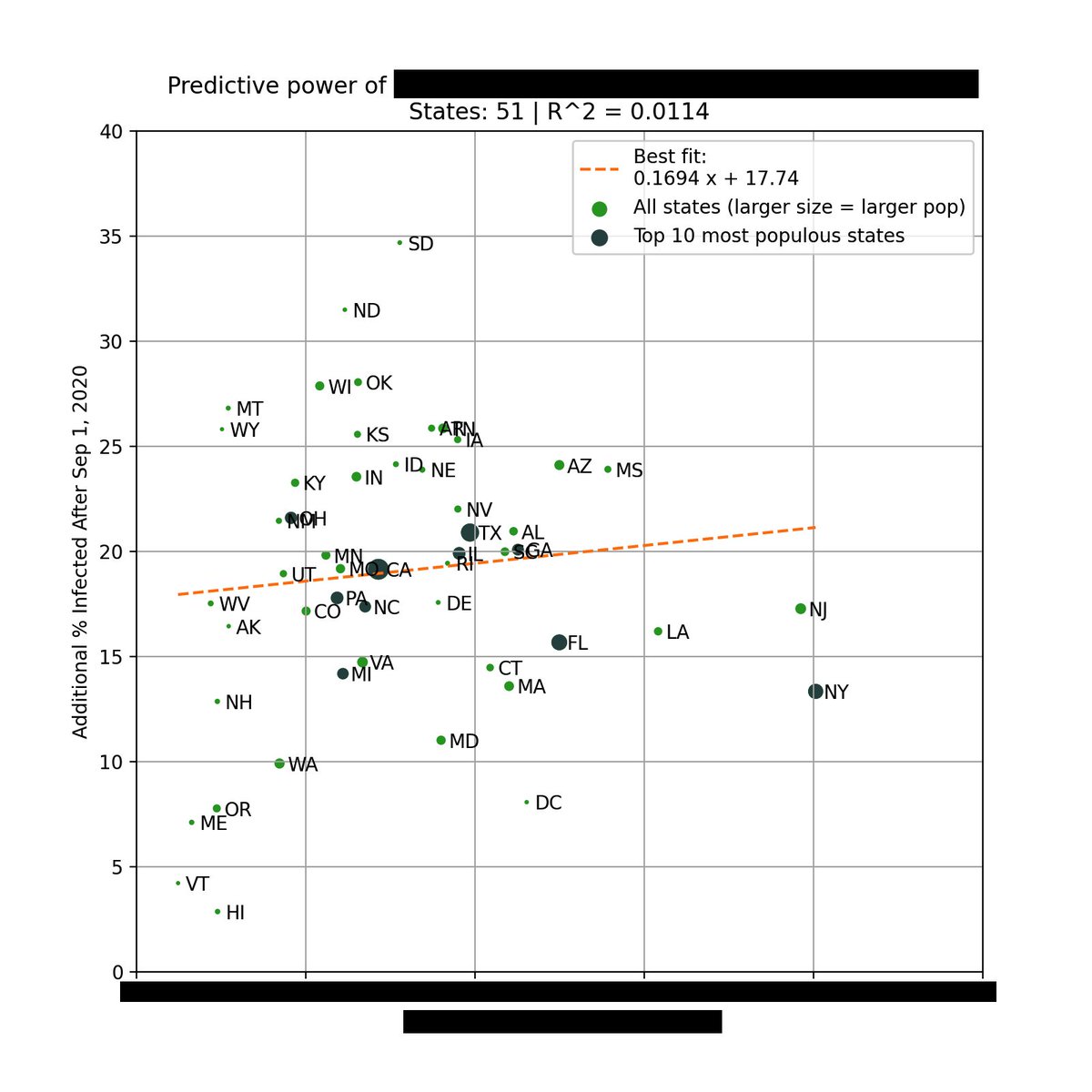
The left plot is based on the % infected through Sep 1, 2020. You can see that there is very little correlation with the % infected since Sep 1.
However, there is a *strong* correlation when using the margin of Biden's victory (right).
Infections % from https://t.co/WcXlfxv3Ah.

This is the strongest single variable I've seen in being able to explain the severity of this most recent wave in each state.
Not past infections / existing immunity, population density, racial makeup, latitude / weather / humidity, etc.
But political lean.
One can argue that states that lean Democrat are more likely to implement restrictions/mandates.
This is valid, so we test this by using the Government Stringency Index made by @UniofOxford.
We also see a correlation, but it's weaker (R^2=0.36 vs 0.50).
https://t.co/BxBBKwW6ta
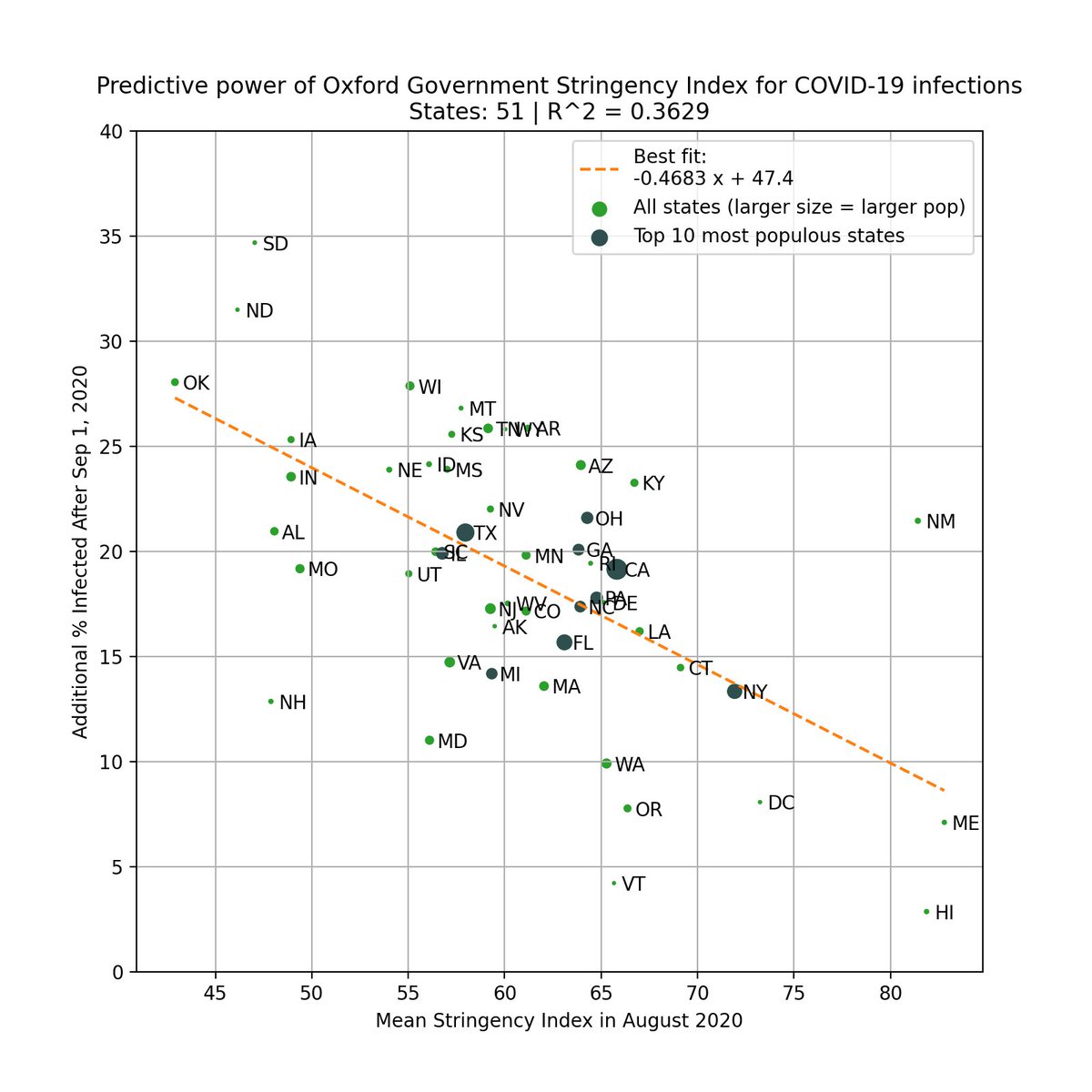
To avoid look-ahead bias/confounding variables, here is the same analysis but using 2016 margin of victory as the predictor. Similar results.
This basically says that 2016 election results is a better predictor of the severity of the fall wave than intervention levels in 2020!
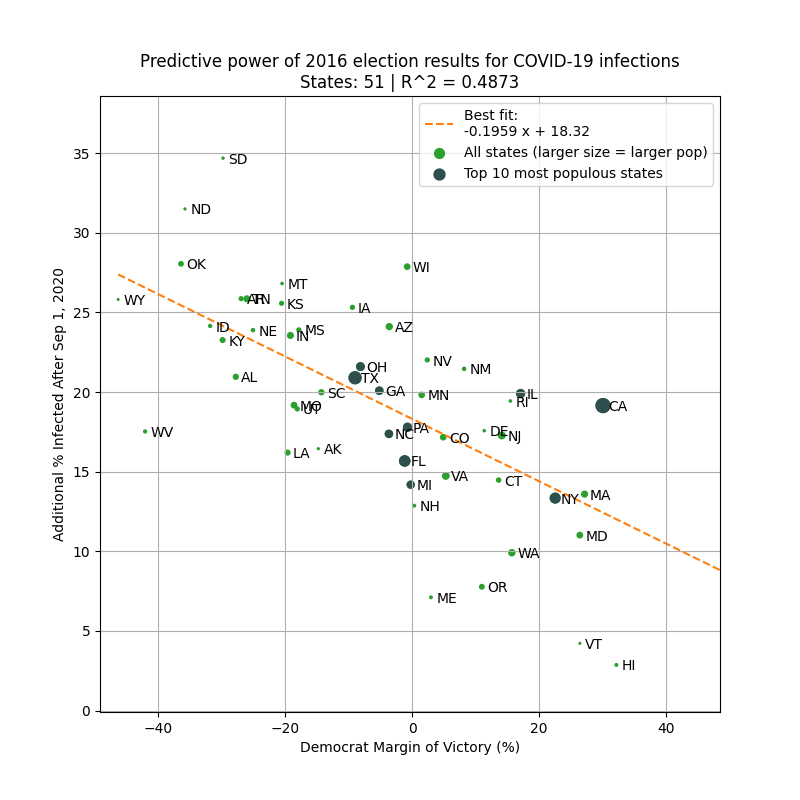
1) Margin of Democrat victory in Nov 2020 election
or
2) % infected through Sep 1, 2020
Can you guess which plot is which?
The left plot is based on the % infected through Sep 1, 2020. You can see that there is very little correlation with the % infected since Sep 1.
However, there is a *strong* correlation when using the margin of Biden's victory (right).
Infections % from https://t.co/WcXlfxv3Ah.
This is the strongest single variable I've seen in being able to explain the severity of this most recent wave in each state.
Not past infections / existing immunity, population density, racial makeup, latitude / weather / humidity, etc.
But political lean.
One can argue that states that lean Democrat are more likely to implement restrictions/mandates.
This is valid, so we test this by using the Government Stringency Index made by @UniofOxford.
We also see a correlation, but it's weaker (R^2=0.36 vs 0.50).
https://t.co/BxBBKwW6ta
To avoid look-ahead bias/confounding variables, here is the same analysis but using 2016 margin of victory as the predictor. Similar results.
This basically says that 2016 election results is a better predictor of the severity of the fall wave than intervention levels in 2020!
You May Also Like



MASTER THREAD on Short Strangles.
Curated the best tweets from the best traders who are exceptional at managing strangles.
• Positional Strangles
• Intraday Strangles
• Position Sizing
• How to do Adjustments
• Plenty of Examples
• When to avoid
• Exit Criteria
How to sell Strangles in weekly expiry as explained by boss himself. @Mitesh_Engr
• When to sell
• How to do Adjustments
• Exit
Beautiful explanation on positional option selling by @Mitesh_Engr
Sir on how to sell low premium strangles yourself without paying anyone. This is a free mini course in
1st Live example of managing a strangle by Mitesh Sir. @Mitesh_Engr
• Sold Strangles 20% cap used
• Added 20% cap more when in profit
• Booked profitable leg and rolled up
• Kept rolling up profitable leg
• Booked loss in calls
• Sold only
2nd example by @Mitesh_Engr Sir on converting a directional trade into strangles. Option Sellers can use this for consistent profit.
• Identified a reversal and sold puts
• Puts decayed a lot
• When achieved 2% profit through puts then sold
Curated the best tweets from the best traders who are exceptional at managing strangles.
• Positional Strangles
• Intraday Strangles
• Position Sizing
• How to do Adjustments
• Plenty of Examples
• When to avoid
• Exit Criteria
How to sell Strangles in weekly expiry as explained by boss himself. @Mitesh_Engr
• When to sell
• How to do Adjustments
• Exit
1. Let's start option selling learning.
— Mitesh Patel (@Mitesh_Engr) February 10, 2019
Strangle selling. ( I am doing mostly in weekly Bank Nifty)
When to sell? When VIX is below 15
Assume spot is at 27500
Sell 27100 PE & 27900 CE
say premium for both 50-50
If bank nifty will move in narrow range u will get profit from both.
Beautiful explanation on positional option selling by @Mitesh_Engr
Sir on how to sell low premium strangles yourself without paying anyone. This is a free mini course in
Few are selling 20-25 Rs positional option selling course.
— Mitesh Patel (@Mitesh_Engr) November 3, 2019
Nothing big deal in that.
For selling weekly option just identify last week low and high.
Now from that low and high keep 1-1.5% distance from strike.
And sell option on both side.
1/n
1st Live example of managing a strangle by Mitesh Sir. @Mitesh_Engr
• Sold Strangles 20% cap used
• Added 20% cap more when in profit
• Booked profitable leg and rolled up
• Kept rolling up profitable leg
• Booked loss in calls
• Sold only
Sold 29200 put and 30500 call
— Mitesh Patel (@Mitesh_Engr) April 12, 2019
Used 20% capital@44 each
2nd example by @Mitesh_Engr Sir on converting a directional trade into strangles. Option Sellers can use this for consistent profit.
• Identified a reversal and sold puts
• Puts decayed a lot
• When achieved 2% profit through puts then sold
Already giving more than 2% return in a week. Now I will prefer to sell 32500 call at 74 to make it strangle in equal ratio.
— Mitesh Patel (@Mitesh_Engr) February 7, 2020
To all. This is free learning for you. How to play option to make consistent return.
Stay tuned and learn it here free of cost. https://t.co/7J7LC86oW0